PIC-based Voice Recorder

[Vinod] just finished building a voice recorder and it turned out even better than he thought it would. The video after the break shows him recording what is surely one of your favorite songs from his cellphone and then playing it back. The audio quality does sound quite good for a project with very few components.

A PIC 16F877A makes up the majority of the build. Its ADC is used to capture the incoming line from an amplified microphone input (you’ll find that amp schematic half way through his post). He’s storing the data on an MMC card, which was a bit of a hack since the PIC has limited RAM to manage that overhead. The stored data is in a raw format, as the card is not accessed using a file system. This makes it easy to record at a high bit rate, leading to better audio quality. Playback consists of connecting a speaker via a low-pass filter and amplifier circuit to the hardware PWM output on the PIC.


Continue reading “PIC-based Voice Recorder”

Weekly Roundup 09/03/11

In case you missed them the first time, here are our most popular posts from this past week.

Our most popular post was about a ‘flashlight’ build. We are using the word flashlight loosely since this monster can draw up to 500 Watts!

Our next most popular post was about another [Jörg Sprave] project where he has built a very large slingshot that can shoot shot puts. He then proceeds to destroy a car with it.

This post describes an open-source Segway. It is built around an ATmega644 has a nice professional look to it.

If you live out in the country and have a problem with rats, this post could be for you. In this post, we look at [Snypercat’s] build where she has mounted a camcorder onto the scope for her pellet gun and also attached an infrared light source so that she can snipe rats at night.

Finally, we have a post about a custom V-12 Kawaskai Voyager. If you are looking for a great way to draw attention at your next motorcycle rally, this post might give you some inspiration.

Engine Hacks: Convert Your Yard Tools To Run On Steam!

Engine Hacks Theme banner

Are you tired of doing things the efficient way when using your lawn equipment? Look no farther. Here are some engine hacks where regular internal combustion engines have been modified to work on steam or compressed air. Surprisingly, all it takes to do this is to remove the carburetor and replace it with a steam line and to modify the valve timing.

First up is a lawn mower that runs on steam posted by [dquad]. This one is pretty great because it just looks so wrong. In [dquad’s] own words: “I am surprised by the fact that nothing at all failed during this test – other than a wheel catching fire!”

http://youtu.be/7qGI6Ogiasg

Check out some other examples of engines converted to run on air or steam after the break…
Continue reading “Engine Hacks: Convert Your Yard Tools To Run On Steam!”

POV Keychain From Prototype To SMD Board

[Augusto] wrote in to tell us about his keychain-sized persistence of vision project. He built the original prototype on some protoboard, using a PIC 16F627 to drive eight LEDs. Synchronization is managed by a tilt sensor on the board that starts the strobing to match the direction the board is traveling. This is a similar setup as the POV device that used an accelerometer, but it should be quite a bit easier to code for the tilt switch.

Once [Augusto] had the hardware dialed in he set to work laying out a surface mount design. The two AAA batteries were traded for a single 3V coin cell, which is on the back side of the board you see above. This is his first attempt at working with surface mount components and we think he did a great job. Check out the POV in action in the video after the break.

Continue reading “POV Keychain From Prototype To SMD Board”

Get Out The Graph Paper Get Started On The New Discrete Logic Contest

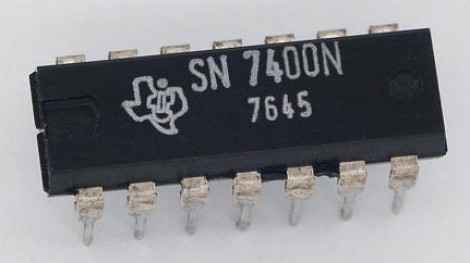
Here’s another chance to ply your hacking skills for cash and prizes. Dangerous Prototypes has just announced the Open 7400 Logic Competition. First prize is $100 and a bunch of hacking goodies. But even better is that since it was announced, more sponsors have stepped up to increase the kitty, and the number of entries that will get prizes.

The parameters for entry are wide open. You can design anything you want, with emphasis on originality. Make sure you take plenty of pictures and document the project along the way. Their judging will take into consideration the amount of detail posted about the project (hence the ‘Open’ in the contest title).

Need some ideas to get you started? We enjoyed the useless machine that used a 7400 NAND gate. You could always build a time piece of some sort like this no-microcontroller clock. Perhaps hardware control like this stepper motor driver is more to your liking?

[Thanks Moderboy]

Simple Transistor Tester Makes Sorting Easy

simple_transistor_sorter

Hacker [Dino Segovis] is back with yet another installment of his Hack a Week series, and it’s looking like he isn’t too worse for wear after hunkering down to face hurricane Irene.

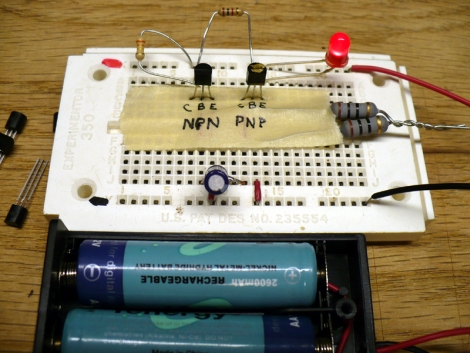
This week, it seems that [Dino] is having some problems separating his PNP transistors from his NPNs. After Albert Einstein proves to be less than useful when it comes to sorting electronic components, [Dino] decided to build a simple transistor tester to help him tell his PNPs and NPNs apart without having to resort to looking up product data sheets.

The tester itself is relatively simple to build. As you can see in the video below, it consists of a power supply, an LED, a few resistors, a pair of known transistors, and not much else. When everything is hooked together, the NPN/PNP pair causes the LED to light up, but the circuit is broken whenever one of the transistors is removed. Inserting a new transistor into the empty spot on the breadboard immediately lets you know which sort of transistor you have inserted.

Sure you can tell transistors apart with a multimeter, but if you have a whole drawer full of loose components, this is a far more efficient option.

Continue reading “Simple Transistor Tester Makes Sorting Easy”

Intel’s New Way Of Creating Randomness From Digital Orderliness

Random number generation is a frequent topic of discussion in projects that involve encryption and security. Intel has just announced a new feature coming to many of their processors that affect random number generation.

The random number generator, which they call Bull Mountain, marks a departure from Intel’s traditional method of generating random number seeds from analog hardware. Bull Mountain relies on all-digital hardware, pitting two inverters against each other and letting thermal noise tip the hand in one direction or the other. The system is monitored at several steps along the way, tuning the hardware to ensure that the random digits are not falling more frequently in one direction or the other. Pairs of 256-bit sequences are then run through a mathematical process to further offset the chance of predictability, before they are then used as a pseudorandom number seed. Why go though all of this? Transitioning to an all-digital process makes it easier and cheaper to reduce the size of microchips.

A new instruction has been added to access this hardware module: RdRand. If it works as promised, this should remove the need for elaborate external hardware as a random number source.

[via Reddit]