Automated Hose Keeps Cats From Watering You

Commenter [TheCreator] reminded us of this fantastic video from [Craig Turner] who you may recognize from SBS’s Top Gear Australia Video Competition.  You see, [Craig] has been struggling for some time with the problem of neighborhood cats relieving themselves pretty much all over his stuff. Through surveillance he identified (and named) around 9 separate cats sauntering into his yard during the wee hours of the night.  The only issue now was to humanely discourage them from entering his yard.

The best solution, in this case, was a simple spray from the garden hose, but who is going to stay up all night to watch for cats? [Craig]’s ’75 Galant happens to have aftermarket door locks. These typically contain a simple powerful 12V actuator that will push or pull when given current. The actuator is strong enough, and has enough travel, to depress your typical garden sprayer handle. The lock actuators even include enough mounting hardware to tack everything together.  The only irreversible part of the hack appears to be the hole drilled into the sprayer’s handle.

The job of cat detection is handled with a PIR sensor (sourced from his home security system) and a paper towel tube to narrow the detector’s field of view. Placed at animal height the PIR detector works like a trip line, and flips a relay connected to an array of devices:  A bright LED lamp, a DSLR set to take several quick photos of the victim, An HD video camera, and the sprayer solenoid.  This whole rig is placed at a convenient choke point and hilarity ensues! A schematic is included in the video but is pretty difficult to interpret, we transcribed it for you. Some details are unclear but essentially a few relays are stapled together to provide either high or low switching signals.

Check out the video, [Craig]’s schematic, and our interpretation of [Craig]’s schematic after the jump!

Continue reading “Automated Hose Keeps Cats From Watering You”
Color Object Tracking With An 8-bit Microcontroller

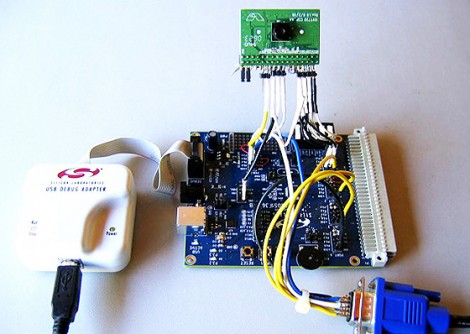
[Craig] sent in a link to this project which manages to implement color tracking on an 8-bit microcontroller at 60 frames per second. That’s some pretty incredible performance, but we’re also not talking about using a hobby-grade microcontroller. The C8051F360 is an ARM microcontroller with 100 MIPS throughput and with a system clock that can operate at up to 100 MHz. You also must consider that the chip will be able to do nothing else while in the tracking mode. Even with those gotchase, it’s still pretty incredible.

The setup uses an Omnivision OV7720 camera module. It has its own 24 MHz clock, which is used as the clock signal on the microcontroller’s PLL to generate a 96 MHz system clock. The code, which is written in a combination of C and assembly language, pushes captured tracking data to a PC via a serial port connection. After the break you can watch a bare-bones demo video that illustrates what the camera sees and what data shows up on the PC.

If you had the system in hand, what would you use it for? Perhaps it’s a perfect addition to that paintball sentry gun at which you’ve been hacking away?

Continue reading “Color Object Tracking With An 8-bit Microcontroller”

The Ins And Outs Of Lithium-based Battery Packs

lithium_batteries

So, you’ve got your awesome project built and are ready to take it on the go, but how are you going to power it? You could use a couple alkaline cells or perhaps swipe a Litihium battery pack from some infrequently used portable device – however before you do that, why not check out what [Lady Ada] has to say on the subject?

The detailed tutorial on her site discusses the different types of Lithium-based batteries and their form factors, as well as the strengths and weaknesses of each type. Voltage ratings are covered, as well as why it is important to choose a Lithium battery pack that fits the task at hand. The dangers of improperly handling batteries are clearly noted, highlighting the importance of selecting a proper charger and resisting the urge to ever wire Lithium batteries together to increase capacity.

While the bulk of the information presented is nothing new to most of our readers, it’s definitely a worthwhile read for those just starting to use Lithium battery technology in their projects.

Extracting Secured Firmware From Freescale Zigbee Radios

decapped_MC13224

[Travis Goodspeed] recently tore down the Freescale MC13224 wireless radio chip in an effort to demonstrate how the device’s firmware could be read, even when locked down in “secure” mode. While you might not recognize the Freescale MC13224 radio by name alone, you are certainly familiar with some of its practical applications. Found in the QuahogCon and Ninja Party badges among other consumer goods, the popular Zigbee radio turned out to be a fairly easy conquest.

[Travis] first used acid to decap one of the microcontrollers to see what was going on under the plastic casing. Inside, he discovered a discrete flash memory chip, which he removed and repackaged using a wedge wire bonder. He was easily able to extract the firmware, however decapping and repackaging a flash chip isn’t necessarily the most user-friendly process.

After digging further, he discovered that holding one of the chip’s pins low during boot would allow him to run custom code that recovers the firmware image once the pin is pulled high once again. This far more practical means of firmware recovery can be easily facilitated via a circuit board revision, as [Travis] mentions in his blog.

Hacked Phone Runs Zork, Gets Lamp

A few months ago, [Ulysses] had a project in mind that would run Zork on a TDD. Although it was a bit of a struggle getting the project ready in time for the Bay Area Maker’s Faire, the accompanying build blog tells us it was more than worth the effort.

After hooking up the guts of the phone to an Arduino Pro, A modem was modified so the acoustically coupled TDD could be interfaced. Although the TDD display is only one line, [Ulysses] is transmitting the text at only 45.5 baud, So even the slowest reader could keep up with the story. For running the actual code, initial attempts at using an Arduino Pro, and then Arduino Mega proved unsuccessful because of the limitations of sram in these AVRs. After discarding the idea of running Zork on an Arduino, the project was finished with a single board FitPC computer mounted inside the phone.

The code of the project runs Zork on a port of the Infocom Z-code Interpreter Program, or ZIP. A lot of interactive text adventures were put out in the Z-code format, so we’re guessing it would be trivial to have this project run Leather Goddesses of Phobos, or the amazing Hitchhiker’s Guide to the Galaxy. It’s a very nice project, and we could easily see ourselves sitting down with this project, a two liter bottle of Shasta, and an all-Rush mix tape on a Saturday night.

Hand-cranked Magnet Machine Is Endless Fun

magnet_machine

We can’t think of a single person who doesn’t enjoy playing with a handful of rare earth magnets now and again. We know that [Dave Johnson] certainly does. As a gift to his father in law, he constructed a magnificent machine that does little more than manipulate spherical rare earth magnets with hypnotizing grace.

The machine is constructed almost entirely from wood, save for a few fasteners and rods. Even the gears have been carefully cut from wood, with special attention paid to ensure smooth operation. When cranked, the machine slices off a single magnet from one end of a long chain, passing it along to a lift arm. The lift arm deposits the magnet into a metal tube, and with the help of eddy currents, it drifts slowly down before being redeposited at the end of the magnet chain.

Be sure to check out a video demonstration of the machine after the break, it really is fun to watch.

[via LaughingSquid]

Continue reading “Hand-cranked Magnet Machine Is Endless Fun”

Wireless Rover Has Two Guns…one For Each Of Ya

texas_ranger_airsoft_rover

We never really get bored with remote-controlled rovers around here, especially when they involve reusing some old hardware as well as lasers. [Tycoon] wrote in to share his creation, which he has dubbed “Texas Ranger”.

Texas Ranger is built around an old Linksys WRT54GL router, which provides the rover’s WiFi connectivity as well as the serial interface through which everything else is controlled. The rover features a pair of PIC microcontrollers, which handle all of the servo control as well as telemetry calculations.

An onboard camera gives the operator a driver’s seat view of the action, allowing for precise control of the vehicle. Laser triangulation is used to help measure object distance, and a pair of airsoft pellet guns straddle the camera for whenever [Tycoon] feels like making his presence known. One feature we are especially fond of is the pair of Wii nunchucks which the rover uses to monitor its position. Always aware of its operating angle, it auto-adjusts the camera to compensate for uneven surfaces, guaranteeing that [Tycoon] doesn’t have to tilt his head to see straight.

Keep reading to see a quick demo video he shot of Texas Ranger in action.

Continue reading “Wireless Rover Has Two Guns…one For Each Of Ya”