Panaplex In A Jar

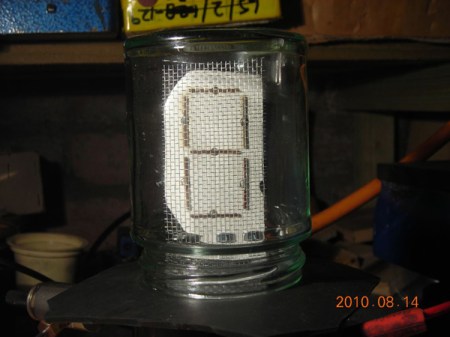
Check out this home made panaplex display. Panaplex displays are closely related to nixie tubes, but instead of layering individual numbers and lighting them separately, it uses pieces to build the numbers like a digital display. [Lindsay] managed to make one at home, using a jam jar as the vacuum tube.  Argon as the gas in the tube gives it a pleasant purple color. We really think the end result is fantastic, you can see some build pictures and a run through of the numbers on the site. Unfortunately there aren’t any videos of the display in action.

[via Makezine]

Tiny FM Transmitter Bugs Rooms

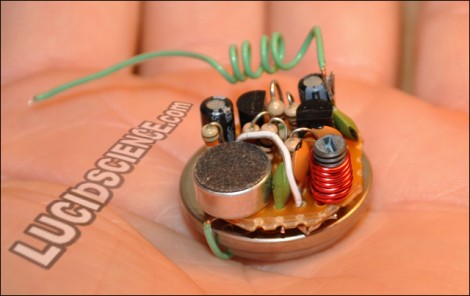
Lucid Science delves into spy-tech once again with this tiny FM transmitter. Their post demonstrates a bit larger version than seen above, using a 9-volt battery and protoboard sized to match which makes for easier soldering. The design uses a microphone, two transistors, enameled wire for the coil, as well as various resistors, capacitors, and a potentiometer. What you end up with is an amazingly clear audio signal that can be picked up with a normal FM radio.

This would make a great project to do with the kids. You can talk about circuit design, practice soldering, and when finished they’ve got an almost miraculous toy to play with. Just be careful what you say around the house, the room might be bugged!

Multiple Core Propeller Speeds Up Display Addressing

Th

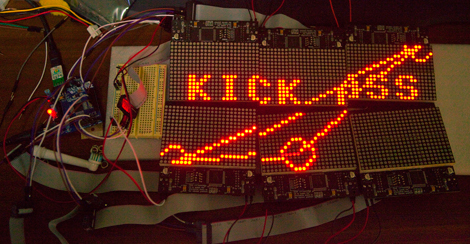
If you ever wondered what an eight-core Propeller processor can do for you, [Tom] found one answer. He’s using the multiple cores to individually address serial displays. He has six display modules, and each of them incorporate six 8×8 LED modules. This makes for a total of 2304 LEDs, and since they’re addressed by cascading serial data, that means 2304 bytes pushed to the display. You’re going to suffer from quite a bit of slow-down if you choose that communication method.

This is where multiple-cores come in handy. Instead of cascading data between the six modules, he assigned a different core to each. Now he can concurrently address the six displays, reducing his serial data from 2304 bits per frame down to 384 bits per frame. As you can see in the video after the break, updating the display six times as fast as before yields fantastic results.

Now what if you’re using a processor that has forty of these multi-core Propeller chips?

This does make us wonder, can’t the same thing be done on a single-core processor? An eight-bit device takes one cycle to set all eight bits on a single port. So why not just connect the six serial connections on six bits of the same port? Weigh in with your thoughts in the comments.

Continue reading “Multiple Core Propeller Speeds Up Display Addressing” →

UV EPROM Eraser In A Toolbox

[Devon Croy] belongs to a hackerspace that works hard to keep hardware from going to the landfill. He found they were in possession of over a hundred Erasable Programmable Read Only Memory chips (EPROM). Not to be confused with EEPROM, which are electronically erasable, these EPROM chips require a strong source of UV light to blank the old data before they can be written again.

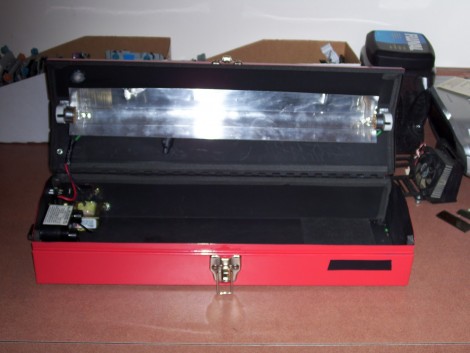
Instead of buying a tool to erase two or three chips at a time he built his own bulk EPROM eraser from an old metal toolbox. He used parts from a fluorescent black light and acquired a new bulb that generates light in the UVC spectrum, the band which works as an eraser for the chips. After bolting the parts into the case he added a spring-loaded timer knob and a safety switch that kills the power when the case is opened, similar to the UV exposure box we looked at yesterday.

Of course, if you don’t need a bulk eraser you could shop some garage sales for a UV pacifier cleaner which can also erase EPROM chips.

90 TB Drive Array For Home Storage Needs

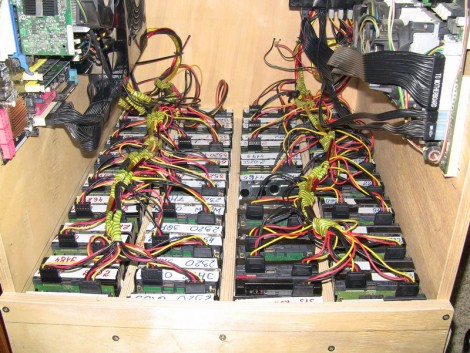
Why store it in the cloud when you could have a 90 Terabyte hard drive (translated) array in your house? The drives are mostly Western Digital Caviar Green EARS 2TB models which are known for energy efficiency and quiet operation. It’s a little unclear as to whether this is using one or two motherboards, but the drives are connected using PCI RAID5 and RAID5+0 controller cards. There’s a total of 40 cooling fans built into the case, half on the bottom and the rest on the top. They move air up through the case, with plans to add a dust filter in the future. Heck, with that type of air movement you could throw on a standard furnace filter. Apparently it is quiet enough to talk in “almost a whisper” while next to the plywood monolith. But we’re a bit skeptical of that claim.

It’s not quite as fancy looking as the 67 TB storage from last year… but it does look pretty easy to build at home.

[Thanks Henrique via EnglishRussia]

Crash Space Takes On The Machine

It’s that time again, time to take on the machine with the Hackerspace, Crash Space (and part two)! The team of Californians set out and successfully turned the front of their building into a musical instrument, similar to [David Byrne’s] Playing the Building. When a pedestrian walks by they set off distance sensors, which in turn actuate mallets that strike particular objects to produce a tone. We were pleasantly surprised at how interactive the installation was, even if it didn’t sound that great. But will it be enough to beat out the previous two teams? And how will it do up against Artisans Asylum’s not what you’re thinking Breakfast Machine next time?

[thanks Deven]

AVR DDS Signal Generator Improvements

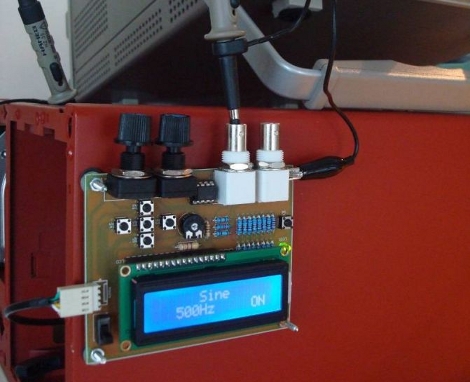
[Vassilis Papanikolaou] took a good thing and made it better with some design upgrades to this AVR based signal generator. We looked at version 1.0 of this tool back in 2006 and since then it saw an upgrade to 2.0. But [Vassilis] wanted to take things one step further, with a compact single-sided PCB. What you see above is the beautiful result of his work; a professionally made board that is compact, uses through-hole components, and has zero wire jumpers.

If you want to build one for yourself there’s a great parts list as well as board artwork and schematic. The system uses an ATmega16 so you’ll need a way to program one. There’s also just a bit of firmware tweaking to remap the control buttons to match the updated hardware layout.