RoBo Blower Sure To Become Stephen King Novel

Snow removal ranks right up there with laundry as one of the least-enjoyed chores. [Herb Spencer] sought to automate the process while terrifying his neighbors as the same time by building a robotic snow blower, the RoBo Blower. The heavy lifting is still handled by a gas motor which propels the snow auger. Two batteries power the electrical system that takes commands from a remote control, moving the show chute and managing the navigation.  He’s done what he can in the way of safety, adding a grate at the front, flashing light atop, an operator-controlled horn, and kill circuitry (to shut it down, not to kill the unsuspecting). All of this is wrapped up in a nice package, especially when compared to the snow blower push platform from last month.

Maybe next year he’ll work on making it autonomous? Take a look at the RoBo Blower clearing a driveway after the break.

Continue reading “RoBo Blower Sure To Become Stephen King Novel” →

DIY Super Soaker

With summer just around the corner you should try out a build like this constant pressure water gun that [JLspacemarine] put together. Similar to the commercially available Super Soaker toys, this isn’t just a squirt gun but includes a water reservoir as well as a pressurized air chamber. Pumping up the air chamber allows for a constant stream when the trigger is depressed. [JLspacemarine] used a combination of hardware store items such as PVC, ABS, springs, hose clamps, and valves to bring this all together.

[Thanks Danukeru]

Tim “The Tool Man” Taylor’s Dream Ride

While surfing one of our favorite websites, we came upon this little jewel. We can’t really tell if this is hack-worthy, or just a deathtrap, so to help decide…

Mechanics crawler + 80cc motor – safety concerns = deathtrap

It’s really that final “Brakes? Why would I need to stop?” that puts this project over the edge. Regardless, check out a video after the break. And please, do not try this at home.

Continue reading “Tim “The Tool Man” Taylor’s Dream Ride” →

Flip-book Style Digitization

[youtube=http://www.youtube.com/watch?v=tCOXC5PTJj8]

This method of book digitization allows you to scan an entire book by fanning through the pages. It uses a high-speed camera that captures 500 frames per second to get a good look at each page. Processing software isolates each pages, analyzes any curve in the paper due to the flipping, and smooths out the image for better optical character recognition results. The greatly reduces the time it takes to digitize a book, even compared to setups that automatically flip pages.

[Thanks Erico]

Graffiti Machine Sprays For You

[Ben’s] father was a metalworker and the combination of being around metal fabrication for most of his life and getting a couple of art degrees brought together a satisfying combination of hacking skills. Above you can see a Graffiti Machine that he built, which we’ll look at in-depth after the break.. This isn’t the first CNC machine he’s worked on. [Ben] became interested in rapid prototyping but was put off by the cost of commercial cutters, which led him to build his own CNC plasma cutter.

Continue reading “Graffiti Machine Sprays For You” →

Laser Cutting Solder Stencils

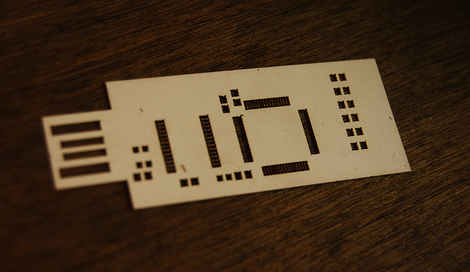
Do you have access to a laser cutter? If so, you can use [Riley Porter’s] method to cut your own solder stencils. He starts with the Eagle files and exports the Dimension and tCream layers to a PDF. That file is then processed using Ghostwriter, Gview, and finally, Corel draw. The result is a 1200dpi file to feed to your Epilog laser. Now you’re ready to stencil on the solder paste and populate the PCB.

[Thanks Travis Goodspeed]

Motion Sensing Camera Hack

[youtube=http://www.youtube.com/watch?v=xlTyCymEM9g]

Researchers at the University of Liege have developed an algorithm to separate movement from background. They call it ViBe and this patented piece of code comes in at under 100 lines of C. Above you can see the proof of concept shown by hacking the code into CHDK, a Canon PowerShot alternative firmware. The package is available for non-commercial use and might be just the thing you need to get your project to recognize where it needs to serve the beer.

[Thanks Juan via Slashdot]