
Though much of [citizenFinerran]’s intent in designing a suit that camouflages the wearer from security camera footage was philosophical, it is designed with a very tangible purpose in mind. The suit does not provide true camouflage (to say nothing of true invisibility), but it does create enough moving visual obstructions to make the wearer completely anonymous on film. More details on this and other invisibility cloaks after the break.
Mozilla’s First Public Release
[youtube=http://www.youtube.com/watch?v=mZTJbsUcdeU&hl=en&rel=0&color1=0x3a3a3a&color2=0x999999]
In honor of Firefox 3.0 download day, Waxy.org has posted the full Code Rush documentary. It spans March ’98 to April ’99, as the Mozilla team publishes the first source code and then the eventual AOL acquisition of Netscape. Embedded above is a short clip of [Jamie Zawinski] pushing the code live at 10AM on March 31, 1998. The hour documentary is well worth watching.
If you’re unsure about moving from FF2 to 3, MultiFireFox still works perfectly fine with the new release.
Hacking Sleep Part Deux
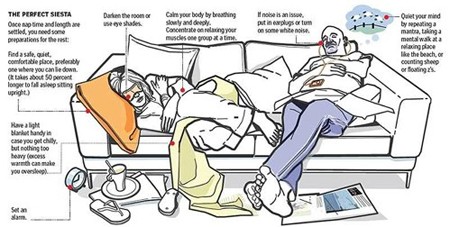
The Boston Globe recently posted some tips to help you get the most from your naps. The information comes in the form of a chart with numerous facts about naps, including the timeline of events in a typical nap, information about chronotypes, and ideas on how to fall asleep quickly and stay asleep. Since our post on polyphasic sleep, we’ve been interested in sleep techniques that essentially trick the body into feeling as rested as possible (the crudest form of biohacking, in our opinion). Many of these techniques are certainly applicable to polyphasic sleep, but one of the most interesting concepts, chronotypes, is not. Chronotypes are simply profiles of sleep habits that denote the times a person’s body is more readily disposed to fall asleep; since polyphasic sleep requires practitioners to sleep several times a day, it is always in conflict with the person’s chronotype at some point in the day. Nonetheless, the chart should help you stay alive if you ever have several back-to-back intercontinental flights.
[via Lifehacker]
IPhone Used To Control Squad Of UAVs
[youtube=http://www.youtube.com/watch?v=CRcld5aAN2E&hl=en]
Building UAVs is only half the work involved in making them fly; the other half is a control system. The Center for Collaborative Control of Unmanned Vehicles (C3UV) from the University of Califorina, Berkeley has devised a way to control a squad of RC airplanes with an iPhone. The system works by submitting commands and coordinates to a web site via the iPhone’s web browser. The site then sends the commands to the team of drones, which carry out the orders. The drones are outfitted with cameras and a tracking device, which allows them to be monitored on the ground using Google Maps.
The iPhone Terms of Service specifically prohibits it being used to drive remote vehicles, but that shouldn’t really pose a problem: since the orders are deployed via the iPhone’s web browser, they could technically be given by any web-enabled device. Before anyone cries foul, though, bear in mind that the idea is to issue orders from the field, and the iPhone is perhaps the most high-profile mobile web device on the market, which maximizes the project’s exposure. Still, we can’t help but think that they’d have gotten more media attention if they had used a hacked Kindle instead.
Boxee Social Media Center Public Alpha
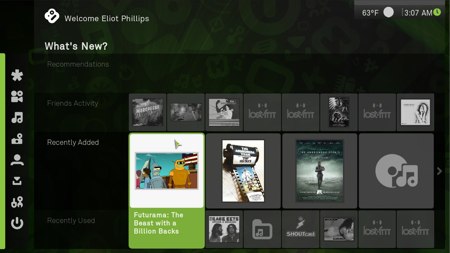
Boxee is the latest piece of software to enter the home theater PC space. It’s recently become available as a public alpha. The first build is only for OSX 10.5, but Ubuntu is coming. Built on the XBMC code base-they even hosted the XBMC developer con last weekend-it has the same goal of letting you navigate and watch/listen to all of your media from your using just a remote. There’s more than just that though.
Servo Focus And Aim Your Telescope

The idea of using servos to aim a telescope isn’t new, but [John]’s build looks so much like a prop from Johnny Mnemomic that we can’t resist posting it. The goal isn’t so much remote control as it is usability. He added a webcam and a pair of servos to help him fine focus and adjust the elevation of the scope to minimize vibration during those sensitive operations.
Get Firefox 3 Early

It’s five hours till the official release of Firefox 3. We know your hands are sweating in anticipation, waiting to click that download link and contribute to the greatest World Record known to man… What? You don’t want your browser to have all the notoriety afforded to fat twins? Well then, let’s just go grab the file now since they’re already on the mirrors.
First, pick out a mirror from the official list. Navigate to the the directory of the Firefox 3.0 release: /pub/mozilla.org/firefox/releases/3.0/ You’ll be greeted by a message that says, “We’re not quite ready yet!” and that “Downloading them directly can harm our ability to distribute Firefox efficiently.” Also, you won’t be in the world record count. Think about that, jerk. All releases are named using a consistent pattern. Looking at an earlier release you can determine that the Mac version of 3.0 will be named: Firefox 3.0.dmg Add on the OS and language directories and it will look like this: /pub/mozilla.org/firefox/releases/3.0/mac/en-US/Firefox%203.0.dmg
You can find out more about the new release by reading Dria’s Field Guide to Firefox 3.