Fail Of The Week: ESP Walkie, Not-So-Talkie

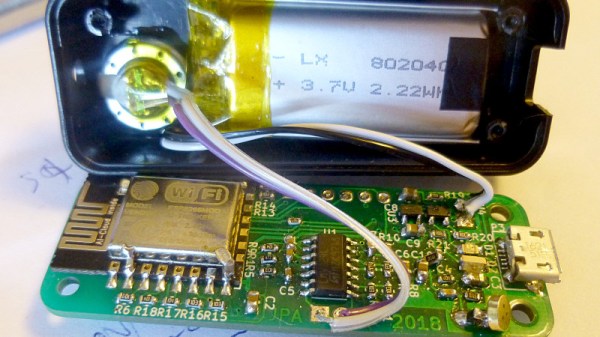
The ESP8266 has become such a staple of projects in our community since it burst onto the scene a few years ago. The combination of a super-fast processor and wireless networking all on the same chip and sold in retail quantities for relative pennies has been irresistible. So when [Petteri Aimonen] needed to make a wireless intercom system for cycling trips it seemed an obvious choice. Push its internal ADC to sample at a high enogh rate for audio, and stream the result over an ad-hoc wi-fi network.

The result was far from satisfactory, as while early results with a signal generator seemed good, in practice it was unusable. Significant amounts of noise were entering the pathway such that the resulting audio was unintelligible. It seems that running a wireless network causes abrupt and very short spikes of power supply current that play havoc with audio ADCs.

He’s submitted it to us as a Fail Of The Week and he’s right, it is a fail. But in a way that’s an unfair description, because we can see there is the germ of a seriously good idea in there. Perhaps with an external ADC, or maybe with some as-yet-to-be-determined filtering scheme, an ESP8266 walkie-talkie is one of those ideas that should be taken to its conclusion. We hope he perseveres.


Hackaday Links Column Banner

Hackaday Links: July 22, 2018

KiCad Version 5 has been released! Footprints are going to be installed locally, and the Github plugin for library management is no longer the default. You now have the ability to import Eagle projects directly, Eeschema has a better configuration dialog, better wire dragging, and Pcbnew now has complex pad shapes. The changelog also says they’ve gone from pronouncing it as ‘Kai-CAD’ to ‘Qai-CAD’.

Kids can’t use computers because of those darn smartphones. Finally, the world is ending not because of Millennials, but because of whatever generation we’re calling 12-year-olds. (I’m partial to Generation Next, but that’s only because my mind is polluted with Pepsi commercials from the mid-90s.)

Need a NAS? The Helios4 is built around the Marvell Armada 388 SoC and has four SATA ports, making it a great way to connect a bunch of hard drives to a network. This is the second run from the team behind the Helios, and now they’re looking to take it into production.

A while ago, [Dan Macnish] built Draw This, a camera that takes an image, sends it through artificial intelligence, and outputs a cartoon on a receipt printer. It’s a camera that prints pictures of cartoons. Of course, some people would want to play with this tech without having to build a camera from scratch, so [Eric Lu] built Cartoonify, a web-based service that turns pictures into cartoons.

Grafitti is fun to spell and fun to do, and for all the proto-Banskys out there, it’s all about stencils. [Jeremy Cook] did a quick experiment with a 3D-printed spray paint stencil. It works surprisingly well, and this is due to leveraging the bridging capability of his printer. He’s putting supports for loose parts of the stencil above where they would normally be. The test sprays came out great, and this is a viable technique if you’re looking for a high-quality spray paint stencil relatively easily.

Belgrade Badge Hacks

We’re still coming off the Hackaday Belgrade conference right now. If you were there, you know it was the greatest hardware conference ever. If you weren’t there, you missed out. Sorry. (Make sure you get in on the Hackaday Superconference in November.)

One of the many highlights of the Belgrade conference was, of course, the badge. The 2018 Hackaday Belgrade Badge is a masterpiece of hardware with a 55-key keyboard, RGB TFT LED, speaker, and a BASIC interpreter.

This badge is a masterpiece of electronic design by Voja Antonic. Just to take one small example from the design, check out the placement of the buttons. Think the slightly rotated buttons that make up the keyboard is only a stylistic choice? It’s not; by carefully rotating each button, the legs of each switch can fit in between each other. It’s brilliant.

Starting hardware this good, adding amazing software by Jaromir Sukuba to bring it to life, and distributing a badge to each hacker through the door is the perfect recipe for some amazing hacks. What were the best badge hacking tricks we saw at the 2018 Hackaday Belgrade conference? Check out the video of the badge hacking ceremonies and then join us below for a few of our favorites.

Continue reading “Belgrade Badge Hacks”

Using Pad Printers To Add Color To Artistic PCBs

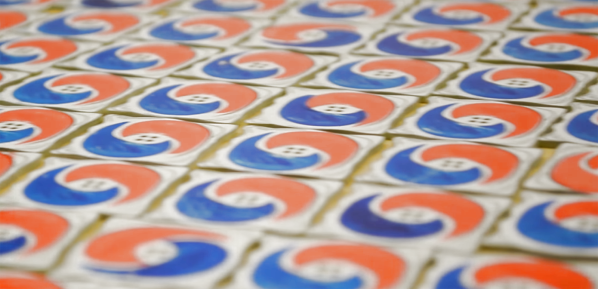
I’ve done a few experiments in adding color to printed circuit boards. These experiments used a process known as pad printing, and so far all indications are that pad printing is a viable process for truly multicolor artistic PCBs. For this year’s DEF CON, I’m stepping things up and taking them to their logical conclusion. I’m making true multicolor PCBs with orange and blue ink. This is, I believe, the first time this has ever been done with printed circuit board art, and it is certainly the first time it has ever been documented.

You may be wondering why I need more color on my boards. It’s that time of year again where PCB artisans all around the world are gearing up for badgecon DEF CON. For the last few years, independent badge makers have come together to form a demoscene of hardware creation. This year, add-ons for badges are a thing, and everyone is getting in on the game. Tindie is filled with amazing electronic badges and add-ons that will be found at this year’s DEF CON. There are badges featuring the Cromulon from Rick and Morty, baby Benders from Futurama, pikachus, and glowing tacos.

This is all about badge art, but when it comes to rendering an image in fiberglass and soldermask, everyone is working with a limited palette. Yes, you can get pink and orange soldermask, but I can’t find a place that will do it inexpensively. For any PCB, your choice of colors are only green, red, yellow, blue, purple, black, or white. No, you can’t mix them.

But I want both orange and blue, on the same board, cheaply and easily — here’s how I did it.

Continue reading “Using Pad Printers To Add Color To Artistic PCBs”

3D Printed Gun Saga: Court Case Over CAD Files Settled

Can you create 3D printed designs and distribute them freely and without restriction? Maybe, and it’s likely to become easier in the future. A settlement has been reached in the saga of the US Department of State versus Cody Wilson, and beginning August 1st the Defense Distributed library of gun designs will once again become available.

Cody is well known for creating the first 3D printed gun. He went on to found Defense Distributed, a company that published designs and technical files for 3D printing firearms before being pulled into litigation that sought to curb the distribution of such plans by subjecting them to International Traffic in Arms Regulations (ITAR) restrictions. Read that carefully, it’s the (international) distribution of CAD files at question here, and not the act of 3D printing, and Defense Distributed has been granted an ITAR exemption. Will other arms-related design files be similarly exempted? The settlement mentions upcoming rule changes seeking to make this type of exemption the standard.

As members of the Hackaday community, we’re the people to whom our friends and family turn for perspective when new technology makes it into their news feeds. Those with little or no exposure to 3D printing may easily fall to doom and gloom reports. But is this a story of doom and gloom? Absolutely not, guns are still guns and 3D printers are still 3D printers. Let’s take a look.

Continue reading “3D Printed Gun Saga: Court Case Over CAD Files Settled”

ERRF 18: The Start Of Something Great

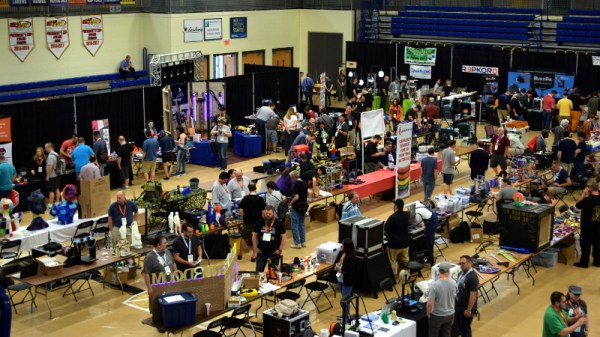
For years, the undisputed king of desktop 3D printing conferences has been the Midwest RepRap Festival (MRRF). Hosted in the tropical paradise that is Goshen, Indiana, MRRF has been running largely unopposed for the top spot since its inception. There are other conferences focused on the industrial and professional end of the 3D printing spectrum, and of course you’d find a Prusa or two popping up at more or less any hacker con; but MRRF is focused on exploring what the individual is capable of once they can manifest physical objects from molten plastic.

But on June 23rd, 2018, MRRF finally got some proper competition. As the name might indicate, the East Coast RepRap Festival (ERRF) is an event very much inspired by its Hoosier State predecessor. Held in Bel Air, Maryland, hackers on the right side of the United States for the first time had the opportunity to attended a true 3D printing festival without having to get on a plane. Not to say it was a neighborhood block party; people from all over the country, and indeed the globe, descended on the APG Federal Credit Union Arena for the two-day celebration of everything plastic.

This inaugural ERRF was, to put it mildly, a massive success. A couple of Hackaday Field Agents were in attendance, and we definitely came away impressed with the event considering it was the first attempt. We saw evidence that the RepRap dream of printable printers is still going strong, a gaggle of new printers and products that will be prying at your wallet this year, and an American-made hotend that challenges traditional wisdom. Of course we also saw a huge number of 3D printing fanatics who were eager to show off their latest creations.

We have no doubt that ERRF will return again next year, but until then, you’ll have to settle for the following collection of selected highlights from this year’s show.

Continue reading “ERRF 18: The Start Of Something Great”