The Book8088 Gets A Post-Hype Review

Last year, a couple of rather unusual computers emerged from China: a 386sx-based palmtop and an 8088-based mini-laptop. The average person isn’t exactly clamoring for a DOS machine these days, but they attracted quite a bit of interest among the retrocomputing scene. Now the dust has settled, [The Retro Shack] has taken a Book 8088 and given it an honest review. Do you need portable 1980s computing in your life, and if so it this the machine to give you it?

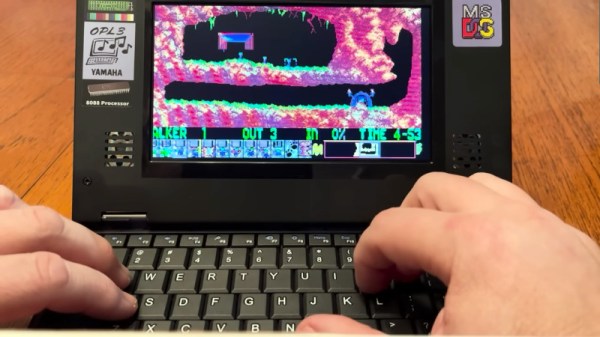
The first impression of the machine is just how svelte it is, being like a small but chunky netbook. He explores the hardware and finds as expected an NEC V20 instead of the Intel part running the show, and what would have been a hugely expanded DOS PC back in the day with its VGA and sound card, not to mention a solid state hard drive.

We’re overcome with a bit of nostalgia here at the sight of DOS running Lemmings, and on a machine we’d have given anything to own back in the 1980s. His final conclusion is that it’s a very nice little PC but around $160 seems a little much for what is essentially a toy. We have sadly to agree with him though we really want one, though noting that such a machine would have retailed for a huge amount more than that in 1980s dollars and we’d have considered it a huge bargain then.

If you’re still curious, we covered the arrival of these machines last year.
Continue reading “The Book8088 Gets A Post-Hype Review”

Making The Commodore SX-64 Mini

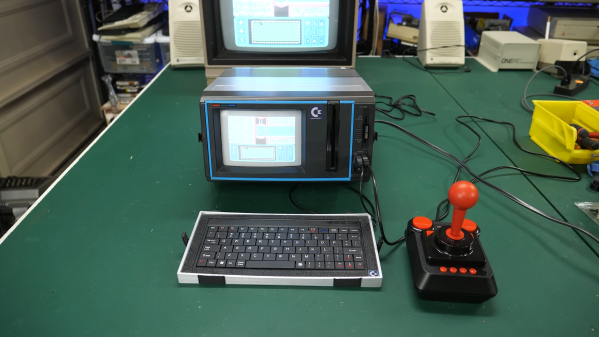
When you find a portable TV from the 1980s, and it reminds you of the portable Commodore 64, there’s only one thing to be done. [Aaron Newcomb] brings us the story of taking an Emerson PC-6 and mating it to the guts of his THEC64 Mini. It’s a bit of a journey, as the process includes modding the TV to include a composite input and trimming some unused PCB off the TV’s mainboard. Then some USB ports and a three-and-a-half inch floppy drive were shoehorned into the chassis, with the rear battery compartment holding the parts from THEC64 Mini.

The build was not entirely without issue. It turns out the degaussing coil connector can plug perfectly into the service port, and Murphy’s law proved itself true again. But no harm was done, and the error was quickly discovered. All that was left was to button the chassis back up and add some paint and 3d-printed trim details. The build looks great! Come back after the break to watch the video from the [Retro Hack Shack] for yourself.

Continue reading “Making The Commodore SX-64 Mini”

Linux Fu: Forward To The Past!

Ok, so the title isn’t as catchy as “Back to the Future,” but my guess is a lot of people who are advanced Linux users have — at least — a slight interest in retrocomputing. You’d like an Altair, but not for $10,000. You can build replicas of varying fidelities, of course. You can also just emulate the machine or a similar CP/M machine in software. There are many 8080 or Z80 emulators out there, ranging from SIMH to MAME. Most of these will run on Linux or — at the least — WINE. However, depending on your goals, you should consider RunCPM. Why? It runs on many platforms, including, of course, Linux and other desktop systems. But it also will work with the Arduino, Teensy, ESP32, or STM32 processors. There is also experimental support for SAM4S and Cyclone II FPGAs.

It’s pretty interesting to have one system that will work across PCs and embedded hardware. What’s more is that, at least on Linux, the file system is directly translated (sort of), so you don’t have to use tricks or special software to transfer files to and from CP/M. It is almost like giving Linux the ability to run CP/M software. You still have to have virtual disks, but they are nothing more than directories with normal files in them.

Goals

Of course, if your goal is to simulate a system and you want to have 180 kB floppies or whatever, then the direct file system isn’t a benefit. But if you want to use CP/M software for education, nostalgia, or cross-development, this is the way to go, in my opinion.

It isn’t just the file system, either. If you need a quick utility inside your bogus CP/M environment, you can write it in Lua, at least on desktop systems. On the Arduino, you can access digital and analog I/O. Theoretically, you could deploy an embedded Altair for some real purpose fairly cheaply. Continue reading “Linux Fu: Forward To The Past!”

Doubling The CPU Speed Of The TRS-80 Model 100 With A Mod Board

The TRS-80 Model 100 was released in 1983, featuring an 80C85 CPU that can run at 5 MHz, but only runs at a hair under 2.5 MHz, due to 1:2 divider on the input clock. Why cut the speed in half? It has a lot to do with the focus of the M100 on being a portable device with low power usage. Since the CPU can run at 5 MHz and modding these old systems is a thing, we got a ready-made solution for the TRS-80 M100, as demonstrated by [Ken] in a recent video using one of his ‘daily driver’ M100s.

This uses the board design from the [Bitchin100] website, along with the M100 ROM image, as one does not simply increase the CPU clock on these old CPUs. The issue is namely that along with the CPU clock, connected components on the CPU bus now have to also run at those speeds, and deal with much faster access speed requirements. This is why beyond the mod board that piggybacks on top of the MPU package, it’s also necessary to replace the system ROM chip (600 ns) with a much faster one, like the Atmel AT27C256R (45 ns), which of course requires another carrier board to deal with incompatible pinouts.

Continue reading “Doubling The CPU Speed Of The TRS-80 Model 100 With A Mod Board”

Developing In Pascal On The Commodore 64 With Abacus Super Pascal 64

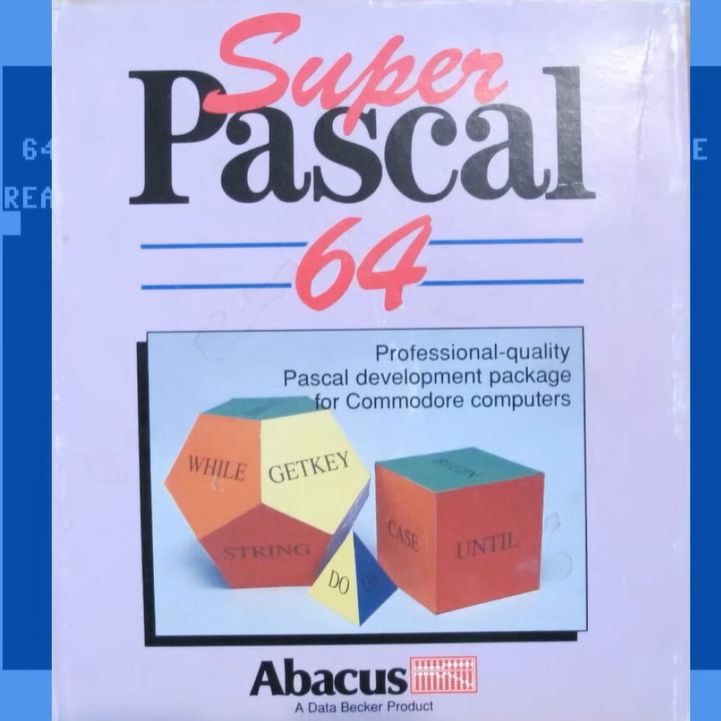
Abacus Super Pascal 64 for the Commodore 64.

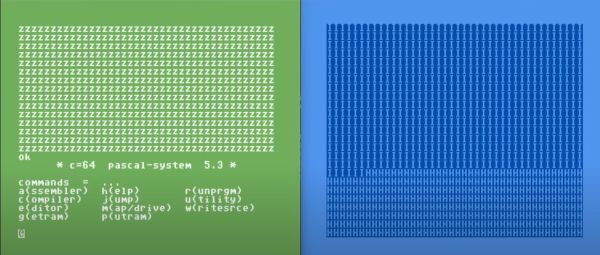
Most people associate the Commodore 64 with Commodore BASIC and precompiled applications, but it also had a number of alternative development environments produced for it. One of these was Super Pascal 64 by Abacus. A solid introduction to this software package is provided in a video tutorial by [My Developer Thoughts] on YouTube. This uses the Abacus Super Pascal 64 software and manual from the [Lyon Labs] website, which incidentally has a lot more development environments and operating systems for the C64 listed for your perusal.

Abacus’ Super Pascal supports the official Pascal language, requiring nothing more than a Commodore 64 and two Commodore 1541 floppy disk drives to get started. One FDD is for the Super Pascal software, which boots into the development environment, the other FDD and the disks in it are the target for the current project’s source code and compiled binary. Although the lack of support for FDDs other than the 1541 is somewhat odd, this comes presumably from the operating system nature of the development environment and the 1541 being by far the most common FDD for the C64.

Continue reading “Developing In Pascal On The Commodore 64 With Abacus Super Pascal 64”

Tandy Pocket Computer Assembly Is… Weird

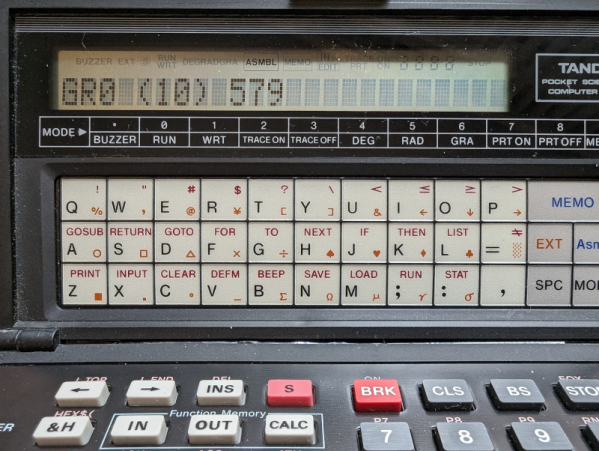
Radio Shack had a long history of buying things overseas, having their name slapped on them, and selling them in the United States. That was the case with the Tandy Pocket Computers, which were in that awkward space between calculators and full-blown computers. Like many computers of those days, if you wanted to do anything interesting, you needed to turn to assembly language. But as [Old Vintage Computing Research] recalls, the assembly for these little devices was very strange, even for an assembly language. He found out that there is a reason it is so strange and shares it in a deep dive into the device’s machine code history.

The story starts with the Japanese government. In 1969, the ministry in charge of such things decided that it wouldn’t be fair for people who knew a particular computer to have an advantage when taking the Information Technology Engineer exam. So, logically, they made up a fictitious instruction set and architecture for the test. Since no one used it, no one would have an unfair advantage.

However, eventually, Japanese manufacturers started making computers that used the architecture. The architecture was COMP-X, and the assembler was CAP-X. The post covers the history of machines either using the architecture or emulating it going back to the 1970s. It eventually winds up at the Sharp and Casio pocket computers that would wear Radio Shack livery in much of the world, especially the United States.

Continue reading “Tandy Pocket Computer Assembly Is… Weird”

Minitel, The 1980s Console Game Platform You Never Had

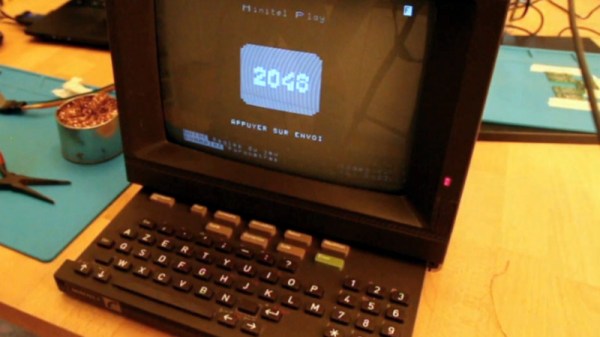
We’ve made no secret over the years here at Hackaday of our admiration for the Minitel. The ubiquitous CRT terminals which made 1980s France the most connected country in the world never made it to where we grew up, but OH! how we wanted them to! We’ve seen quite a few Minitels repurposed as serial terminals here, but for the time being we think [Louis H] has won the Minitel Internet with his plugin game console cartridges. These have a DIN plug to fit the Minitel serial port, and present themselves as a serial game.

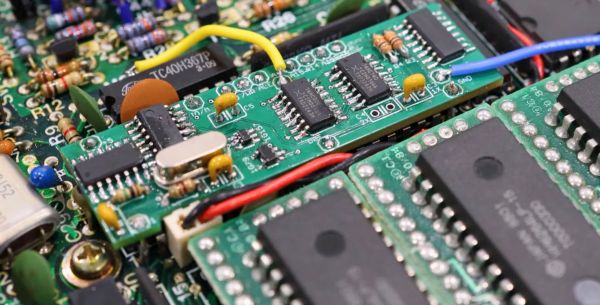
The cartridge itself is an extremely simple affair, a tube which fits over the DIN plug body, containing a slim PCB with an ATmega328 and its supporting components. The games must be programmed such that their gameplay can work over a serial interface, so as an example the first game is a version of 2048.

We applaud both the simplicity and creativity of this project, and we love it that a new 1980s console we never knew we had has been unearthed, without the need for hardware modification. Meanwhile if you’d like to peer inside an Alcatel Telic 1, we can take you there.