Minitel, The 1980s Console Game Platform You Never Had

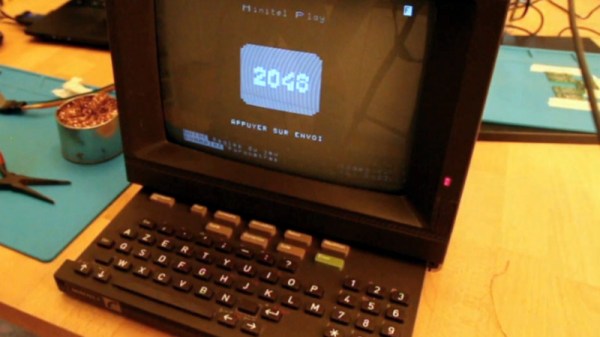
We’ve made no secret over the years here at Hackaday of our admiration for the Minitel. The ubiquitous CRT terminals which made 1980s France the most connected country in the world never made it to where we grew up, but OH! how we wanted them to! We’ve seen quite a few Minitels repurposed as serial terminals here, but for the time being we think [Louis H] has won the Minitel Internet with his plugin game console cartridges. These have a DIN plug to fit the Minitel serial port, and present themselves as a serial game.

The cartridge itself is an extremely simple affair, a tube which fits over the DIN plug body, containing a slim PCB with an ATmega328 and its supporting components. The games must be programmed such that their gameplay can work over a serial interface, so as an example the first game is a version of 2048.

We applaud both the simplicity and creativity of this project, and we love it that a new 1980s console we never knew we had has been unearthed, without the need for hardware modification. Meanwhile if you’d like to peer inside an Alcatel Telic 1, we can take you there.

[Usagi] Whips A Chain Printer Into Shape

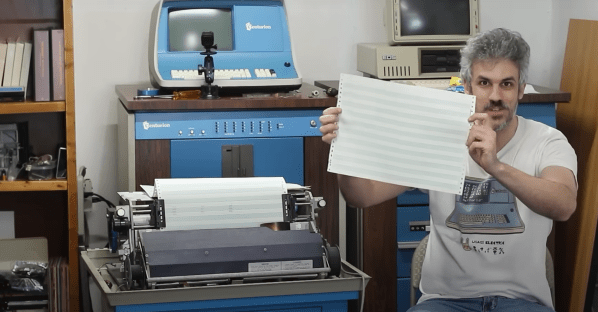
What does it take to get a 47-year-old printer working? [Usagi Electric] shows us it’s not too hard, even if you don’t exactly know what you’re doing.  When we last left this project, he’d tested and verified his power supply was working. This week, after a bit of cleaning, it was time to dig into the mechanics.

If you haven’t seen a chain printer in action before, definitely check one out. They’re big, loud, and sound a bit like a turbine when they spool up. The type chains on these printers never stops moving. This means the printer has to know exactly where a particular letter is before launching one of 66 hammers at it. If the timing is off, parts will fly. To the average computer user, they’re quite intimidating.

Thankfully [Usagi’s] printer was in pretty good shape. When he flipped the big power switch, there was plenty of strange noises, culminating in the test pattern of dollar signs. Probably an early reminder to customers that they needed to order more print supplies.

Continue reading “[Usagi] Whips A Chain Printer Into Shape”

Revisiting A Z80 Game From 1990

Back in the days of 8-bit computers, like no doubt many readers of similar age, we wrote little games. First in BASIC, then augmented with little machine code speed-ups. We didn’t come close to [Óscar Toledo Gutiérrez] though, who’s reverse engineering a 2K all-machine-code game he wrote back in 1990. As a tale of software archaeology it’s fascinating.

The game itself is an avoid-the-monsters platformer with plenty of ladders for the little sprite-based protagonist to run down. The computer was a Mexican homebrew educational machine with a TMS9118 display chip and an AY-3-8910 synthesizer, so the result had both color and music. His run through the code breaks it down neatly into individual sections, so it’s possible to see what’s going on without an in-depth knowledge of machine code.

He readily admits it bears all the hallmarks of an 11-year-old’s knowledge at the time, and that it has some parts less elegant, but nevertheless it’s something of an achievement at any age. It was out of date gameplay-wise in 1990 but in 1982 it could probably have been bought on a tape by eager kids. Here in 2024 he’s got it for download should you have a Colecovision or an MSX. There’s a gameplay video below the break, take a look.

Continue reading “Revisiting A Z80 Game From 1990”

It Wasn’t DOOM That Killed The Amiga

If you were the type of person who might have read Hackaday had we been around in the late 1980s or early 1990s, it’s a reasonable guess that you would have had a 16-bit home computer on your desk, and furthermore that it might have been a Commodore Amiga. These machines gave the best bang for the buck in those days with their impressive multimedia capabilities, and they gained a fervent following which persists to this day. [Carl Svensson] was one of them, and he’s penned a retrospective on the demise of the platform with the benefit of much hindsight.

The heyday of the Amiga from its 1985 launch until the days of the A1200 in the early-to-mid 1990s saw Moore’s Law show perhaps its fastest effects for the consumer. In that decade the PC world jumped from the 8088 to the Pentium, and from a PC speaker and CGA if you were lucky, to a Sound Blaster 16 and accelerated SVGA. By comparison the Amiga didn’t change much except in model numbers and a few extra graphics modes, and when a faster processor came it was far to little too late.

Defender of the Crown, released in 1986

There’s a well-worn path with some justification of blaming Commodore-s notoriously awful management for the debacle, but the piece goes beyond that into the mid ’90s. His conclusion is that what really killed the Amiga was that the CPU price reductions which defined the x86 world at that time never came to 68k or PowerPC lines, and that along with the architecture zealotry of the fan base meant that there would never be the much-longed-for revival.

He also takes a look at the other home computer platforms of the era, including the “all its killer architecture managed to kill was, sadly, Atari itself” Atari Falcon, and the Acorn Archimedes, which also lives on for enthusiasts and is perhaps the most accessible survivor. From here having also the benefit of hindsight we can’t disagree with him on his assessment, so perhaps it’s best to look at the Amiga not as the platform we should rightfully still be using, but the great stepping stone which provided us a useful computer back in t he day without breaking the bank.

An Apple ][ With A Pendulum

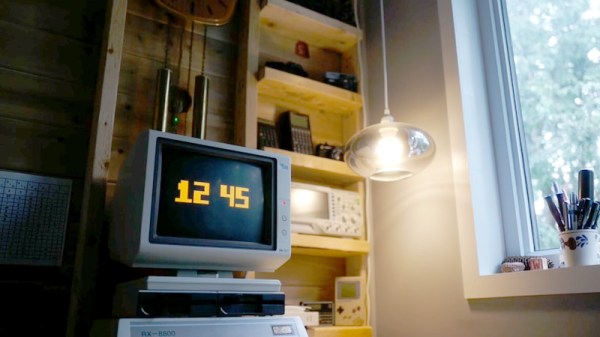
Clocks are a favourite project here, and we can say we’ve seen all conceivable types over the years. Just a software clock on a retrocomputer perhaps isn’t the coolest among them, but [Willem van der Jagt ]’s Apple][ clock has a little bit extra. It takes its time reference from a real pendulum, on an antique wall clock.

A proximity sensor next to a metal pendulum gives an easy way to generate a digital pulse on each pass, but leaves the question of how to transfer it to the computer. With computers of this age the circuitry is surprisingly simple, and in this case he’s sending an interrupt to the machine which the software can pick up for its timing. There is a small logic circuit between the sensor and the interrupt allowing him to gate the pendulum line, triggered from one of the output lines exposed on the Apple’s game port.

The code is written in assembly, and counts the number of pendulum swings before incrementing the number of minutes. It’s an enjoyable reminder of the days when the architecture of a computer was this accessible, and for those of us whose past lies in the Sinclair world it’s also been a little peek into something of how the Apple works.

We think this is the first pendulum-driven retrocomputer clock we’ve seen here at Hackaday, as you might understand when a clock has a pendulum it’s usually a more traditional design.

Arctic Adventures With A Data General Nova II — The Equipment

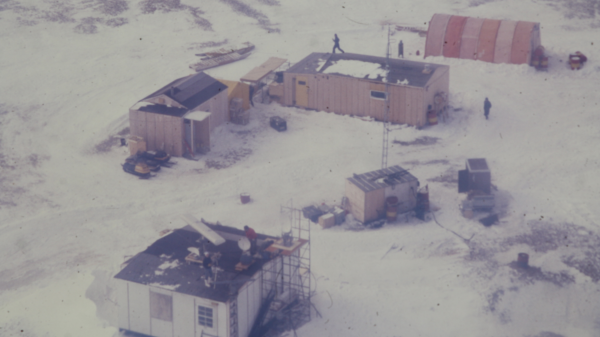
As I walked into the huge high bay that was to be my part-time office for the next couple of years, I was greeted by all manner of abandoned equipment haphazardly scattered around the room. As I later learned, this place was a graveyard for old research projects, cast aside to be later gutted for parts or forgotten entirely. This was my first day on the job as a co-op student at the Georgia Tech Engineering Experiment Station (EES, since renamed to GTRI). The engineer who gave me the orientation tour that day pointed to a dusty electronic rack in one corner of the room. Steve said my job would be to bring that old minicomputer back to life. Once running, I would operate it as directed by the radar researchers and scientists in our group. Thus began a journey that resulted in an Arctic adventure two years later.

The Equipment

The computer in question was a Data General (DG) mini computer. DG was founded by former Digital Equipment Corporation (DEC) employees in the 1960s. They introduced the 16-bit Nova computer in 1969 to compete with DEC’s PDP-8. I was gawking at a fully-equipped Nova 2 system which had been introduced in 1975. This machine and its accessories occupied two full racks, with an adjacent printer and a table with a terminal and pen plotter. There was little to no documentation. Just to turn it on, I had to pester engineers until I found one who could teach me the necessary front-panel switch incantation to boot it up. Continue reading “Arctic Adventures With A Data General Nova II — The Equipment”

Sega’s AI Computer Embraces The Artificial Intelligence Revolution

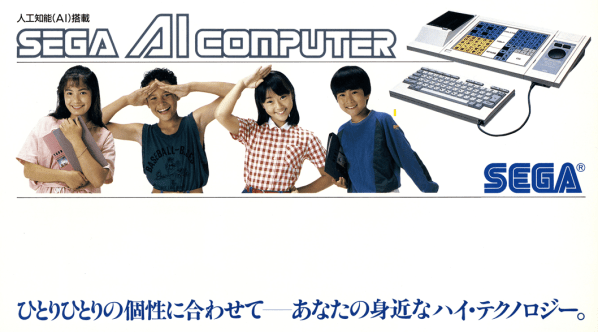
Recently a little-known Sega computer system called the Sega AI Computer was discovered for sale in Japan, including a lot of the accompanying software. Although this may not really raise eyebrows, what’s interesting is that this was Sega’s 1986 attempt to cash in on Artificial Intelligence (AI) hype, with a home computer that could handle natural language. Based on the available software and documentation, it looked to be mostly targeted at younger children, with plans to launch it in the US later on, but ultimately it was quietly shelved by the end of the 1980s.

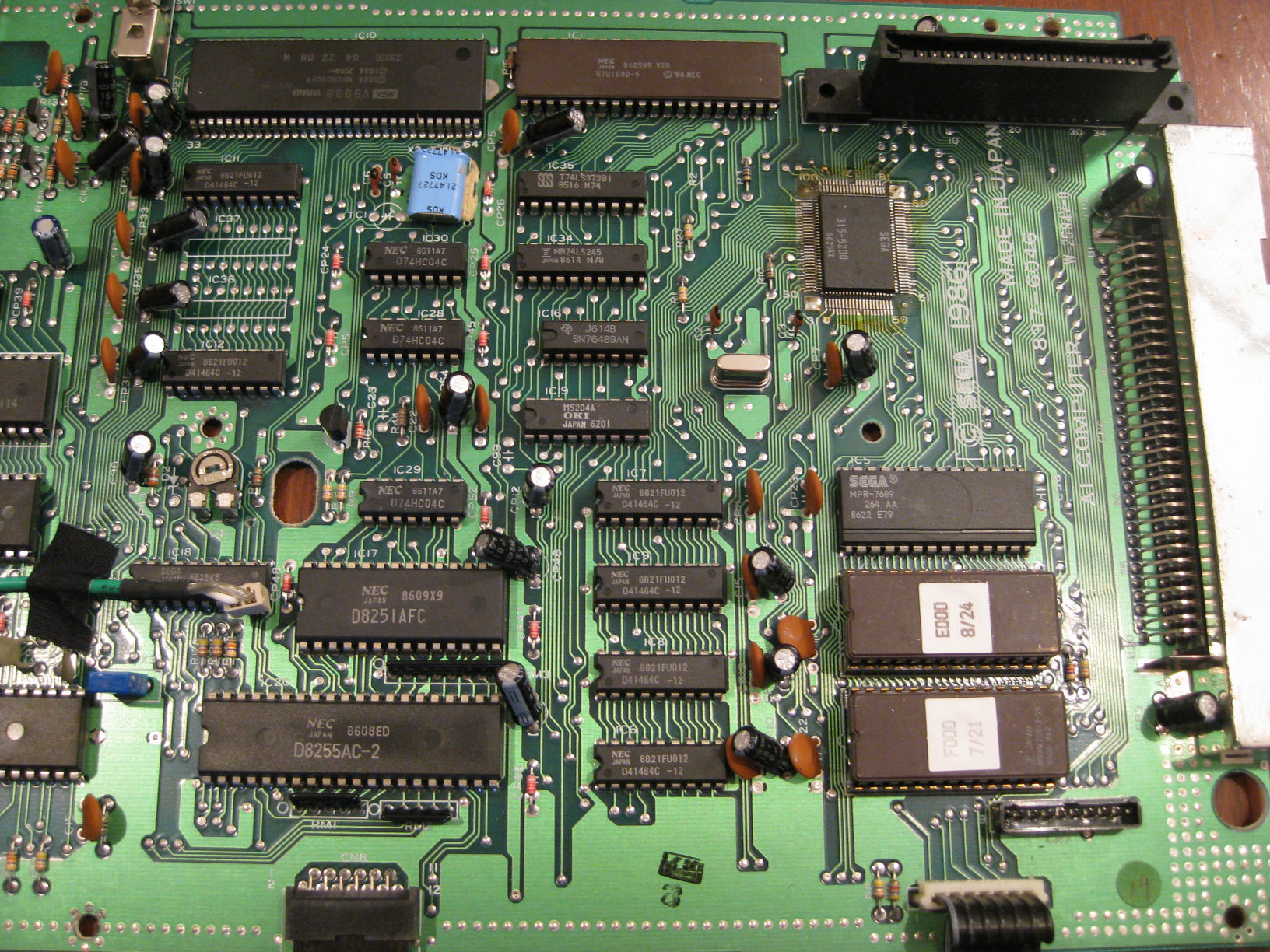
Part of the Sega AI Computer's mainboard, with the V20 MPU and ROMs.
Part of the Sega AI Computer’s mainboard, with the V20 MPU and ROMs.

The computer system itself is based around the NEC v20 8088-compatible MPU with 128 kB of RAM and a total of 512 kB of ROM, across multiple chips. The latter contains not only the character set, but also a speech table for the text to speech functionality and the Prolog-based operating system ROM. It is this Prolog-based environment which enables the ‘AI’ functionality. For example, the ‘diary’ application will ask the user a few questions about their day, and writes a grammatically correct diary entry for that day based on the responses.

On the system’s touch panel overlays can be used through cartridge or tape-based application to make it easy for children to interact with the system, or a full-sized keyboard can be used instead. All together, 14 tapes and 26 cartridges (‘my cards’) had their contents dumped, along with the contents of every single ROM in the system. The manual and any further documentation and advertising material that came with the system were scanned in, which you can peruse while you boot up your very own Sega AI Computer in MAME. Mind that the MAME system is still a work in progress, so bugs are to be expected. Even so, this is a rare glimpse at one of those aspirational systems that never made it out of the 1980s.