Wolfram Alpha Shows Its Work

The bane of math students everywhere is the teacher asking for you to show your work. If you’ve grown up where a computer is a normal part of school work, that might annoy you since a lot of tools just give you an answer. We aren’t suggesting you cheat at homework, but we did notice that Wolfram Alpha now shows more of its work when it solves many common math problems.

Granted, the site has always shown work on some problems. However, a recent update shows more intermediate steps and also covers more kinds of problems in a step-by-step format. There are examples, but be aware that for general use, you do need to upgrade to pro (about $6 a month or less if you are student or teacher).

Continue reading “Wolfram Alpha Shows Its Work”

A Great Guide To Software PLLs

There are some things that you think you know quite well because you learned them in your youth and you understand their principles of operation. Then along comes a link in your morning feed that reminds you of the limits of your knowledge, and you realize that there is a whole new level of understanding to be reached.

Take Phase Locked Loops (PLLs) for example. You learn how they work, you use them for frequency synthesis, and you know they can do other things like recover noisy clock lines and do FM demodulation. But then you read [Paul Lutus’] Understanding Phase-Locked Loops page, and a whole new vista opens.

He’s discussing PLLs in the context of software, as part of a weather fax decoder project, and this allows a perspective that was unavailable to those of us who learned about them through the medium of hardware such as the venerable 4046 CMOS chip. We can easily look at different PLLs with varying parameters, for example their use with a narrowband loop filter to retrieve signals buried in the noise, all through some straightforward code tweaks rather than extensive circuitry. It’s a page that’s a few years old now, but resources like this one do not age.

If PLLs are entirely new to you then you need to reat last year’s excellent PLL primer by Hackaday’s own [Al Williams].

[via Hacker News]

[PLL diagram: Chetvorno CC0]

Hardware For Deep Neural Networks

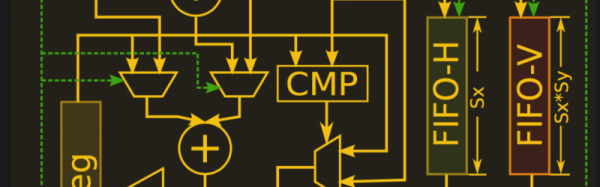
In case you didn’t make it to the ISCA (International Society for Computers and their Applications) session this year, you might be interested in a presentation by [Joel Emer] an MIT  professor and scientist for NVIDIA. Along with another MIT professor and two PhD students ([Vivienne Sze], [Yu-Hsin  Chen], and [Tien-Ju Yang]), [Emer’s] presentation covers hardware architectures for deep neural networks.

The presentation covers the background on deep neural networks and basic theory. Then it progresses to deep learning specifics. One interesting graph shows how neural networks are getting better at identifying objects in images every year and as of 2015 can do a better job than a human over a set of test images. However, the real key is using hardware to accelerate the performance of networks.

Hardware acceleration is important for several reasons. For one, many applications have lots of data associated. Also, training can involve many iterations which can take a long time.

Continue reading “Hardware For Deep Neural Networks”

Language Parsing With ANTLR

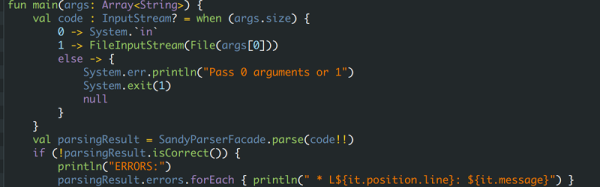
There are many projects that call out for a custom language parser. If you need something standard, you can probably lift the code from someplace on the Internet. If you need something custom, you might consider reading [Federico Tomassetti’s] tutorial on using ANTLR to build a complete parser-based system. [Frederico] also expanded on this material for his book, but there’s still plenty to pick up from the eight blog posts.

His language, Sandy, is complex enough to be a good example, but not too complex to understand. In addition to the posts, you can find the code on GitHub.

Continue reading “Language Parsing With ANTLR”

Forget Troy. Try HelenOS

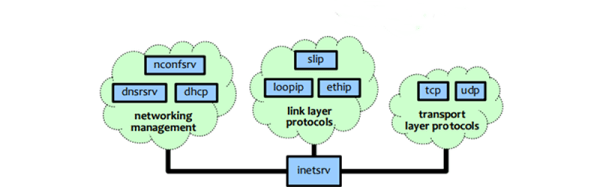
Even though it seems like there are a lot of operating system choices, the number narrows if you start counting kernels, instead of distributions. Sure, Windows is clearly an operating system family, and on the Unix-like side, there is Linux and BSD. But many other operating systems–Ubuntu, Fedora, Raspian–they all derive from some stock operating system. There are some outliers, though, and one of those is HelenOS. The open source OS runs on many platforms, including PCs, Raspberry PIs, Beaglebones, and many others.

Although the OS isn’t new, it is gaining more features and is now at version 0.7. You can see a video about some of the new features, below.

According to the project’s web site:

HelenOS is a portable microkernel-based multiserver operating system designed and implemented from scratch. It decomposes key operating system functionality such as file systems, networking, device drivers and graphical user interface into a collection of fine-grained user space components that interact with each other via message passing. A failure or crash of one component does not directly harm others. HelenOS is therefore flexible, modular, extensible, fault tolerant and easy to understand.

Continue reading “Forget Troy. Try HelenOS”

Enigma neural network

Decoding Enigma Using A Neural Network

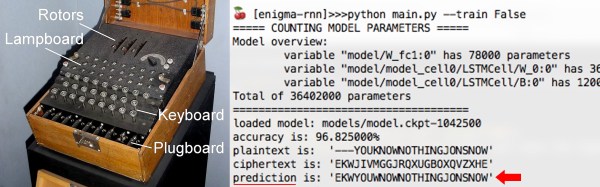
[Sam Greydanus] created a neural network that can encode and decode messages just as Enigma did. For those who don’t know, the Enigma machine was most famously used by the Germans during World War II to encrypt and decrypt messages. Give the neural network some encrypted text, called the ciphertext, along with the three-letter key that was used to encrypt the text, and the network predicts what the original text, or plaintext, was with around 96-97% accuracy.

The type of neural network he used was a Long Short Term Memory (LSTM ) network, a type of Recurrent Neural Network (RNN) that we talked about in our article covering many of the different types of neural networks developed over the years. RNNs are Turing-complete, meaning they can approximate any function. [Sam] noticed the irony in this, namely that Alan Turing both came up with the concept of Turing-completeness as well as played a big part in breaking the Enigma used in World War II.

How did [Sam] do it?

Continue reading “Decoding Enigma Using A Neural Network”

InstantCAD Promises Faster Iterative Design

The design process for any product is necessarily an iterative one. Often, a prototype is modelled or built, and changes are made to overcome problems and improve the design. This can be a tedious process, and it’s one that MIT’s CSAIL has sought to speed up with InstantCAD.

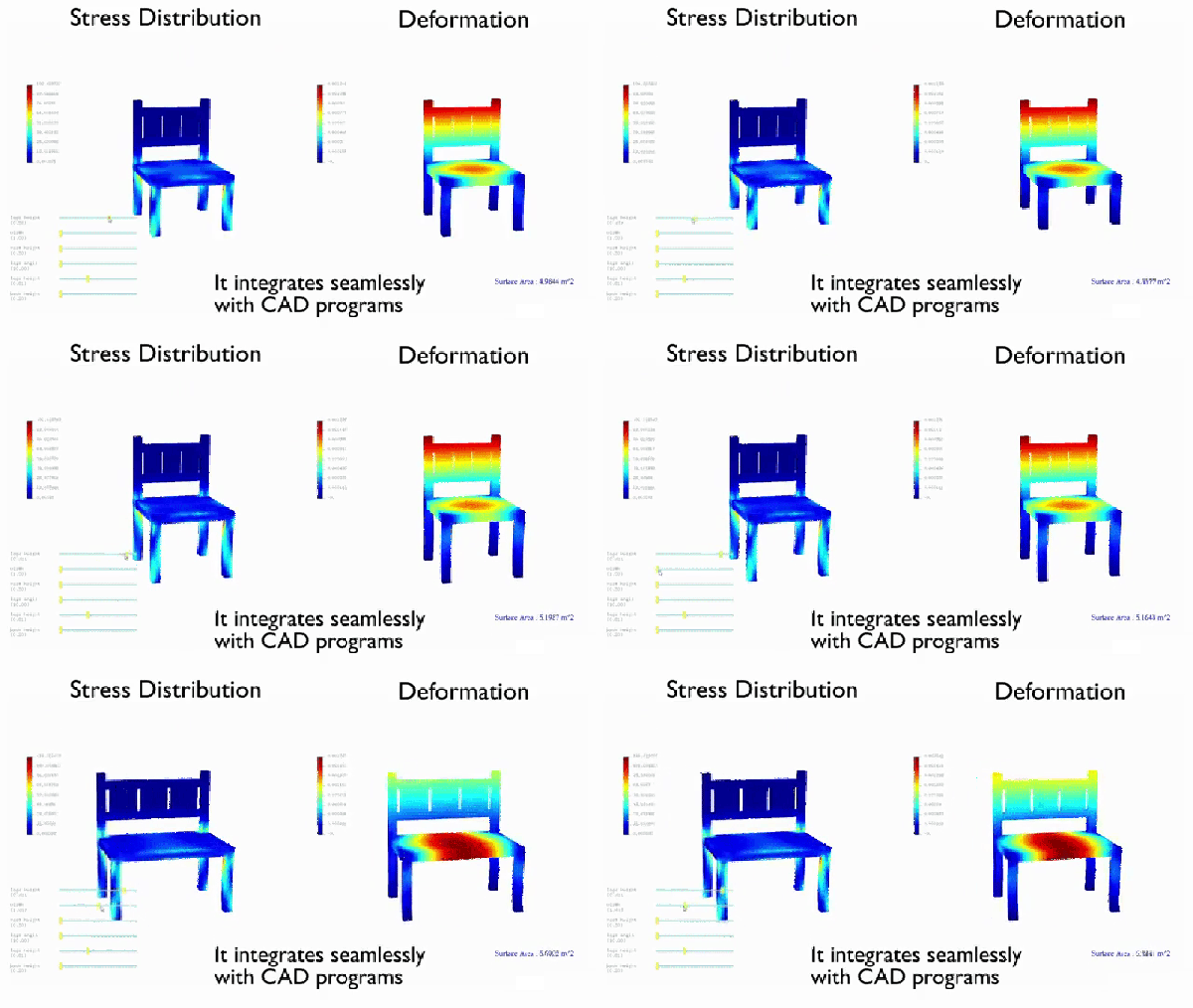
The basic idea is integrating analysis tools as a plugin within already existing CAD software. A design can be created, and then parametrically modified, while the analysis updates on screen in a near-live fashion. Imagine modelling a spanner, and then dragging sliders to change things like length and width while watching the stress concentrations change in real time. The tool appears to primarily be using some sort of finite element analysis, though the paper also shows examples of analyzing fluid flows as well.

The software is impressive, however there are caveats. Like any computer analysis, serious verification work must be undertaken to ensure its validity. We suspect that there may be issues with more complex geometries that lead to inaccurate simulation. It’s not the sort of tool you’d use for anything that puts life and limb at risk, but we can see it having great uses for designing basic objects when you want to quickly gain an idea of what sort of effect certain parameter changes will have.

The other main disappointment is that while this tool looks great, it doesn’t appear to be publicly available in any form. Whether this is due to universities and complicated IP requirements or the potential for future commercialization is anyone’s guess. Regardless, you can read the conference paper here or check out the video below. Or you could read up on the applications of finite element analysis to 3D printer slicers, too.

Continue reading “InstantCAD Promises Faster Iterative Design”