We live in a world where everything must be portable, ranging from mobile applications to making an application able to run on Linux, Windows and OS X. Making a C# application to be completely portable across all windows computers is a problem that Microsoft knows about and willingly admits they will not fix. [Mike] from Geek Republic has taken it upon himself to show us how to hack up some code to make your programs portable. This code is a good push forward for people loving the portability of modern applications. He will admit that bugs may exist so be on the lookout and he would probably appreciate the feedback. Looking forward to a fully working provider so that .NET applications can be carried wherever people go!
Software Hacks1043 Articles
Firesheep: Promoting Privacy In A Scary Way
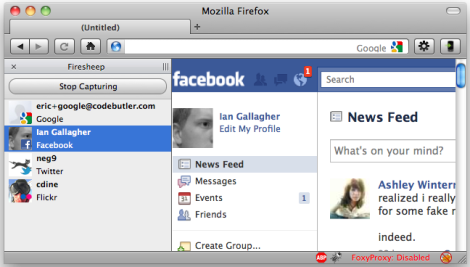
Often, software hackers are the activists that push software giants towards updating vulnerable applications. In todays example, [Eric Butler] is pushing Facebook, Twitter, Flickr, and more all at the same time. By creating a user script-kiddie friendly extension for Firefox, he has allowed just about anyone to sniff unsecured connections on public Wi-Fi access points and log into these unprotected accounts.
Right now the extension is available for Windows and Mac, with a Linux port coming soon. Temporarily, the best way for a user to avoid getting taken advantage of would be to not use these social networking sites on a public connection, or to implement a secure proxy for these connections that would keep your data safe. Hopefully these websites will have a quick rebuttal that allows for security without workarounds. With all of the bad press they are recieving, they certainly have incentive to.
Are there any software or security buffs out there? We would love to see someone port this to an iPhone or Android app that could check and log open Wi-Fi points. We’ll leave the foot work to the experts out there, but do be sure to give us a heads up if anyone manages to make it happen, okay?
Use A 3D Mouse With Eagle CAD
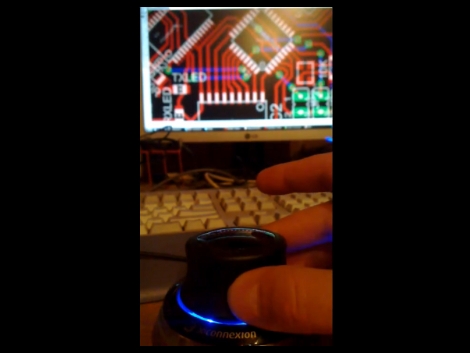
[Sebastian] made a 3D mouse work with Eagle CAD. He was inspired after using a 3DConnexion device to manipulate the views in a copy of Solid Edge 3D CAD modeling software. The system uses the 3D mouse in one hand with the regular mouse in the other.
It turns out that 3DConnecxion offers a lot of tools to get their devices working with your software. [Sebastian] downloaded the .NET example and modified it to read in data from the device. With the use of hot-keys he manages to get zoom, pan, and centering to work (see for yourself after the break). The only drawback to his implementation is that he can’t pan while dragging parts. But that’s just a small issue waiting for you to find a solution.
Decoding MP3 In Python
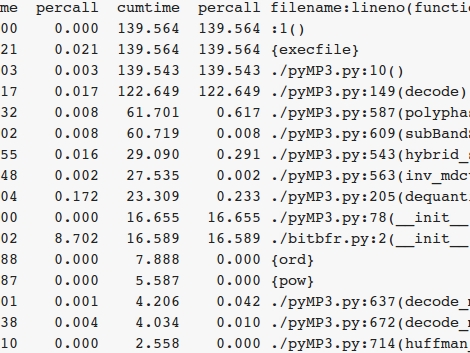
We all listen to them, but do you know how the compression for an MP3 file actually works? [Portalfire] wanted to find out, while honing his Python skills at the same time. He’s been working on an MP3 decoder in the Python language. So far he’s had some success, with the first working decoder clocking in at just 34 times slower than real-time. But since then a bit of optimization improved that to 10 times slower.
Sure, it’s not a usable module yet but his goal of learning the algorithms has been reached. A combination of reading about the standard and looking at code from other projects made that possible. In the future he plans to try the same thing with the H.264 codec.

16 Bit ALU In Minecraft
We love games here but we don’t often get a reason to write about them. This, however, is worth mentioning. The indie hit Minecraft is eating the entire internet right now. The game itself is hit and miss amongst our staff, but this project is unanimously accepted as awesome. [Theinternetftw} has created a simulation of the ALU section of a 16bit processor. He can set it in motion and run around watching as the states change. This is part of an even bigger project to create the entire processor as shown in the book “The Elements of Computer Systems“.
For those that are wondering how long it took him to place all of those pieces, he actually imported most of it from another program. You can get more details on how they pulled this off in this forum thread. Be sure to catch the video after the break.
GPU Processing And Password Cracking
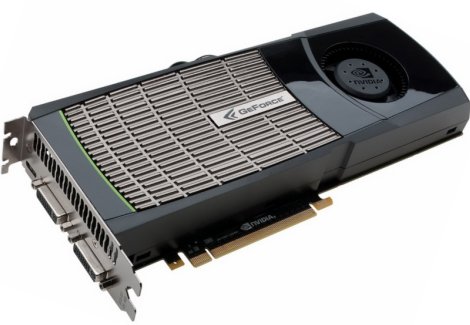
Recently, research students at Georgia Tech released a report outlining the dangers that GPUs pose to the current state of password security. There are a number of ways to crack a password, all with their different pros and cons, but when it comes down to it, the limiting factor in all of these methods is processing complexity. The more operations that need to be run, the longer it takes, and the less useful each tool is for cracking passwords. In the past, most recommendations for password security revolved around making sure your password wasn’t something predictable, such as “password” or your birthday. With today’s (and tomorrows) GPUs, this may no longer be enough.
Hacking Wing Commander For Windows 7 Compatibility

For everyone using a later version of Windows like Vista or Windows 7 they will probably never get to enjoy the awesomeness that was Wing Commander…until now. [Jari Komppa] has managed to use DirectDraw to his advantage and hack out a solution to this disappointing problem. He used DirectX to do this and has even managed to get OpenGL to load from a DLL after a few problems with Windows XP and Windows 7. This is truly a step forward in retro gaming. No more should we have to load a virtual machine to play Starcraft. Hopefully getting this ported to even older games such as Sim Farm or Commander Keen are on the way!