Teardown: Verizon AC791L Jetpack 4G Mobile Hotspot

The saying “time and tide wait for no man” is usually used as a verbal kick in the pants, a reminder that sometimes an opportunity must be seized quickly before it passes by. But it can also be interpreted as a warning about the perpetual march of time and how it impacts the world around us. In that case, we would do well to add cellular technology to the list of proverbial things that wait for no one. Do you need 5G? No. Do you want it? Probably not. But it’s here, so be a good consumer and dump all your 4G hardware in the name of technical progress.

This line of logic may explain how the Verizon-branded Netgear AC791L 4G “Jetpack” hotspot you see here, despite being in perfect working order, found itself in the trash. The onset of 5G must have been particularly quick for the previous owner, since they didn’t even bother to wipe their configuration information from the device. In the name of journalistic integrity I won’t divulge the previous owner’s identity; but I will say that their endearing choice of WPA2 key, iluvphysics, makes for a nice fit with our publication.

A quick check of eBay shows these devices, and ones like it, are in ample supply. At the time of this writing, there were more than 1,500 auctions matching the search term “Verizon jetpack”, with most of them going for between $20 and $50 USD. We like cheap and easily obtainable gadgets that can be hacked, but is there anything inside one of these hotspots that we can actually use? Let’s find out.

Continue reading “Teardown: Verizon AC791L Jetpack 4G Mobile Hotspot”
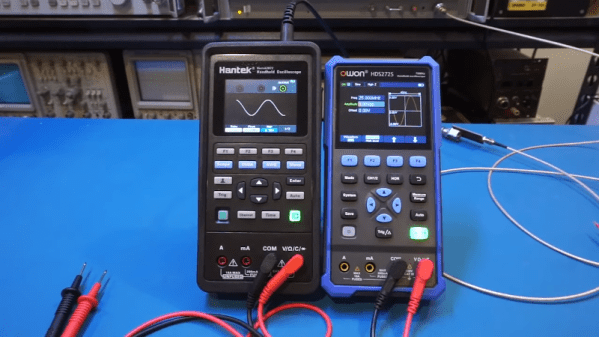
[Kerry Wong] Is Really Into Scope Meters

If a combination multimeter and oscilloscope is on your holiday shopping list this year, you might want to have a look at some of [Kerry Wong’s] recent videos on the subject. Over several videos he looks at — inside and out — an OWON HDS272S and a Hantek 2D72, both reasonably inexpensive entries in the field. Both instruments are similar and have a few variants depending on the frequency capability and the addition of a waveform generator.

There are several videos on the Hantek device that are a few months old, then some recent videos — like the one below — on the OWON device along with some comparison videos.

Continue reading “[Kerry Wong] Is Really Into Scope Meters”

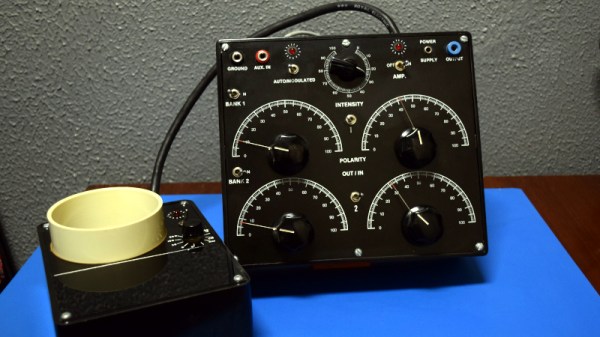
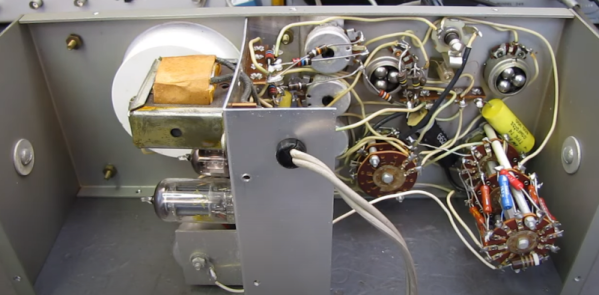
Teardown: Analog Radionic Analyzer

Have you ever looked up a recipe online, and before you got to the ingredients, you had to scroll through somebody’s meandering life story? You just want to know how many cans of tomato paste to buy, but instead you’re reading about cozy winter nights at grandma’s house? Well, that’s where you are right now, friend. Except instead of wanting to know what goes in a lasagna, you just want to see the inside of some weirdo alternative medicine gadget. I get it, and wouldn’t blame you for skipping ahead, but I would be remiss to start this month’s teardown without a bit of explanation as to how it came into my possession.

So if you’ll indulge me for a moment, I’ll tell you a story about an exceptionally generous patron, and the incredible wealth of sham medical hokum that they have bestowed upon the Hackaday community…

Continue reading “Teardown: Analog Radionic Analyzer”

Heathkit IM-13 VTVM Repair

If you are under a certain age, you might not know the initialism VTVM. It stands for vacuum tube voltmeter. At first glance, you might just think that was shorthand for “old voltmeter” but, in fact, a VTVM filled a vital role in the old days of measuring instruments. [The Radio Mechanic] takes us inside a Heathkit IM-13 that needed some loving, and for its day it was an impressive little instrument.

Today, our meters almost always have a FET front end and probably uses a MOSFET. That means the voltage measurement probes don’t really connect to the meter at all. In a properly working MOSFET, the DC resistance between the gate and the rest of the circuit is practically infinite. It is more likely that a very large resistor (like 10 megaohms) is setting the input impedance because the gate by itself could pick up electrostatic voltage that might destroy the device. A high resistance like that is great when you make measurements because it is very unlikely to disturb the circuit you are trying to measure and it leads to more accurate measurements.

Continue reading “Heathkit IM-13 VTVM Repair”

Mystery HP Gear Teardown

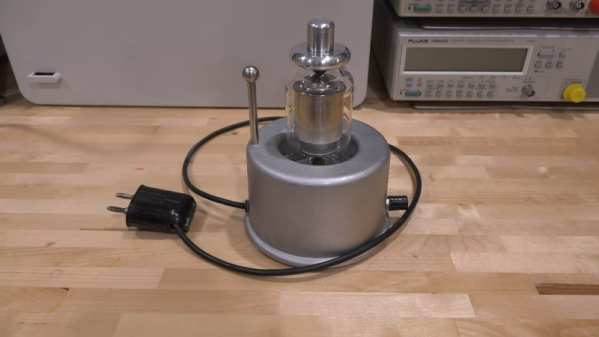
What’s round, has what looks like a vacuum tube in the center, and was made in the 1950s by HP? We don’t know either, but [The Signal Path] restored one and shows us this mystery instrument in a recent video that you can see below. We aren’t going to spoil the surprise over what the device is, but we will share that he does reveal what it is very early in the video, so there’s not much of a tease.

We will, however, give you a few hints. Looking at it, you can guess that it is meant for high voltage use and, in fact, it is rated for up to 25 kV. We’ll also drop the hint that it is made for use with AC, not DC. The shape of the plug at the end of the wire is also a clue, we think.

There isn’t much inside the unusual round case (another clue, by the way), but there are some vintage parts we haven’t seen in quite awhile. One last clue: Why is there a metal rod and ball sticking out of one side of the device?

Honestly, the insides are a bit underwhelming so unlike some teardown videos we’ve seen, the real star of this video is the unusual device more so than its inner workings. If you have a hankering for a more sophisticated HP exploration, check out the HP3458A repair we covered earlier. Or go old school and peek inside an HP 150A.

Continue reading “Mystery HP Gear Teardown”

The HP3458A: King Of Multimeters For Three Decades

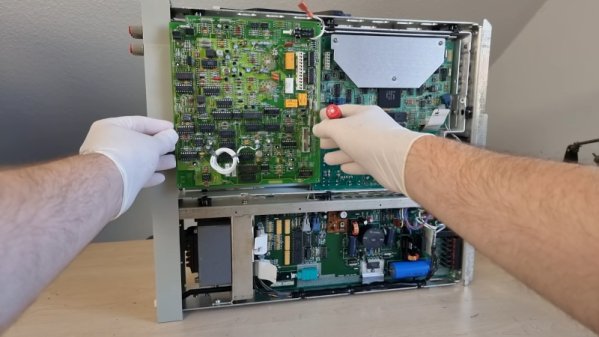
[Marco] looks at a lot of meters. However, he considers the HP3458A the best even though they were introduced more than 30 years earlier in 1989. Someone donated one to [Marco] but it presented some error messages on startup and exhibited erratic behavior, so he had some repairs to do.

The error codes hinted there were issues with the multislope analog to digital converter and that’s what sets the meter apart, according to [Marco]. The meter has 8.5 digits, so a normal conversion stage won’t cut it.

Continue reading “The HP3458A: King Of Multimeters For Three Decades”

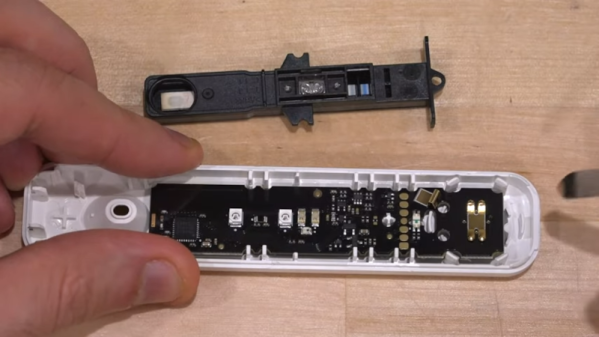
Electronic Covid Test Tear Down Shows Frustrating Example Of 1-Time-Use Waste

The latest video from [TheSignalPath] is a result of his purchase of a home COVID-19 test. He found an electronic version that connects to your cell phone and displays the results on the phone. The device is an antigen test and, internally, works like the home tests that show the results using lines similar to a pregnancy test. So, somehow, the phone version reads the lines and communicates with the phone. But how? That’s the point of the video, which you can see below.

In a traditional test, there’s a control line that has to appear to show that the test was done correctly. Then a line under that indicates detection of the virus. The circuit board inside the electronic test has a plastic unit onboard that contains a similar strip and has optical sensors for both the reference line and the detection line. Since it is essentially an optical device — there are some lenses in the strip assembly that look like they are detecting the dye as it moves through the strip with LEDs onboard to shed light on the situation.

Under the microscope, the CPU is a typical Bluetooth-capable ARM chip from Nordic. The board did power up, but the device is made to only operate once because of the test strip. The video notes — and we agree — it seems wasteful to create an entire Bluetooth-enabled microcontroller board with optical components just to read a strip one time that is pretty easy to read to start with. We’ll stick with the simple test strip. Still, it is interesting to see the insides.

If you want to read more about antigen tests, we covered that. We also talked about PCR testing.

Continue reading “Electronic Covid Test Tear Down Shows Frustrating Example Of 1-Time-Use Waste”