And For My Next Trick, I’ll Be Pulling Carbon Nanofibers Out Of Thin Air!

Scientists at the George Washington University have managed to figure out a process in which they can literally grow carbon nanofibers out of thin air, using solar power.

Not only that, they do it using carbon dioxide — you know, that gas that contributes heavily to climate change? Using two electrodes, they pump power into a mixture of molten salt; lithium carbonate and lithium oxide. Then, carbon dioxide from the air reacts with the lithium oxide, producing carbon nanofibers — with more lithium carbonate and oxygen as byproducts.

The carbon nanofibers can then be used for a wide range of products or further processes. But beyond getting a useful material out of it, getting rid of carbon dioxide, if done on a large scale, could be beneficial for climate change. Unfortunately, they haven’t figured out how to do that just yet…

Continue reading “And For My Next Trick, I’ll Be Pulling Carbon Nanofibers Out Of Thin Air!”
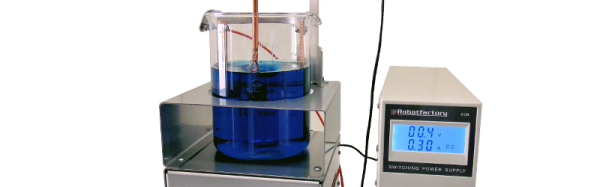
Metal 3D Printing With Your Printer

Over in Italy, [Robotfactory] has a new setup called CopperFace that they claim allows you to essentially electroplate 3D printed objects with a metal coating using copper, nickel, silver, or gold.

We’ve talked about electroplating on plastic before, but that technique required mixing graphite and acetone. The CopperFace kit uses a conductive graphite spray and claims it deposits about 1 micron of plating on the object every two minutes.

We couldn’t help but wonder if the graphite spray is just the normal stuff used for lubricant. While the CopperFace’s electroplating tech seems pretty standard (copper sulfate and copper/phosphorus electrodes), we also wondered if some of the simpler copper acetate process we’ve covered before might be workable.

Continue reading “Metal 3D Printing With Your Printer”

Growing Copper And Silver Crystals For Art

Usually when Hackaday covers electroplating techniques, it’s to talk about through-hole PCB plating. But did you know you can use the same method to produce beautiful copper and silver crystal structures?

[Fred and Connie Libby] are kind enough to share how they make their crystals that they sell in tiny glass vials you can wear around your neck. The process is simple as you would think; it’s just an electrolyte solution, with a current passing through it, depositing the metal in an ion-exchange. Rather then stop once the part is sufficiently covered, you let the process run amok, and soon large crystal formations begin to emerge. [Fred and Connie] share their technique very briefly, so if you’re looking for a more detailed how-to guide, you can find one here.

Although silver crystals are a bit out of our budget, we wonder how large of a copper crystal could be grown? Large enough to be displayed on a coffee table? Surely such a work of art and science could be an interesting conservation piece in any hacker’s home.

Simple, Cheap Nitrate Tester Is Open Source

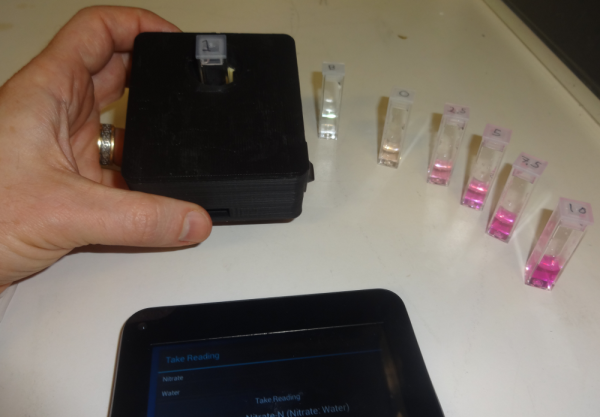
Too much of a good thing can be a bad thing, and nitrate pollution due to agricultural fertilizer runoff is a major problem for both lakes and coastal waters. Assessing nitrate levels commercially is an expensive process that uses proprietary instruments and toxic reagents such as cadmium. But [Joshua Pearce] has recently developed an open-source photometer for nitrate field measurement that uses an enzyme from spinach and costs a mere $65USD to build.

The device itself is incredibly simple – a 3D printed enclosure houses an LED light source and a light sensor. The sample to be tested is mixed with a commercially available reagent kit based on the enzyme nitrate reductase, resulting in a characteristic color change proportional to the amount of nitrate present. The instrument reads the amount of light absorbed by the sample, and communicates the results to an Android device over a Bluetooth link.

Open-source instruments like this can really open up educational opportunities for STEM groups to get out into the real world and start making measurements that can make a difference. Not only can this enable citizen scientists and activists, but it also opens the door for getting farmers involved in controlling nitrate pollution at its source – knowing when a field has been fertilized enough can save a farmer unnecessary expense and reduce nitrate runoff.

There are a lot of other ways to put an open-source instrument like this to use in biohacking – photometery is a very common measuring modality in the life sciences, after all. We’ve seen similar instruments before, like a DIY spectrophotometer, or this 2015 Hackaday Prize entry medical tricorder with a built-in spectrophotometer. Still, for simplicity of build and potential impact, it’s hard to beat this instrument.

Building A Battery From Molten Salt

During World War II a scientist named Georg Otto Erb developed the molten salt battery for use in military applications. The war ended before Erb’s batteries found any real use, but British Intelligence wrote a report about the technology and the United States adopted the technology for artillery fuses.

Molten salt batteries have two main advantages. First, you can store them for a long time (50 years or more) with no problems. Once the salt melts (usually from a pyrotechnic charge), the battery can produce a lot of energy for a relatively short period of time thanks to the high ionic conductivity of the electrolyte (about three times that of sulfuric acid).

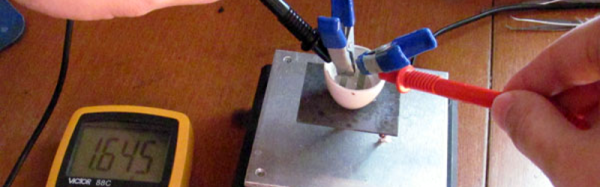
[OrbitalDesigns] couldn’t find a DIY version of a molten salt battery so he decided to make one himself. Although he didn’t get the amount of power you’d find in a commercial design, it did provide 1.6V and enough power to light an LED.

The electrolyte was a mixture of potassium chloride and lithium chloride and melts at about 350 to 400 degrees Celsius. He used nickel and magnesium for electrodes. Potassium chloride is used as a salt substitute, so it isn’t dangerous to handle (at least, no more dangerous than anything else heated to 400 degrees Celsius). The lithium compound, however, is slightly toxic (even though it was briefly sold as a salt substitute, also). If you try to replicate the battery, be sure you read the MSDS for all the materials.

Continue reading “Building A Battery From Molten Salt”

Dissolve Steel Drill Bits In Alum From The Grocery

Breaking a stud or a bolt is a pretty common shop catastrophe, but one for which a fair number of solutions exist. Drill it out, shoot in an extractor, or if you’re lucky, clamp on some Vise-Grips and hope for the best. But when a drill bit breaks off flush in a hole, there aren’t a lot of options, especially for a small bit. If the stars align, though, you may follow this video guide to dissolve the drill bit and save the part.

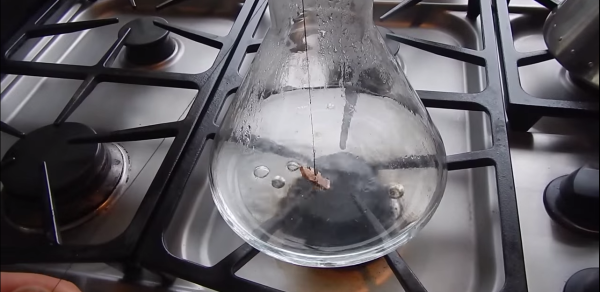
Looks like [Adam Prince] lucked out with his broken bit, which he was using to drill the hole for a pin in a small custom brass hinge. It turns out that a hot solution of alum (ammonium aluminum sulfate), which is available in the spice rack of your local supermarket, will dissolve the steel drill bit without reacting with the brass. Aluminum is said to be resistant to the alum as well, but if your busted bit is buried in steel, you’re out of luck with this shop tip.

We’re a bit disappointed that [Adam]’s video ends somewhat abruptly and before showing us the end result. But a little Googling around reveals that this chemical technique is fairly well-known among a group that would frequently break bits in brass – clockmakers. It remains to be seen how well it would work for larger drill bits, but the clocksmiths seem to have had success with their tiny drills and broaches.

As for the non-dissolved remains of the broken bit, why not try your hand at knife making?

One Way To Recharge Alkaline Batteries

It says it right on the side of every alkaline battery – do not attempt to recharge. By which of course the manufacturer means don’t try to force electrons back into the cell. But [Cody] figured he could work around that safety warning chemically, by replacing the guts of an alkaline dry cell.

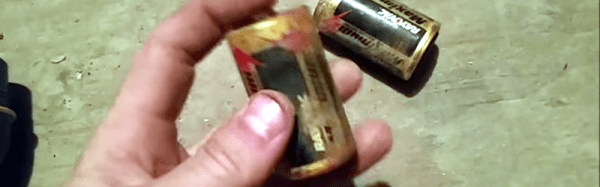
The batteries in question were certainly old, gnarly looking, and pretty dead – [Cody] barely got a reading on his multimeter. As you can see after the break, he cleaned off the exterior corrosion and did a quick teardown of the dry cells, removing the remains of the zinc anode, now in the form of zinc oxide paste looking very much like what you’d slather on your nose before a day at the beach. He filled the resulting cavity with a putty of zinc dust, freshened up the electrolyte charge with a squirt of 20% potassium hydroxide, sealed up the cell with a little silicone caulking, and put the recycled cell to the test. Result: 1.27 volts. Not too shabby.

Continue reading “One Way To Recharge Alkaline Batteries”