Cabbage Haters Can Turn Their Leftovers Into Litmus Paper

[William Finucane] is making his own litmus paper by harnessing the power of cabbage. The process is much easier than the faux gunpowder he made, as it take just the one ingredient and a few kitchen tools.

In case you’ve forgotten your High School chemistry, Litmus is a set of dyes that change color when exposed to basic or acidic materials. It is common in liquid form, or as a paper. [William] is getting his dye from the leaves of red cabbage by running half a head through a blender with just a bit of water. Once that is reduced to pulp and boiled in the microwave (mmm, must smell great!) he separates the liquid using a coffee filter. A fresh coffee filter serves as a donor for the substrate, just dip some strips in the cabbage juice and let them dry. You can test them with some Ammonia as seen in the video after the break, or just start grabbing whatever is under the sink and see what happens.

Continue reading “Cabbage Haters Can Turn Their Leftovers Into Litmus Paper”

Lego Mindstorms Used To Automate Tedious Laboratory Tasks

lego-bone-machines

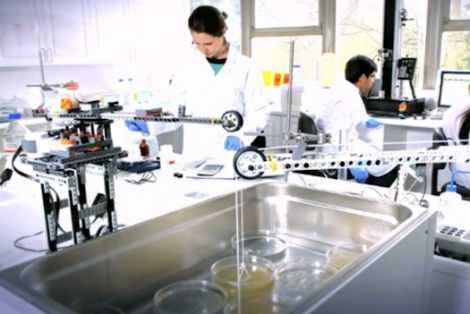
Modern society owes so much to medical research, though what happens behind the scenes in a laboratory is usually far less than glamorous. A group of scientists at the University of Cambridge are working to develop synthetic bone tissue, but the process to create the samples used in the study is incredibly tedious.

To make the bones, a substructure must be dipped in a mixture of calcium and protein, rinsed, then dipped in a mixture of phosphate and protein…hundreds and hundreds of times. Equipment that can automate the process is available but very cost prohibitive, so the scientists did what they do best and built a set of robots to do the work for them.

Their new bone manufacturing setup was constructed using Lego Mindstorm kits, which were a perfect solution to their problem in several ways. The kits are relatively cheap, easy to construct, easy to program, and able to perform the same function precisely for days on end.

Now instead of burning time manually creating synthetic bone samples, the group can focus on the more important facets of their research.

Continue reading to see a video presented at the 2012 Google Science Fair, showing how everything came together for the crew at Cambridge.

[via Make]

Continue reading “Lego Mindstorms Used To Automate Tedious Laboratory Tasks”

Neosporin…the Retrobright For Bench Equipment?

polishing-knobs

[linux-works] picked up an old power supply from eBay, and as it was built back in the 60’s or 70’s, it was in need of a little TLC. One thing that immediately caught his eye was the condition of the knobs, dials, and banana plug receptacles – they were dull and faded, showing off 40+ years of heavy usage.

He started off by simply removing the knobs from the power supply, giving them a thorough cleaning with soapy water before leaving them to air dry. They didn’t look any better afterward, so he decided to take a different approach and apply some triple antibiotic ointment to the knobs. As it turns out, letting the ointment sit for a few minutes then wiping the knobs with a soft cloth really made them shine, as you can see in the image above. [linux-works] attributes the effect to the white petrolatum base of the product rather than the antibiotics, likely making a wide array of products equally suitable for the job.

We know how well Retr0bright has worked for the vintage computer folks, so we’ll be interested to see how long the effects of the triple antibiotic treatment last. It certainly can’t hurt those readers who spend their time perusing flea markets in search of classic electronic equipment.

Shocking Use Of Ice Cube Trays

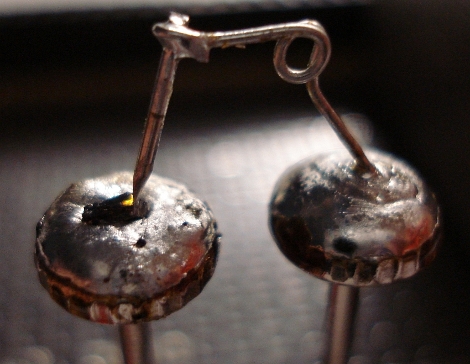
Looks like ice-cube trays are once again proving their versatility as this one is serving as the vessel for a home made lead-acid battery. With a collection of uniformly sized non-conductive containers, it makes the perfect base for a set of small cells. This project is the culmination of a Hackerspace class about batteries, and was put together to turn theoretical knowledge into a hands-on lab.

This is a captured image from the low-quality video found after the break. [Carpespasm] describes the setup; the black pieces are lead plates which are bent into a U-shape to straddle two ice-cube compartments. The each end of the plate is dipping into the acid to make the connection. Once assembled the battery was connected to a charger for about two hours. It puts out 8.5V and is tested by powering an LED cube. This works for just a short period and really drives home the lesson that battery concepts are easy to understand, but reliable battery technology is a bit harder to achieve.

Continue reading “Shocking Use Of Ice Cube Trays”

Print Your Own Supercaps

[Gil] recently wrote in to tell us about some awesome research going on at UCLA. Apparently by layering some oxidized graphite onto a DVD and tossing it into a lightscribe burner, it’s possible to print your own super capacitors; some pretty high capacity ones at that.

For those that are unaware, supercapcaitors are typically made using two electrolyte soaked, activated carbon plates separated by an ion permeable film. Since activated carbon has an incredible surface area huge energy densities can be reached, in some cases 1kJ/lb.

Laser-formed graphite sponge replaces the activated carbon in the researchers’ printed capacitors. A video after the break discusses  the whole process in moderate detail, meanwhile greater detail can be found in their two papers on the subject.

First one to print a transistor gets a bag of mosfets!

Continue reading “Print Your Own Supercaps”

Chocolate As Rocket Fuel

[Adric Menning] has an unfortunate allergy. He’s allergic to chocolate. Instead of eating the stuff, he’s using it to build model rocket engines. The project stems from the Quelab Hackerspace’s chocolate hacking challenge which spawned a number of interesting hacks. [Adric’s] doesn’t use pure chocolate (an experiment with a Hershey’s bar was a bust) but manages to ignite using a Milky Way bar.

This is not as unorthodox as you might think. Sugar and potassium nitrate have long been used to create solid rocket propellant. The chocolate version is swapping out plain old sugar for the candy bar. It was chopped into 10 gram chunks to make proportion calculations easier later on. The chunks go into the freezer to make them easier to grind using a mortar and pestle. Once it’s a somewhat chunk-free powder he mixes it with the potassium nitrate which previously had its own trip through the grinder. After being packed into a chunk of PVC pipe and fitted with an exhaust nozzle the engine is ready to go.

You can check out the test-fire video after the break. There’s a burn restriction in his area due to drought so this is just an engine test and not an actual rocket launch.

Continue reading “Chocolate As Rocket Fuel”

Brewing Up Gunpowder With Household Products

When the zombiepocalypse comes you’re not going to want to run out to the store for more ammo. But you can always reload great grandpa’s musket with some homemade gunpowder. All kidding aside, the invention and proliferation of gunpowder had a profound effect on the world. Here you can see just how easy it is to make with chemicals that are common in our modern world.

The two compounds that go into this experiment are ammonium nitrate and potassium chloride. Where can you get your hands on these materials? Instant cold packs use ammonium nitrate and water to start an endothermic reaction. The potassium chloride can be found in the grocery store as a table salt alternative.

The chemicals need to be measured by weight. [William Finucane] didn’t have a digital scale on hand so he made a balance using a wooden ruler, two plastic component drawers, and a Bic lighter as a fulcrum. With approximately equal parts of the two materials he sets about dissolving in water, filtering, and heating of the concoction to produce saltpeter. Combine this with powdered sugar and you’ve got gun powder. Don’t believe that it works? You can see the fiery goodness in the clip after the break.

Flammable and explosive materials are dangerous to work with, so you probably shouldn’t do this yourself. But then again, it can’t be as dangerous as working with thermite. Continue reading “Brewing Up Gunpowder With Household Products”