Alvaro Prieto’s Laser-Shooting Robots

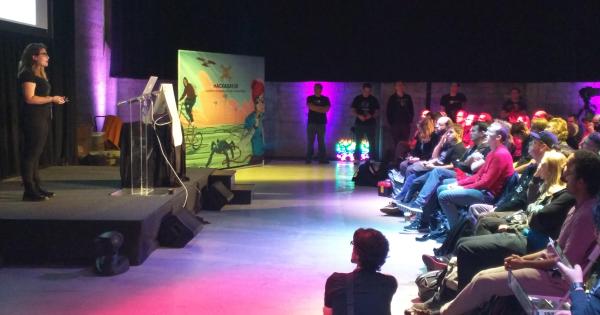
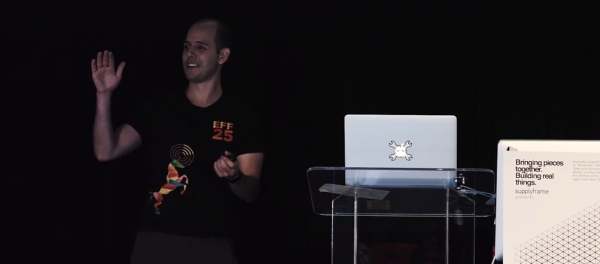
[Alvaro Prieto]’s talk at the Hackaday Supercon began with a slide that asks the rhetorical question “Why Laser-Shooting Robots?” Does a rhetorical question need an answer? [Alvaro] gives one anyway: “Because lasers are awesome.” We concur.

But it doesn’t hurt that DEFCON holds a laser robot contest to give you an excuse, either. You see, [Alvaro]’s laser-wielding robot was the First Place finisher in the 2014 DEFCONBOTS contest, and a much more ambitious design came in third in 2015. His Supercon talk is all about the lessons he’s learned along the way, because that’s really the point of these contests anyway, right?

“I have no idea what I’m doing.”

[Alvaro] started off with a disclaimer, but when [Alvaro] says he doesn’t know what he’s doing, what he means is that he hasn’t received formal training in building laser-wielding, autonomous turret robots. (How did we miss that class in school?)
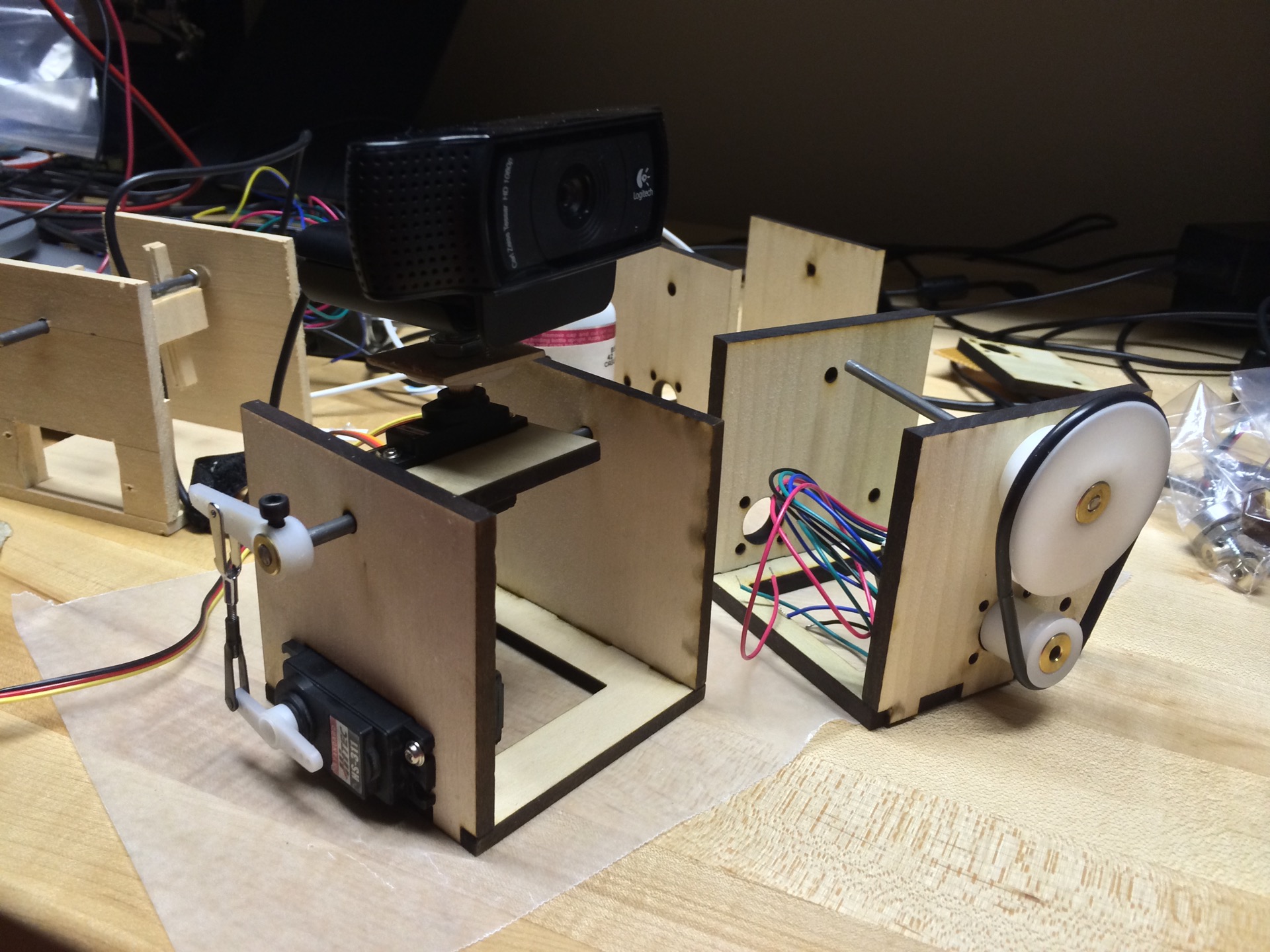
iterations

He’s a true hacker, though; he didn’t know what he was doing when he started out but he started out anyway. [Alvaro]’s takes us from the first prototypes where he used servo motors with inadequate angular resolution mounted to balsa wood frames that he (obviously) cut with a knife by hand, through laser-cut frames with custom gearing and stepper motors, all the way to his DEFCONBOTS 2015 entry, based on OpenBeam aluminum extrusions and using professional laser-show galvos capable of swinging the beam around to thousands of points per second.
Continue reading “Alvaro Prieto’s Laser-Shooting Robots”

Kay Igwe Explains Brain Gaming Through SSVEP


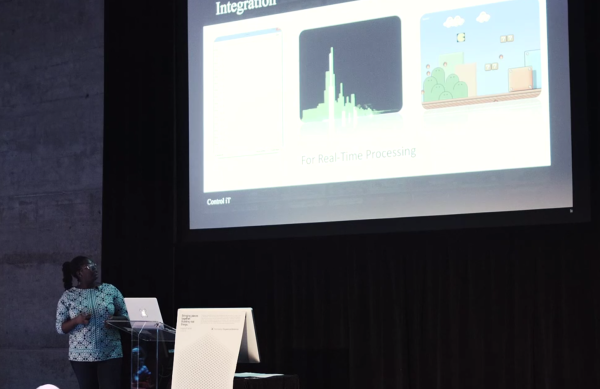
We had some incredible speakers at the Hackaday SuperConference. One of the final talks was given by [Kay Igwe], a graduate electrical engineering student at Columbia University. [Kay] has worked in nanotechnology as well as semiconductor manufacturing for Intel. These days, she’s spending her time playing games – but not with her hands.

Many of us love gaming, and probably spend way too much time on our computers, consoles, or phones playing games. But what about people who don’t have the use of their hands, such as ALS patients? Bringing gaming to the disabled is what prompted  [Kay] to work on Control iT, a brain interface for controlling games. Brain-computer interfaces invoke images of Electroencephalography (EEG) machines. Usually that means tons of electrodes, gel in your hair, and data which is buried in the noise.

[Kay Igwe] is exploring a very interesting phenomenon that uses flashing lights to elicit very specific, and easy to detect brain waves. This type of interface is very promising and is the topic of the talk she gave at this year’s Hackaday SuperConference. Check out the video of her presentation, then join us after the break as we dive into the details of her work.

Continue reading “Kay Igwe Explains Brain Gaming Through SSVEP”

OpenBionics Fabs Prosthetics As Unique As Those Who Wear Them

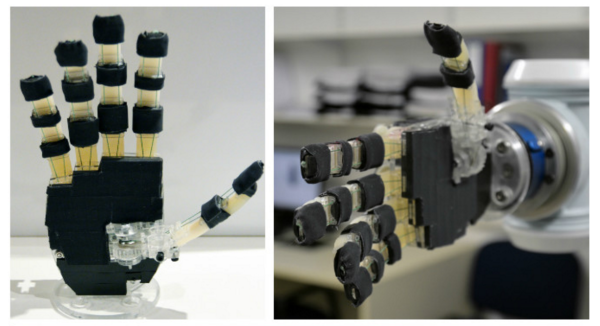
Humans may all have the same overall form, but when we need to find a suitable replacement for a missing limb, it’s clear that between the variety of finger-lengths and hand-breadths, a one-size-fits-all prosthetic just wont cut it. OpenBionics puts a spin on today’s approach to prosthetics, putting forth a framework of tools that’s flexible enough to fit the spectrum of hand shapes and enables us to create our own prosthetic at home that can meet the challenge of most everyday tasks.

Minas Liarokapis of the OpenBionics team gave a talk at this year’s Hackaday SuperConference which covered the design considerations and unique features of the project. This incredible work was recognized with 2nd Prize in the 2015 Hackaday Prize. Watch Minas’ talk below, then join us after the break as we cover more details that went into developing this prosthesis.

Continue reading “OpenBionics Fabs Prosthetics As Unique As Those Who Wear Them”

A Fireside Chat With Grant Imahara

Grant Imahara was on hand at the Hackaday SuperConference for a fireside chat led by Sophi Kravitz and Chris Gammell. You know Grant from his work on the television show MythBusters. He holds a Bachelor’s degree in Electrical Engineering, is known for his work on robots and special effects, he’s the engineer behind the Energizer Bunny, and has even competed on BattleBots. Over the past year he joined with Mouser Electronics to promote engineering through their Empowering Innovation Together campaign. Mouser was one of the sponsors of the 2015 Hackaday Prize and they were happy to work with Grant to make this appearance possible.

Continue reading “A Fireside Chat With Grant Imahara”

Uses For Quantum Entanglement With Shanni Prutchi

For those of you that weren’t at the Hackaday SuperConference, it started off with a pretty intense talk that could have been tough for anyone to follow. However, [Shanni Prutchi] presented her talk on quantum entanglement of photons in a way that is both approachable, and leaves you with plenty of hints for further study. Check it out in the video below, and join us after the break for a rundown of what she covered in her presentation.

Continue reading “Uses For Quantum Entanglement With Shanni Prutchi”

Building The Infinite Matrix Of Tamagotchis

Tamagotchi is a digital pet, living in and cared for through a key-chain size piece of hardware. The mid-90’s toy lives in pop culture, but now it lives well beyond. A limitless network of Tamagachi has been created using some amazing tricks to feed, socialize, and monitor the beast now known as the Tamagachi Singularity.

Last weekend at the Hackaday SuperConference we were graced with a talk by [Jeroen Domburg], a.k.a. [Sprite_tm]. [Sprite] is a favorite of ours and over the years his hacker cred includes everything from reverse engineering hard drive controller chips to putting video games in his keyboard.

[Sprite] is also something of an Architect, and like all Architects he only wants what is best for the system he created. In this case, it’s a Matrix of Tamagotchis. [Sprite] created a hive of Tamagotchis that are able to interact with each other in their own separate world. The best part about this Matrix? There’s no allusions to violating the laws of thermodynamics in the exposition.

xkcd.com/1546
xkcd.com/1546

Like all good hacks, a Tamagotchi Matrix wasn’t created in a vacuum. A few years ago at 29C3, [Natalie Silvanovich] dumped the ROM in the current generation of Tamagotchis. This is an incredible feat of reverse engineering, that allows anyone to use the full capabilities of the 6502-based microcontroller that controls these digital pets

After [Sprite] figured out how to read and run the code in the Tamagotchi, the next obvious step towards a world of egg-shaped pods containing an entire population of Tamagotchis is virtual Tamagotchis. [Sprite] used a hard-coded state machine that takes care of pooping, flushing, training, feeding, and turning the lights off at bedtime.

With a single Tamagotchi described as a state machine, it’s a simple matter to build another. This is where things get interesting and Matrix-ey. Tamagotchis don’t live alone; they have an IR LED and receiver that allows them to interact with each other, eat, play, marry, and have kids. Emulating a single Tamagotchi is one thing, but controlling multiples is another thing entirely; some sort of protocol was needed to breed Tamagotchis and keep them happy and well-fed.

Continue reading “Building The Infinite Matrix Of Tamagotchis”

The Best Conference Badge Hacking You’ve Ever Seen

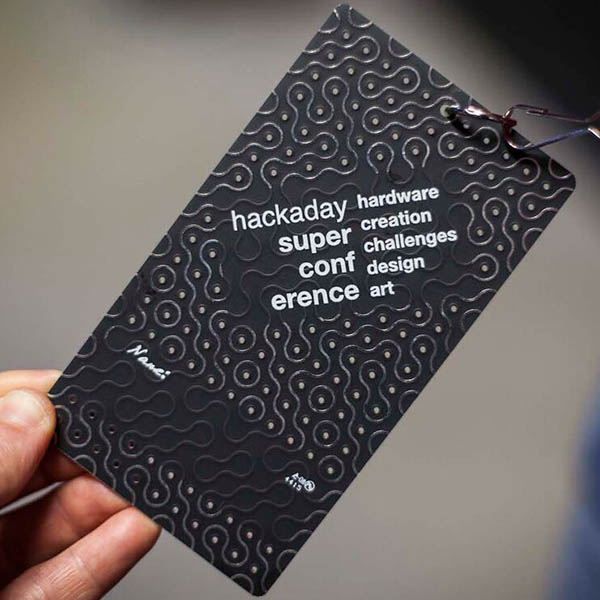
72EJpM5noCVCOQOeMV74_fmZeSQKcPxiqv70JYc9psgAs with any proper hardware con, the Hackaday Supercon needed a badge, and preferably one that was electronic. This conference centered around hardware creation, and the badge was no exception.

Designed on a tight timeline, it was possible to deliver a PCB badge for the attendees but it didn’t include microcontrollers, FPGAs, or software defined radios. This blank slate was the foundation for a completely unconstrained freestyle electronics soldering session.

The front of the badge includes a matte black solder mask with Truchet tiles of traces. Put multiple badges edge-to-edge and the pattern continues indefinitely. Inside of each curved trace is a through-hole via and those makes up a grid of holes on the back of the badge. On that back side there are also two rectangular grids that presented a nice area to which hackers soldered their components.

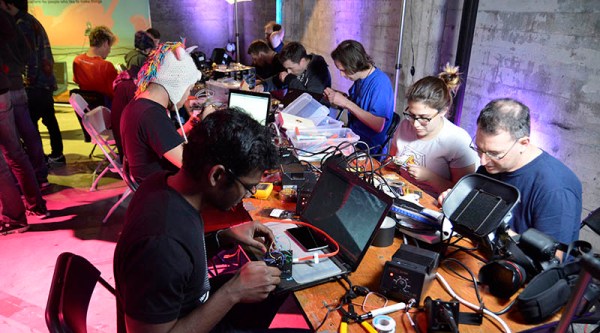
More than a few people took up the challenge of hacking their badge, and despite a strange pitch for the through holes (0.230″), and traces that didn’t go anywhere, there were some amazing builds. I would go so far to say that the badge hacking at the Supercon was the best I’ve ever seen, and this includes DEFCON and CCC.

Continue reading “The Best Conference Badge Hacking You’ve Ever Seen”