Sous Vide With Racing Stripes

We’re not going to question the logic that went into putting racing stripes on a slow cooker, but [Evan]’s sous vide machine is the most professional one we’ve seen.

After [Evan] found a cooking book that went into the physics and chemistry of making a meal, he wanted to make some really good meals. Sous vide spoke out to him and [Evan] committed himself to building an immersion cooker.

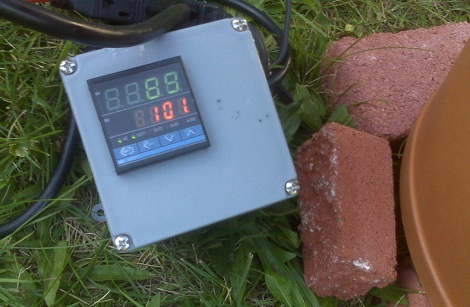
After trolling around on the Internet, [Evan] came across a little gem on Make. The Make build was cheap – it was built around an off-the-shelf PID controller and thermocouples. [Evan] though about building his own PID controller, but time is money and he couldn’t beat the commercial version in features.

The enclosure was the most time-consuming part of [Evan]’s build. It’s a 1/8″ sheet of aluminum cut and bent to the correct size. The sharp edges were filed down and joined with epoxy; definitely not the ‘normal’ way of building an enclosure. The color scheme is borrowed from this Renault – French cooking inspired by a French car.

As for [Evan]’s results, he cooked a 5oz filet marinated in garlic, thyme, olive oil, salt and pepper. This dish was flanked with some roasted Yukon Gold potatoes and sautéed broccoli. Our mouth is watering just looking at the picture, so we’re betting [Evan] did an excellent job.

Hacking A VS200 Food Sealer

This food sealer just wasn’t cutting it for [Tinkering Engineer], so he decided to do something about it. The issue with this sealer was that it didn’t have a mode where it could simply seal bags without pulling a vacuum on it. Going through the whole process takes a reported 40 seconds in order to evacuate the air and then seal the bag. Without pulling a vacuum, the sealing process took only 9.

After taking everything apart and looking around, a PIC microcontroller, and vacuum switch were found as well as other assorted electronics. Although the first thought was to replace the onboard PIC with an Arduino, a much simpler solution was arrived at. Two switches were added, one to disable the vacuum pump and the other to manually turn on the heater. This would allow the machine to function as originally intended or simply let bags be sealed without the vacuum function.

This hack may not be the most advanced one that we’ve ever seen, but it’s a good reminder that some projects can be done very simply if you’re willing to look around!

Kitchen Hacks: What Would You Cook If You Had A Sous-Vide This Large?

We’ve seen no shortage of temperature controlled immersion cooking devices, called Sous-Vide, around here. But this one probably has the capacity of all of them combined! Flickr user [RogueGormet] isn’t writing about the build, but his Large Form Water Oven build photo set speaks for itself.

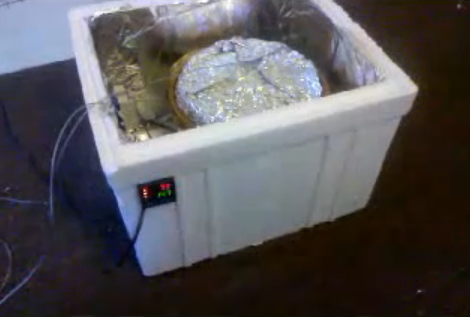
We’d wager that the donor vessel is a 16-gallon chest cooler. He cut the lid into two sections, sealing off the insulated cavity with High Density Polyethylene (the stuff those white cutting boards are made out of). This gives him a place to mount the heating element, with a box for the PID controller riding on top. A submersible pump keeps the liquid moving to help regulate the cooking temperature throughout.

What do you put in one of these? Right off the top of our heads we’d think he had something like a pig roast planned. But it could just as easily be a Turkey, or other large hunk of meat. What would you use it for?

If you don’t need quite as much capacity you might make some alterations to your slow cooker for your own immersion cooking.

[George Foreman] Seedling Starter For Kitchen Herbs

Sometimes the best kitchen hacks aren’t about the best barbecue, the rarest steak, or the baconiest bacon. Sometimes you need a little color on your plate, son, so why not grow your own herbs in a [George Foreman] rotisserie greenhouse?

[Sam] first saw his barely used rotisserie as his friend was throwing it out. Like any good maker, he quickly snatched it up and began work on some modifications. After removing the fun bits like the motor, heating element, and timer, [Sam] installed two compact fluorescent light bulbs to start a few herbs off right.

Kitchen herb gardens are surprising common, so much so that entire forums are dedicated to the practice. [Sam] doesn’t have any soil in his seedling starter yet but when he does, we expect he’ll be harvesting a nice crop of basil, oregano or cilantro in the spring.

Of course, [Sam] could use his seed starter to grow more “unconventional” plants, but some of us have been kicked out of a dorm for growing a pomegranate seedling, so we’ll leave it at that.

Candied LEDs Are A Light, Tasty Treat

rock_candy_diffused_leds

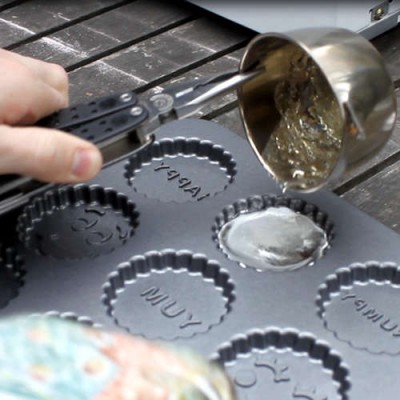
[Emily Daniels] recently snagged a free iPad in the Instructables “Play with your food challenge” with an interesting way to work with LEDs. Growing up, most kids attempted to make, or at least have seen rock candy be produced. [Emily] thought it would be interesting to mix LEDs with the stuff to see what she could come up with, and her candied LEDs are the result.

The process is pretty straightforward, and involves mixing up a batch of supersaturated sugar syrup in which LEDs are suspended. The LEDs act as a nucleation point for the crystal formation, growing a nice solid coating of sugar after a couple weeks’ time. After some cleaning up, the LEDs can be connected to a coin cell battery or similar, as you would normally do. The sugar acts as a diffusing medium for the LEDs, giving them a nice soft beam pattern.

Obviously you likely wouldn’t want to use these for any long-term electronics project, but it’s a fun activity for the kids, and it could be a good way to incorporate electronics into baked goods.

Improving A Cheap Espresso Machine

For those of us that would like a good cup of coffee but don’t want to put up with the ‘burnt butt’ taste of Starbucks and don’t have a decent coffee shop nearby, we’ve had very few options. Most of us have been made to suffer with an el-cheapo espresso machine. [Joe] sent in a great build that improves these el-cheapo models and brings them up to the quality we would expect from their more expensive brethren.

For the best pull from an espresso machine, the great [Alton Brown] says 200° F water must be forced through the grind at around 10 PSI atm. [Joe]’s espresso machine can’t build up pressure because the heating element is only active when the lever is in the ‘brew’ or ‘froth’ position. To build up pressure in the water reservoir, [Joe] simply added a pressure gauge to the frothing attachment. When the gauge reads the necessary 10 atmospheres, just move the lever over to the ‘brew’ position and enjoy a nice cup of espresso.

[Joe] has already tested the pressure relief valve of his espresso machine. With the gauge in the way, [Joe] can’t make use of his frother, but a secondary valve could easily remedy that. [Joe] hasn’t published his espresso hack anywhere, but he did email us some pics of his build. We’ve embedded them as a slideshow after the break. Check out the pressure gauge on the frothing attachment and the pressure relief valve below.

Continue reading “Improving A Cheap Espresso Machine”

Hacking A Better Pressure Cooker

This pressure cooker hack on [Dave Arnold]’s great cooking blog was sent into us (thanks, [techartisan]!). Most pressure cooker recipes are written for pressure cookers that can go up to 15 PSI or 250° F / 121° C. At these temperatures, a lot of interesting chemistry happens in the food. The popular Cuisinart electric pressure cooker doesn’t reach these pressures and temperatures, so [Dave Arnold] set out to make his Cuisinart better.

After measuring the temperature with a thermocouple, [Dave] deduced that the Cuisinart cooker only reached 237° F and 9 PSI. After having a look at the electronics, he realized that adding a resistor to the temperature sensor circuit would give him the pressure he wanted. After soldering in a trim pot, everything went swimmingly and the cooker was able to reach 15 PSI.

[Dave] isn’t sure how his modifications will hold up – he doesn’t know how the cooker will hold up to overheating (and there are a few concerns about non-stick pressure cookers in the first place). That being said, it’s a great mod to get some more capabilities out of a Cuisinart.