Wiring Was Arduino Before Arduino

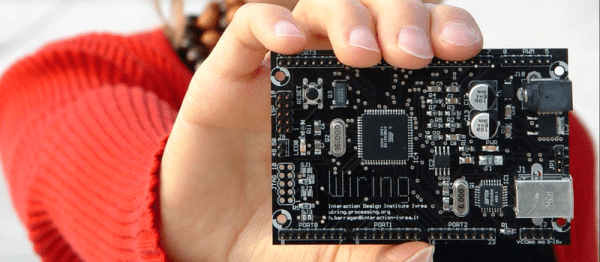
Hernando Barragán is the grandfather of Arduino of whom you’ve never heard. And after years now of being basically silent on the issue of attribution, he’s decided to get some of his grudges off his chest and clear the air around Wiring and Arduino. It’s a long read, and at times a little bitter, but if you’ve been following the development of the Arduino vs Arduino debacle, it’s an important piece in the puzzle.

Wiring, in case you don’t know, is where digitalWrite() and company come from. Maybe even more importantly, Wiring basically incubated the idea of building a microcontroller-based hardware controller platform that was simple enough to program that it could be used by artists. Indeed, it was intended to be the physical counterpart to Processing, a visual programming language for art. We’ve always wondered about the relationship between Wiring and Arduino, and it’s good to hear the Wiring side of the story. (We actually interviewed Barragán earlier this year, and he asked that we hold off until he published his side of things on the web.)

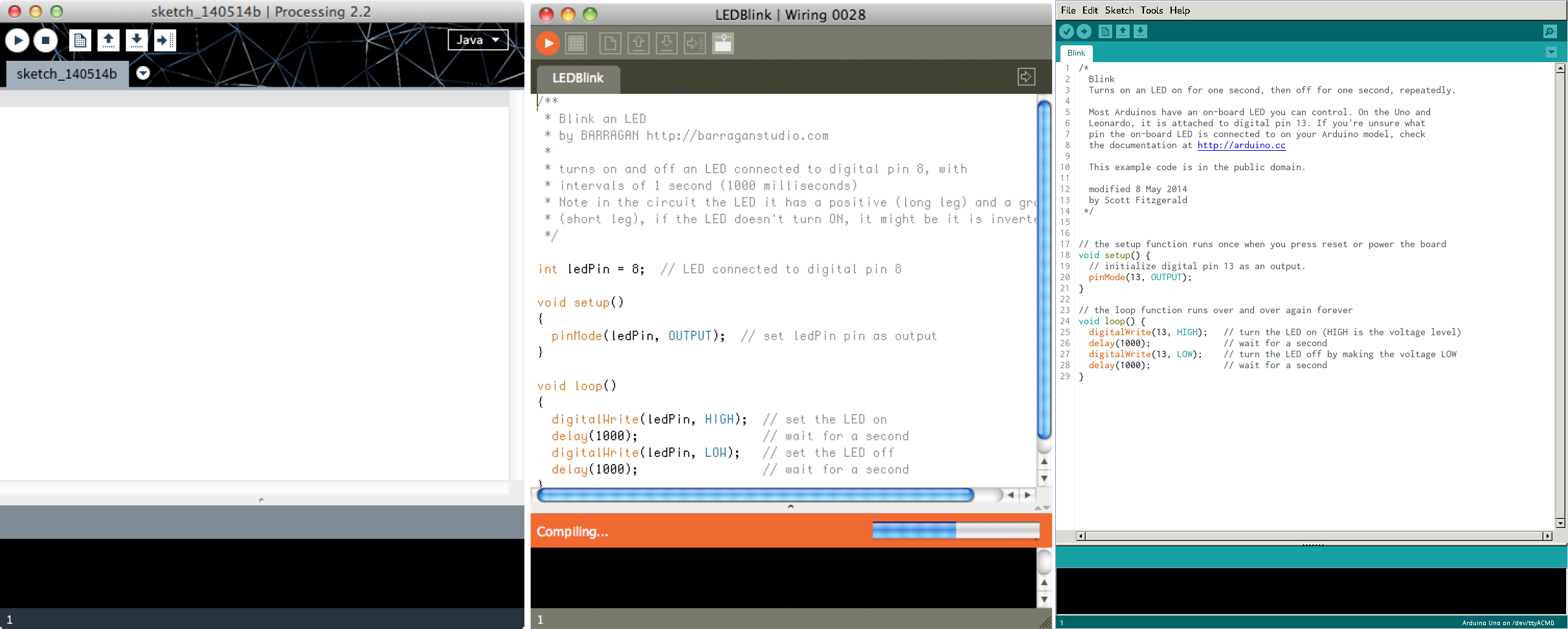
The short version is that Arduino was basically a fork of the Wiring software, re-branded and running on a physical platform that borrowed a lot from the Wiring boards. Whether or not this is legal or even moral is not an issue — Wiring was developed fully open-source, both software and hardware, so it was Massimo Banzi’s to copy as much as anyone else’s. But given that Arduino started off as essentially a re-branded Wiring (with code ported to a trivially different microcontroller), you’d be forgiven for thinking that somewhat more acknowledgement than “derives from Wiring” was appropriate.
screenshots_comparo
See what we mean?

The story of Arduino, from Barragán’s perspective, is actually a classic tragedy: student comes up with a really big idea, and one of his professors takes credit for it and runs with it.
Continue reading “Wiring Was Arduino Before Arduino” →

World’s Smallest Cordless Power Tools, 3D Printed Of Course

What is this?  A circular saw for ants?!

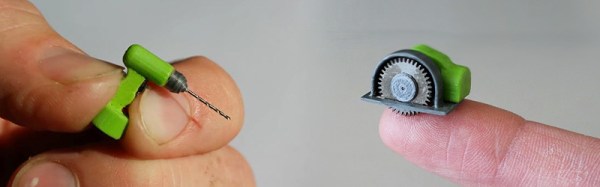
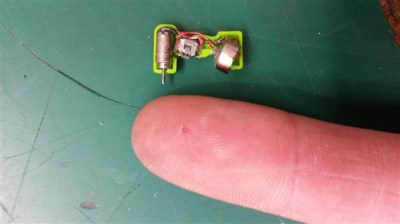
There isn’t much information we could find on this one (sorry, no source files that we know of), but this little hack is so playful and fun, we just had to share it with you. [Lance Abernethy] has built both a working cordless drill, and circular saw using nothing more than a 3D printer, what seems to be a pager-type vibration motor, a tactile switch and a coin cell battery – you can see them both working in the video after the break.

drillinside

[Lance] used an Ultimaker 2, running a 0.25mm nozzle, and printing at a 0.04mm layer height in PLA. As you would expect, the 0.25mm nozzle is needed for such small parts – it’s also close to the limit of what extruder can still squeeze plastic through. it greatly increases the chance of blocked or clogged nozzles.

[Lance] admits that the saw can’t quite cut anything just yet, but he does say that he has plans to make more miniature cordless tools.  We can’t wait to see how he might manage the mechanism for a jig-saw.

[VIA adafruitdaily.com newsletter]

Continue reading “World’s Smallest Cordless Power Tools, 3D Printed Of Course” →

Materials To Know: Acetal And Delrin

Delrin, Acetal, and its many trade names is a material properly known as Polyoxymethylene or POM. It is one of the strongest plastics and is a good go-to material when you want the best properties of plastic, and don’t need the full strength of a metal part. It was originally formulated to compete with Zinc and Aluminum castings after all.

I won’t go too deep into the numbers behind POM. If you need the Young’s Modulus, you probably don’t need this guide. This is intended to be more of a guide to its general properties. When you’re looking for something to fit an application it is usually easier to shift through the surface properties to select a few candidates, and then break the calculator out later to make sure it will work if you’re uncertain about the factor of safety.

The most popular property of POM is its ease of machining. While doing this research every single site I came across referred to it as the most machinable plastic. That’s about as objective as subjective praise can get. It doesn’t tend to grab tools like, for example, HDPE. It also chips nicely unlike UHMW and Nylon. Some plastics, like UHMW, have the unfortunate tendency to render the dials on a mill or lathe meaningless as the plastic deflects away from the tool. POM does not do this as much. Of course these other plastics have their strengths as well, but if any plastic will do, and you’re machining, POM is a very good choice.

Continue reading “Materials To Know: Acetal And Delrin” →

Swarm Of Tiny Pirate Transmitters Gets The Message Out In Syria

They say that the first casualty of war is the truth, and that’s probably only more the case in a civil war. When one side in a conflict controls the message, the other side is at a huge disadvantage. Technology can level the playing field, and in the case of the Syrian Civil War, a swarm of tiny Raspberry Pi transmitters is helping one side get their message out.

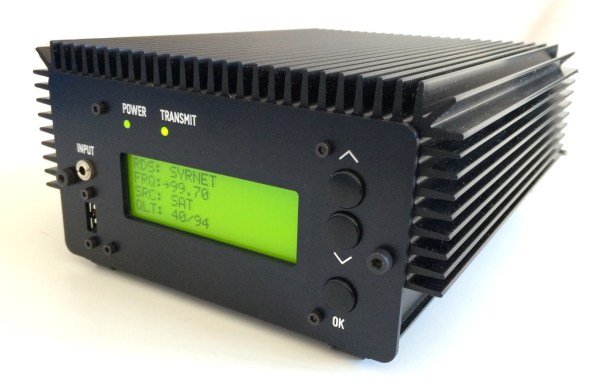
We won’t pretend to understand the complexities of this war, but it’s clear that the Syrian government controls broadcast media and access to the internet, and is using them for propaganda while denying the opposition access to the same. A decentralized medium can get the message out under these conditions, and that’s exactly what Pocket FM does. Built around a Raspberry Pi and a frequency-agile FM transmitter, a Pocket FM can take multiple audio feeds and transmit them out to a 5km radius. Small enough to be packed up and deployed quickly and able to be powered by batteries or solar panels, the pirate transmitters can be here one minute and gone the next, yielding a robust network resistant to takedown attempts.

The network built around Pocket FM in Syria is small but growing, and it appears to be making a difference in the conflict. We find the concept of a decentralized network intriguing and potentially empowering, at least in situations where the letter of the law regarding broadcasting is not a prime consideration. That’s where projects like Airchat seek to build an unsanctioned network. The same goes for Tweeting on the Amateur Radio Band in a project aptly named HamRadioTweets.

We wonder how a fleet of these Pi-based transmitters could aid in recovery from natural disasters?

[via r/amateurradio and TomHiggins]

Broken Promises Of The Wankel Engine

Through the history of internal combustion engines, there has been plenty of evolution, but few revolutions. Talk of radically different designs always leads to a single name – Wankel. The Wankel rotary engine, most notably used in automobiles by Mazda, has been around since the late 1950’s. The Wankel rotary is an example of a design which makes sense on paper. However, practical problems cause it to underperform in the real world.

Invention and History

felixwankelFelix Wankel’s engine was conceived during a dream. In it, 17-year-old Felix was driving his car to a concert. When he arrived, he bragged to his friends that his car used a new type of engine – half turbine, half reciprocating. “It is my invention!” he told his friends. Upon waking up, Wankel became dedicated to building his engine. Though he never received a formal degree (or a driver’s license), Wankel was a gifted engineer.
Young Wankel’s checkered history includes membership in several anti-semitic groups in the 1920’s. He was also involved with the founding of the Nazi party. His conflicting views on the direction of the party lead to his arrest in 1933. Eventually released through action of Hitler himself, Wankel joined the SS in 1940. The end of the war saw Wankel spending several months in a French prison for his wartime involvement.

Continue reading “Broken Promises Of The Wankel Engine” →

Overclocking The Raspberry Pi 3 For Tasty Speed Increases

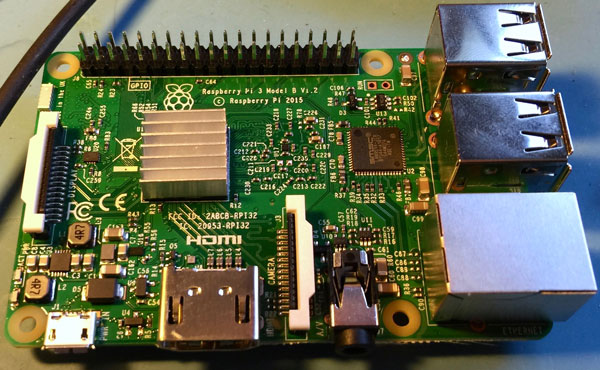
Some people are never happy. [Jackenhack] got hold of a couple of shiny new Raspberry Pi 3s, and the first thing he did is to start overclocking them. Fortunately, he knows what he is doing, so none of the magic smoke escaped, but it seems not all Pis are happy with the process.

For one of the three seemingly identical Pi 3, adding heat sinks let him push the CPU from the native 1.2GHz up to 1.45GHz. That did involve a bit of overvolting (increasing the voltage to the CPU), but that can be easily done in software. He also experimented with adding heat sinks to the memory, then bumping up the speed of the memory to increase throughput. Again, he was able to make some impressive gains, bumping the speed up from the native 400 Mhz to 500 Mhz. Both of those are stable overclocks: he was able to run the system at 100% CPU load for an extended time, and has incorporated the overclocked Pi into his system that contributes to the NTP pool project.

However, when he tried the same overclock with the second of the Pi 3 victims test subjects, it failed due to the CPU overheating. So, it seems that there is a lot of variation in the individual bits of silicon on the Pi 3. Perhaps some liquid nitrogen would help? It did for an Arduino…

Google Is Building A 100kW Radio Transmitter At A Spaceport And No One Knows Why

You can find the funniest things in public government documents. There’s always ample evidence your local congress critter is working against the interests of their constituency, nation, and industry controlled by the commission they’re chairperson of. Rarely, though, do you find something surprising, and rarer still does it portend some sort of experiments conducted by Google at a spaceport in New Mexico.

In a publication released last week, Google asked the FCC to treat some information relating to radio experiments as confidential. These experiments involve highly directional and therefore high power transmissions at 2.5 GHz, 5.8GHz, 24GHz, 71-76GHz, and 81-86GHz. These experiments will take place at Spaceport America, a 12,000 foot runway in the middle of New Mexico occasionally used by SpaceX, Virgin Galactic, and now Google.

For the most part, this document only tells the FCC that Google won’t be causing harmful interference in their radio experiments. There few other details, save for what bands and transmitters Google will be using and an experimental radio license call sign (WI9XZE) that doesn’t show up in the FCC database.

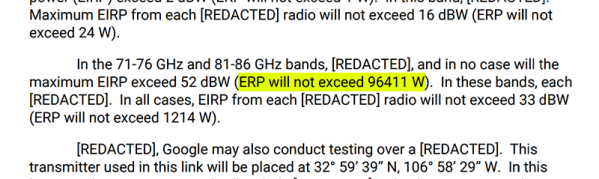
Of the few details listed in the documents, one thing does pop out as exceptionally odd: a 70-80 GHz transmitter with an effective radiated power (ERP) 96,411 W. That’s close enough to 100 kilowatts to call it as such. This is the maximum effective radiated power of the highest power FM stations in the US, but radio stations are omnidirectional, whereas Google is using very high gain antennas with a beam width of less than half a degree. The actual power output of this transmitter is a mere half watt.

The best guess for what Google is doing out in the New Mexico desert is Project Skybender, a project to use millimeter waves to bring faster Internet to everyone. There aren’t many details, but there is a lot of speculation ranging from application in low Earth orbit to something with Google Loon.