Anti-Tetris Project Is A Study In Hand Tracking

anti-tetris

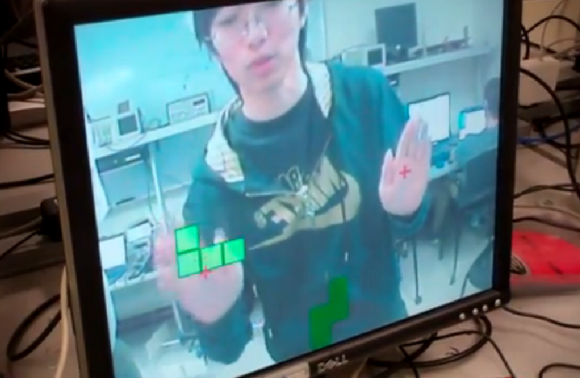
The game of Anti-Tetris is played by standing in front of a monitor and watch falling Tetris pieces overlaid on a video image of your body. Each hand is used to make pieces disappear so that they don’t stack up to the top of the screen. We don’t see this as the next big indie game. What we do see are some very interesting techniques for hand tracking.

An FPGA drives the game, using a camera as input. To track your hands the Cornell students figured out that YUV images show a specific range of skin tones which can be coded as a filter to direct cursor placement. But they needed a bit of a hack to get at those values. They patched into the camera circuit before the YUV is converted to RGB for the NTSC output.

Registering hand movement perpendicular to the screen is also a challenge that they faced. Because the hand location has already been established they were able to measure distance between the upper and lower boundaries. If that distance changes fast enough it is treated as an input, making the current block disappear.

Continue reading “Anti-Tetris Project Is A Study In Hand Tracking”
FPGA Plays Mario Like A Champ

fpga-controls-mario-bros

This isn’t an FPGA emulating Mario Bros., it’s an FPGA playing the game by analyzing the video and sending controller commands. It’s a final project for an engineering course. The ECE5760 Advanced FPGA course over at Cornell University that always provides entertainment for us every time the final projects are due.

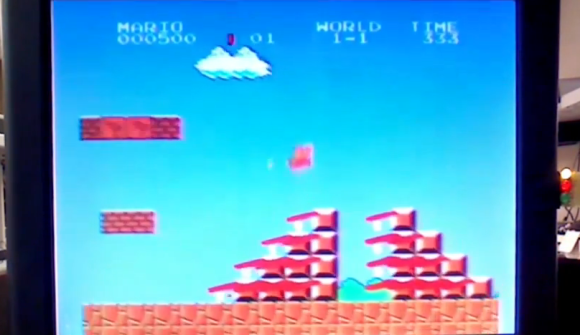
Developed by team members [Jeremy Blum], [Jason Wright], and [Sima Mitra], the video parsing is a hack. To get things working they converted the NES’s 240p video signal to VGA. This resulted in a rolling frame show in the demo video. It also messes with the aspect ratio and causes a few other headaches but the FPGA still manages to interpret the image correctly.

Look closely at the screen capture above and you’ll see some stuff that shouldn’t be there. The team developed a set of tests used to determine obstacles in Mario’s way. The red lines signify blocks he will have to jump over. This also works for pits that he needs to avoid, with a different set of tests to detect moving enemies. Once it knows what to do the FPGA emulates the controller signals necessary, pushing them to the vintage gaming console to see him safely to the end of the first level.

We think this is more hard-core than some other autonomous Mario playing hacks just because it patches into the original console hardware instead of using an emulator.

Continue reading “FPGA Plays Mario Like A Champ”

HDMI Color Processing Board Used As An FPGA Dev Board To Mine Bitcoins

fpga-eeColor-bitcoin-mining

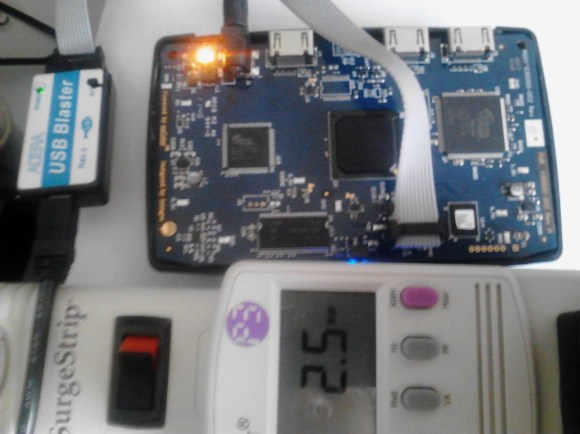
The blue board seen above is the guts of a product called the eeColor Color3. It was designed to act as a pass-through between your television and HDMI source device. It boasts the ability to adjust the color saturation to suit any viewing conditions. But [Taylor Killian] could care less about what the thing was made for, he tore it open and used the FPGA inside for his own purposes.

The obvious problem with this compared to a proper dev board is that the pins are not all broken out in a user-friendly way. But he got his hands on it for free after a mail-in-rebate (you might find one online for less than $10 if you’re lucky) and it’s got an Altera Cyclone IV chip with 30k (EP4CE30F23C6N) gates in it so he’s not complaining. The first project he took on with his new toy was to load up an open source Bitcoin mining program. The image above shows it grinding away at 15 megahashes per second while consuming only 2.5 watts. Not bad. Now he just needs to make a modular rack to hold a mining farm.

Playing Meat Boy On An FPGA

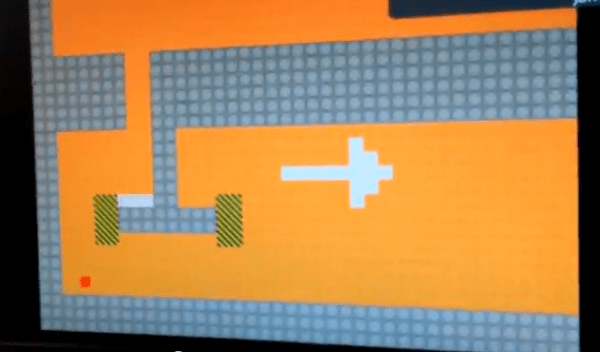
We usually look at these FPGA University projects and think how much fun it must have been to get credit for the work. But in this case we can’t image the grind it must have been to implement the game mechanics of Meat Boy in an FPGA. See how well it came out in the clip after the break.

Remember that with an FPGA you’re basically building hardware devices by using code. The Reddit discussion of the project sheds some light on where to start (and even shares the source code). The Altera DE2 is pushing the game to a monitor using SXGA at 60Hz. The map is laid out as a collection of 32×32 tiles, each represented by 2 bits in memory. [SkipToThe3nd] does go into detail about how the physics work but we can’t even begin to paraphrase that part of the discussion.

The game being cloned here is Meat Boy, the Flash game predecessor to Super Meat Boy. If you’ve never heard of the title we’d suggest watching Indie Game: The Moviea documentary which follows several independent game developers as they try to get their titles to market.

Continue reading “Playing Meat Boy On An FPGA”