First Hackaday Prize Challenge Closes In One Week

The first five weeks of the Hackaday Prize have flown by but many of you have already been busy, submitting over 400 entries! For those that haven’t (or for those considering a second entry) there’s still time. You have until 7am PDT on Monday 4/25 to Design Your Concept.

20 Entries Will Win $1000

This is the round that everyone should enter. It’s all about documenting your idea to solve a technology problem; showing you have a plan that will lead to success. From this first challenge, 20 entries will be selected to win $1000 each and move on to the final round of the 2016 Hackaday Prize.

hackaday-world-create-dayDesign with a Team During World Create Day

That’s right, you don’t need to build anything to be eligible for this round. It’s the perfect opportunity to get your engineering dream team together for an afternoon and come up with that impressive design concept. We’re making this even easier with Hackaday World Create Day. This Saturday, 4/23, there will be Hackaday Meetups all over the world. Show up, brainstorm your concept, and submit it as an entry. Many of the World Create Day meetups have more in store, like talks and socializing. Don’t miss this opportunity to meet the Hackaday community in your town!

The HackadayPrize2016 is Sponsored by:

Hackaday Links: April 17, 2016

There have been really cool happenings in the CNC world for the past few years. There is a recent trend of portable, handheld CNC machines. Yes, you read that correctly. This SIGGRAPH paper demonstrated a handheld router with a camera and a few motors that would make slight corrections to the position of the router. Load in a .DXF or other vector file, and you become the largest CNC machine on the planet. We saw it at one of the Maker Faires, and about a year ago the team soft launched. Apparently, the Shaper router is gearing up for production and [Ben Krasnow] got the first look with a full 17-minute demonstration of [Ben] fabricating parts out of aluminum. It looks like a great tool, and we can’t wait to see this thing in production.

Octoprint is the best way to give a 3D printer a web interface. The dev for Octoprint, [Gina Häußge] used to have a sponsor for developing Octoprint. They’re gone now, which means it’s time for [Gina] to start a Patreon. If you use Octoprint, you know it’s worth more than a dollar a month.

Really bad USB power supplies are nothing new around these parts. There are cheap USB supplies that don’t have any fuses, don’t have any circuit protection, and are noisy as hell. This is the worst USB power supply the Internet has to offer. It’s from one of the relatively new designs of USB power supplies that steps down mains voltage to five USB A ports. [bigclive]’s teardown revealed this was passing half wave mains voltage to the USB ports. It can light up a light bulb. It can kill your phone. The fault? A pinhole in the insulation between the windings of the transformer.

Electronic conference badges are getting excessive, but they can be so much cooler. Here’s Atmel’s take on a high-end conference badge. It has a display, sensors, WiFi, Bluetooth, runs Android, and has 512MB of RAM, 4GB of Flash. It’s a freakin’ mini tablet meant to last for three days.

Speaking of Atmel, they’re having a few growing pains in the merger with Microchip. Employees coming to Microchip from Atmel are getting their severance benefits cut in half. Apparently, the severance benefits given to Atmel employees were not communicated to Microchip before the merger.

Raspberry Pi Zeros are back in production. There’s also going to be a mysterious new feature. Is it WiFi? No, it’s confirmed not to be WiFi. How about Ethernet? Bluetooth? an RTC? Full size HDMI port? Actual pin headers? Audio port? Improved CPU / RAM? No, children. It’s none of these.

C.H.I.P., the nine dollar computer that made some waves last summer, has on-board Flash storage. That means you don’t need to put an image on an SD card. The folks behind C.H.I.P. have recently improved the method for flashing a new OS onto their tiny board: a Chrome plugin. Yes, this sounds completely bizarre, but Chrome plugins are becoming increasingly popular for USB gadget wizardry. You can program an Arduino with Chrome and log USB power profiles with a USB tester and Chrome. You will ride eternal, shiny and chrome.

Hacklet 104 – Test Equipment Projects

Hardware hackers love their test equipment. There are entire forums dedicated to talking about multimeters, oscilloscopes, signal generators, and other common bench tools. At times it seems we spend more time talking about our tools than actually using them. For some, off the shelf equipment is never quite good enough. These hackers, makers and engineers design and build their own test equipment. This week’s Hacklet is dedicated to some of the best test equipment projects on Hackaday.io!
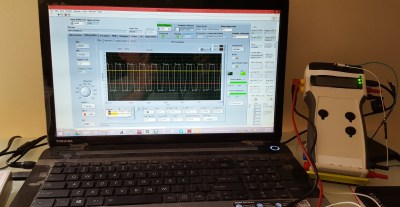
test-tool-1We start with [Roman] and Handheld Electronic Test And Measurement Lab. [Roman] travels a lot, and often needs to bring a lab’s worth of tools with him. After suffering through several ‘random’ searches, he decided to design a simple tool that would cut down his packing, and not get him strip searched. The handheld lab packs a multimeter, low-frequency oscilloscope, data logger, waveform generator, and several other tools into a small package. The tool can be connected to a PC to display data and update settings. The on-board PIC24 handles all the hard work of taking measurements. Some careful analog design gives this tool 10 megohm of input impedance.
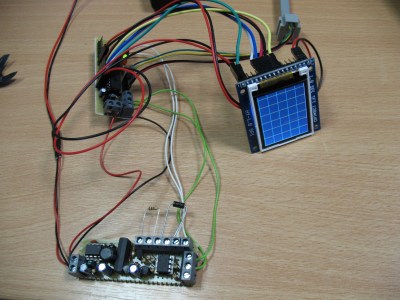
test-2Next up is [Jaromir Sukuba] with 10$ curve tracer. The only way to find out of that a transistor or diode really works as well as the data sheet suggests is to pull out your semiconductor curve tracer. Curve tracers are also perfect for matching transistors for projects like analog synthesizers. [Jaromir] built this quick and dirty tracer over the course of just two evenings. A dsPIC microcontroller runs the show, generating an IV curve by sending pulses through the device under test. Once the curve has been traced, the PIC displays the results on a TFT LCD module. The tracer is a bit limited with a max of 35V at 0.5 amps. Knowing [Jaromir] though, extending the range would only take another evening or two of work.
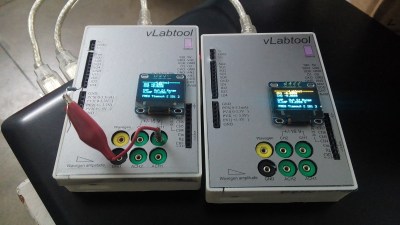
vlabtoolNext we have [Jithin] with A Versatile Labtool. This tool can do just about everything you could want – all in one box. From oscilloscope to frequency counter to multimeter to current source, and much more. Much like [Roman] up above, [Jithin] chose a Microchip PIC24 MCU as processing heart of his design. The Versatile Labtool connects to a PC via USB. If you’re not close to your PC, an ESP8266 module allows the unit to connect over WiFi. A PC isn’t required though. The on-board OLED is always available for quick measurements.
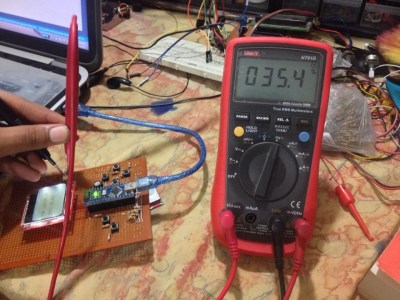
emtFinally we have [ZaidPirwani] with Engineer’s Multi Tool, his entry in the 2015 Hackaday Prize. [Zaid] started with the popular transistor tester codebase. He ported the code to his own hardware, an Arduino Nano and Nokia LCD. Making the port function required quite a bit more work than [Zaid] expected. He ended up going with a fresh repository and adding a bit of code at a time. Once everything was working, [Zaid] verified that his hardware design operated as expected with a good old-fashioned multimeter. Now that everything is working, [Zaid] is just about out of space on the little ATmega328. Next stop is a Teensy 3.2!


A special thank you goes out to [Jaromir Sukuba] for suggesting test equipment as the theme for this week’s Hacklet. You can find his projects and more on the new test equipment project list! If I missed your project, or if you have a suggestion for a future Hacklet theme, don’t be shy! Drop me a message on Hackaday.io. That’s it for this week’s Hacklet. As always, see you next week. Same hack time, same hack channel, bringing you the best of Hackaday.io!

128 LEDs, 5 Buttons, IR Comm, And A Few Hours: What Could You Create?

When the second band had played its last encore, before the legendary DJ took the stage, a cadre of hardware hackers climbed three steps with a twinkle in their eyes and glowing electronics in their hands. I’m surprised and relieved that the nugget of excitement that first led me to twiddle a byte in a microcontroller is still alive, and this moment — this crossroads of hacker family — stirred that molten hot center of adventure in everyone.

The badge hacking demoscene is a welcoming one. No blinking pixel is too simple, and no half-implemented idea falls short of impressing everyone because they prove the creativity, effort, and courage of each who got up to share their creation. How could we ever get together as a community and not do this?

It was after midnight before we began the demoparty. I somehow managed to come to the Hackaday | Belgrade conference without a USB webcam to use as a top-down camera. I also didn’t line up someone to record with a camera until minutes before. Please forgive our technical difficulties — we first tried to use a laptop webcam to project to the bigscreen. When that failed, focusing on the badges because tough for our ad-hoc camera operator. This video is a hack, but I think it’s worth looking past its tech problems.

The crowd gathered as close to the stage as possible and there was electricity in the audience as the wiles of the day were explained. Join me after the break for a brief rundown of each demo, along with a timestamp to find it in the video.

Continue reading “128 LEDs, 5 Buttons, IR Comm, And A Few Hours: What Could You Create?”

Hackaday Dictionary: Ultrasonic Communications

Say you’ve got a neat gadget you are building. You need to send data to it, but you want to keep it simple. You could add a WiFi interface, but that sucks up power. Bluetooth Low Energy uses less power, but it can get complicated, and it’s overkill if you are just looking to send a small amount of data. If your device has a microphone, there is another way that you might not have considered: ultrasonic communications. Continue reading “Hackaday Dictionary: Ultrasonic Communications”

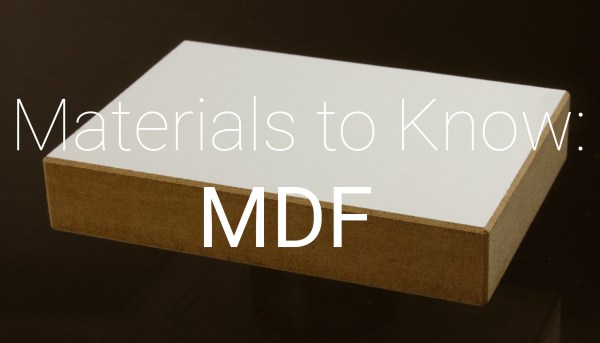
MDF as a mold master. It works, but nowhere near as well as tooling board.

Materials To Know: Medium Density Fiberboard

MDF is the cheapest and flattest wood you can buy at local hardware stores. It’s uniform in thickness, and easy to work with. It’s no wonder that it shows up in a lot of projects. MDF stands for Medium Density Fiberboard. It’s made by pressing materials together along with some steam, typically wood, fibers and glue. This bonds the fibers very tightly. Sometimes MDF is constructed much like plywood. Thinner layers of MDF will be made. Then those layers will be laminated together under glue and steam.The laminated MDF is not as good as the monolithic kind. It tends to tear and break out along the layers, but it’s hard to tell which kind you will get.

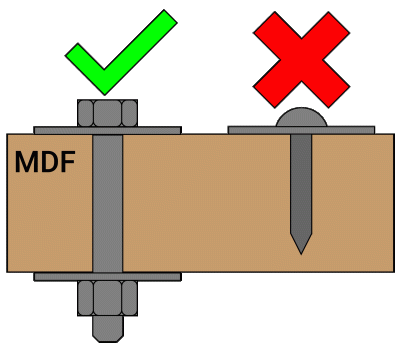
Proper way to attatch a fastener to MDF.

MDF is great, but it has a few properties to watch for. First, MDF is very weak in bending and tension. It has a Modulus of Elasticity that’s about half of plywood. Due to its structure, short interlocking fibers bound together by glue and pressure, it doesn’t take a lot to cause a crack, and then, quickly, a break. If you’d like to test this, take a sheet of MDF, cut it with a knife, flip it over, and hit the sheet right behind your cut. Chances are the MDF will split surprisingly easily right at that point.

Because of the way MDF is constructed, fasteners tend to pull out of it easily. This means that you must always make sure a fastener that sees dynamic loads (say a bearing mount) goes through the MDF to the other side into a washer and bolt. MDF also tends to compress locally after a time, so even with a washer and bolt it is possible that you will see some ovaling of the holes. If you’re going to use screws, make sure they don’t experience a lot of force, also choose ones with very large threads instead of a finer pitch. Lastly, always use a pilot hole in MDF. Any particle board can split in alarming ways. For example, if you just drive a screw into MDF, it may appear to go well at first. Then it will suddenly jump back against you. This happened because the screw is compressing the fibers in front of it, causing an upward force. The only thing pressing against that force is the top layer of laminate contacting the threads. The screw then jumps out, tearing the top layer of particle board apart.

Continue reading “Materials To Know: Medium Density Fiberboard”

After The Prize: What’s Next For The Light Electric Utility Vehicle

Winner of the third place in last year’s Hackaday Prize was [Chris Low]’s Light Electric Utility Vehicle. In case you think that once a Hackaday Prize is in the bag then that’s it and the project creator packs up and goes home, [Chris] dispels that idea, he’s invested his winnings straight back into his project and posted his latest progress on an improved Mk3 model.

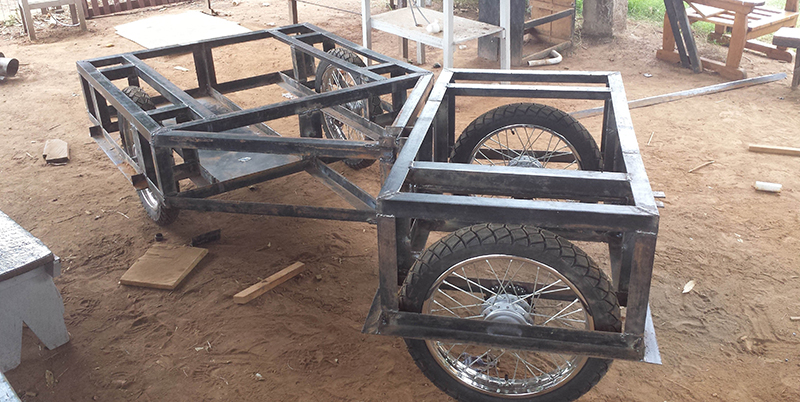
Light Electric Utility Vehicle, 2015-style

We first covered the Light Electric Utility Vehicle back in June 2015 when it was first entered for the 2015 Hackaday Prize. The aim was to produce a rugged and simple small electric vehicle that could be powered by solar energy and that was suitable for the conditions found in South Sudan, where [Chris] works. The vehicle as we saw it then was an articulated design, with chain drive to bicycle-style wheels. The Mk3 version by comparison has lost the articulation in favour of rack-and-pinion steering, has in-hub motors instead of chain drive, and now features coil-spring suspension. You might comment that it has lost some of its original simplicity and become something more like a conventional electric UTV, but along the way it has also become more of a practical proposition as an everyday vehicle.

You can follow the entire build log on the Light Electric Utility Vehicle’s project page on hackaday.io, and below the break have a look at [Chris]’s video showing it in action. Continue reading “After The Prize: What’s Next For The Light Electric Utility Vehicle”