Retrotechtacular: Cut All The Cables In This Speedy Teleco Switch Upgrade

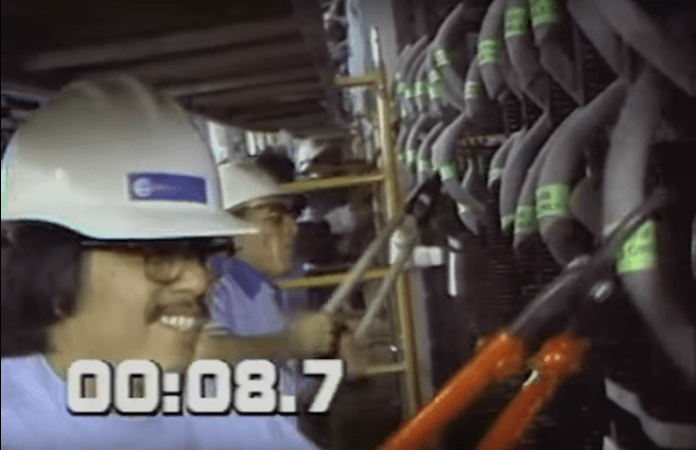
In this short but intense classic of corporate cinematography, we get to watch as the Pacific Bell central office in Glendale, California is converted to electronic switching in a 47-second frenzy of cable cutting in 1984.

In the 1970s and 1980s, conversion of telephone central office (CO) switch gear from older technologies such as crossbar (XBar) switches or step-by-step (SxS) gear to electronic switching systems (ESS) was proceeding apace. Early versions of ESS were rolling out as early as the 1950s, but telcos were conservative entities that were slow to adopt change and even slower to make changes that might result in service outages. So when the time finally came for the 35,000 line Glendale CO to cutover from their aging SxS gear to ESS, Pacific Bell retained Western Electric for their “Speedy Cutover Service.”

Designed to reduce the network outage time to a minimum, cuts like these were intricately planned and rehearsed. Prep teams of technicians marked the cables to be cut and positioned them for easy access by the cutters. For this cut, scaffolding was assembled to support two tiers of cutters. It looks like the tall guys got the upper deck, and the shorter techs – with hard hats – worked under them.

At 11PM on this cut night, an emergency coordinator verified that no emergency calls were in progress, and the cut began. In an intense burst of activity, each of the 54 technicians cut about 20 cables. Smiles widened as the cut accelerated, and sparks actually flew at the 35.7 second mark. When done, each tech turned around and knelt down so the supervisors knew when everyone was done. At least one tech couldn’t help but whoop it up when the cut was done. Who could blame him? It must have been a blast.

Continue reading “Retrotechtacular: Cut All The Cables In This Speedy Teleco Switch Upgrade”

Get Your Hackaday Belgrade Tickets Now

We have just opened up registration for Hackaday | Belgrade — a hardware conference on April 9th. Get your ticket now and make arrangements to visit Belgrade this Spring. Tickets are inexpensive, travel costs from other parts of Europe are very reasonable, the weather will be beautiful, and the all-day madness that we have planned will make you wish it were a week instead of just sixteen hours. These tickets will sell out so please share this post with your friends so they are not left ticketless.

Packed with Amazing People

mike
If you don’t recognize the name you will almost certainly recognize his internet persona: Mike’s Electric Stuff. He’s been regularly featured on the front page of Hackaday as he churns out a unique body of work like tearing down Flir’s low-end gear to discover it’s identical to their high-end offerings.

Hackaday is a global community and that is what makes Hackaday | Belgrade spectacular. We are still accepting proposals for talks through February 15th but haven’t yet made all of the decisions regarding presenters — you should submit a proposal! We’ll publish an article about all of the presenters once we have wrapped up the call for proposals. Expect to hear back about this around February 22nd.

One thing I am very excited about is that Mike Harrison will be at the conference. His talk will cover his exploration of an absurdly expensive and complicated relic which was used in the 1950’s for large-format video projection. Mike’s ability to unlock understanding of complex (and awesome) electronics is quite amazing; this talk is not to be missed. But Mike is just one of a dozen presenters from all over Europe. Several members of the Hackaday crew will be on hand and the venue will be packed with hundreds of fellow hardware hackers. You won’t want to miss this.

You Will Hack This Badge

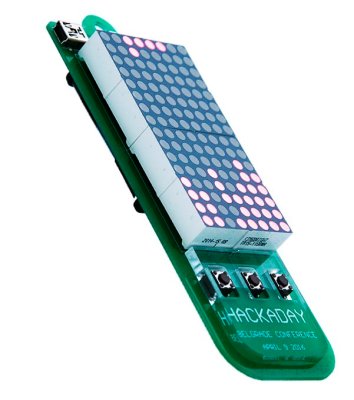
hackaday-belgrade-badge-prototypeThis is the first Hackaday event where we have an active electronic badge. Voja Antonic has been hard at work with the design and just published the first details a few days ago.

The central feature of the badge is an 8×16 LED matrix driven by a PIC microcontroller. It’s running a USB bootloader which will let you flash your own custom code without needing a programmer. We were speaking with some of our friends over at Microchip regarding the bootloader and they offered to supply all the microcontrollers for the badge, an offer we were happy to accept.

Voja has already programmed the first demo application seen here, it’s Tetris written in assembly language. Impressive!

We were overwhelmed by the popularity of badge hacking at the Hackaday SuperConference last November. You can bet that badge hacking will be one of the most popular activities at Hackaday Belgrade. I have written a hardware emulator to work on some animations. It uses the SDL2 library to display the LED matrix and take three button inputs (the final badge design will have four buttons arranged in up/down/left/right configuration). Our hope is to host a demoscene competition that is open to anyone, whether you can attend the conference or not. More on that later.

Live Music and Hacking

As the evening sets in and the talks wind down, we have lined up bands and DJs to take the stage and carry us well into night. You won’t have to stop the badge hacking or anything else that you’re into, but you won’t have to solder in silence either.

As you can tell, this conference goes way beyond talks. This is hardware culture and you’ve just got to be there. Running from 10am until 2am, there’s more than enough to keep you occupied for one day. But make sure to hang out on the event page to get inside information on other non-formalized social events that will happen the night before and the day after. See you in Belgrade!

Hackaday Links: February 7, 2016

For a very long time, the original, 11 foot-long on-screen model of the USS Enterprise from Star Trek the original series – “NCC one seven O one. No bloody A, B, C, or D.” – was housed in the Smithsonian’s Air and Space Museum in Washington, DC. Recent visitors may have noticed the Enterprise is no longer on display. It’s being restored by the finest aircraft conservators in the world. There are a few great videos showing off how much goes into restoring a cultural icon.

Last weekend Hackaday visited Sparklecon in Fullerton, CA. This means I was in LA on the last Saturday of the month. What’s so special about that? The W6TRW Swap Meet at Northrop Grumman in Redondo Beach. Here’s the pics from that. The best thing I found? A wooden acoustic coupler modem for $15. Once I told the guys at the booth what it was, the price went up to $20. Still worth it.

What’s the worst thing about modern computers? They’re all LCDs, and that means worse resolution, terrible colorspace, and monitors that are very, veeeerrrrryyyy wide. The consequence of this is a complete and total lack of screen savers. Never fear, because the flying toaster is back, this time as an SD card holder. It’s 3D printable, so if you have some white, silver, and black filament sitting around, you know what to do.

The USB Killer hit the tips line a few times this week for inexplicable reasons. We’ve seen it before, but we haven’t seen it again. Surprisingly, no one – outside a bizarre Indiegogo campaign that shouldn’t exist – has made their own USB killer. Here’s your call to action: build a USB killer, and I’ll test it out.

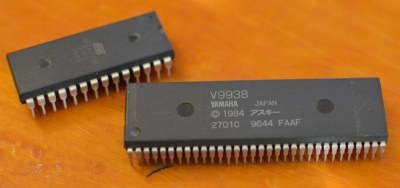
An SDIP-64 chip compared to a DIP-28 chip. Note the finer lead spacing on the SDIP device.

There’s more variety to your standard DIP-packaged chips than you might expect. The weirdest of these – at least when it comes to perfboard construction – is the SDIP, or Skinny Dual In-line Package. Instead of having a standard 0.1″ pitch between leads, the SDIP has a 0.070″ pitch. [Chuck] was having some problems looking for SDIP to DIP adapters until he found this amazing trick the connector companies don’t want you to know aboutJust plop the chip in at a 45º angle, bend a few pins, and you’re good to go.

Hacklet 94 – Pi Zero Contest Entries

Hackaday and Adafruit have joined forces to present the Raspberry Pi Zero Contest. A great contest is nothing without entries though. This is where the Hackaday.io community is proving once again that they’re the best in the world. The contest is less than a week old, yet as of this Thursday evening, we’re already up to 33 entrants! You should submit your own project ideas now for a chance at one of the many prizes. This week on The Hacklet, we’re going to take a look at a few of these early entrants!

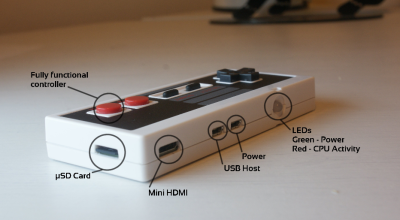
controllerWe start with [usedbytes] and Zero Entertainment System [usedbytes] has crammed an entire emulator into a classic Nintendo Entertainment System control pad thanks to the Raspberry Pi Zero. Zero Entertainment System also has something the original NES couldn’t dream of having: An HDMI output. The emulator uses the popular RetroPie front end. We’re happy to say that [usedbytes] knew that hacking up a real Nintendo controller would be sacrilegious, so they grabbed a low-cost USB clone from the far East. A bit of creative parts-stuffing and point-to-point wiring later, ZES was ready to meet the world!

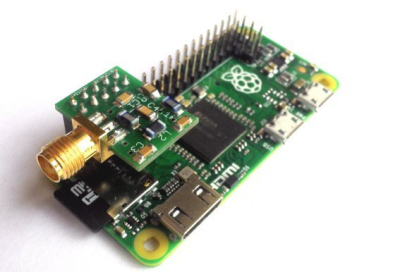
wsprNext up is [Jenny List] with The Australia Project. [Jenny] is a hacker from Europe. She’s hoping to use a Pi Zero to talk to Australia. “Talk” may be pushing it a bit though. The Australia Project will use the Weak Signal Propagation Reporter (WSPR) network to transmit RF straight out of the Pi’s GPIO ports. All that is required is a good filter, an antenna, and a balun. The filter in this case is a 7-pole Chebyshev low-pass filter. The filter keeps the Pi’s harmonic filled square waves from messing up every band from DC to light. [Jenny] normally sells these filters as a kit, but she’s made a special version specifically for the Pi Zero.

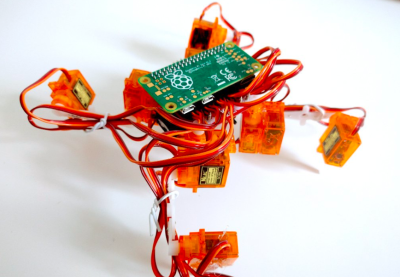
tote0[Radomir Dopieralski] has brought his signature walking robots to the Pi Zero world with Tote Zero. Tote Zero is a quadruped walking robot built mainly from 9 gram servos. [Radomir’s] custom tote board interfaces the servos to the Pi Zero itself. The Pi Zero opens all sorts of doors for sensors, vision, and advanced processing. The Arduino board on the original Tote would have been hard pressed to pull that off. Tote is programmed in Python, which will make the code quick and easy to develop. Tote Zero just took its first steps a few days ago, so follow along as a new robot is born!


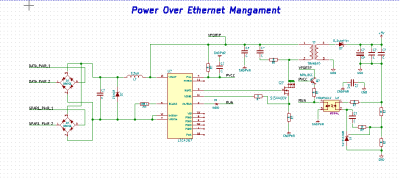
ethernetpoFinally we have [julien] with PoEPi: Pi Zero Power over Ethernet with PHY. The Raspberry Pi Zero is so tiny, that it’s easy to forget it needs a fair amount of power to run. [Julien] is giving us a way to connect our Pi to a network while ditching the USB power supply using Power Over Ethernet (PoE). PoE has been powering devices like IP cameras for years now. It’s become a standard way of transmitting power and data. For the Ethernet physical interface, [Julien] is using Microchip’s ENC28J60, which has a handy SPI interface. Linux already has drivers in place for the device, so it’s a slam dunk. The “power” part of this system comes with the help of an LTC4267 PoE interface chip, which has a built-in switching regulator.

If you want to see more entrants to Hackaday and Adafruit’s Pi Zero contest, check out the submissions list! If you don’t see your project on that list, you don’t even have to contact me, just submit it to the Pi Zero Contest! That’s it for this week’s Hacklet. As always, see you next week. Same hack time, same hack channel, bringing you the best of Hackaday.io!

This Is How You Run A Hackathon: Tech Valley Center Of Gravity

What’s not to love about a hackathon? The junk food and caffeine that fuel the weekend; the highs that come with success and the lows that come when the blue smoke is released; the desperate search for inspiration as the clock ticks away; nerve-wracking pitches to the judges, hoping against hope that everything works in the demo. Hackathons are the contact sport of the hacker world, bringing in top competitors and eager upstarts, and when done well you just might attract interested “civilians” and other newbies that will catch the hacking bug from what they witness.

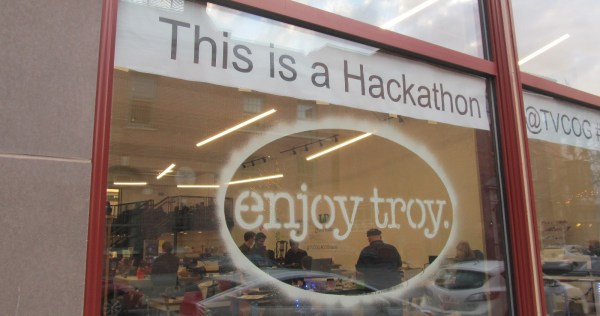
Such was the scene at the Tech Valley Center of Gravity in Troy, NY over the last weekend of January. New for 2016, the CoG is hosting a series of four hardware hackathons this year, each with a different theme. This event’s theme was “Internet of Things”, and the call went out to any and all to come compete for bragging rights and over $1,000 in prizes. Incentives to compete included some big name corporate sponsors, like AT&T, and judging and mentoring provided by the likes of SparkFun’s [Jeff Branson]. There was also a steady stream of food and drink, saturation coverage by local media outlets, and your humble Hackaday writer and his son, who made the trip up to Troy with a small passel of Hackaday swag and a curiosity to see how the CoG has fared since our last visit at the grand opening of their glorious new home. We were not disappointed.

Continue reading “This Is How You Run A Hackathon: Tech Valley Center Of Gravity”

Code Craft: Cross Compiling For The Raspberry Pi

Sometimes there’s just no place like your desktop. You’ve already got your favorite development tools and references setup or installed and it’s a pain when you’re trying to work on an unfamiliar, or simply uncustomized, system. On your desktop everything is at your fingertips. If you want to search the web, the browser is just an alt-tab away. If you need a calculator, it’s right there to run. Your editor highlights syntax in your favorite colors already.

When developing on a Raspberry Pi, you leave all these creature comforts behind unless you spend the time to configure the Pi to your liking. Then it all gets wiped when you install a new distribution, like the recent change from Wheezy to Jessie. Even then it’s frustrating to switch back and forth between the desktop and the Pi because there is always something on the other system that you need. My usual comment is, “dirty word”, literally.

Cross-developing on your desktop is a very workable solution. We’re going to walk through setting up your desktop and a Pi to do this. This means loading a Pi ARM toolchain on your desktop and a debugging server on the Pi. This’ll let you develop and debug from in the comfort of your desktop. An added advantage is when you put that Pi in a robot you can debug over a wireless link.

Continue reading “Code Craft: Cross Compiling For The Raspberry Pi”

Russian Rocket Tech Comes In From The Cold

Decades after the end of the space race, an American rocket took off from Cape Canaveral. This was a routine launch to send a communications satellite into orbit, but the situation was an historic first. The rocket in question was driven by a powerful Russian engine unlike any ever built in the States. Although this particular engine was new, the design dated back to the space age.

By the early 1960s, the Russians were leaps and bounds ahead of the United States in terms of space exploration. They had already launched Sputnik and sent Yuri Gagarin to orbit the Earth. All in all, the Russians seemed poised to send a man to the moon. Russian technology had the Americans worried enough to spy on them with satellites, and the images that came back revealed something spectacular. Out in the Kazakh desert, the Russians were building an enormous causeway and two launch pads. As it turns out, the US had every reason to be worried.

Continue reading “Russian Rocket Tech Comes In From The Cold”