Retrotechtacular: [Zoltán Bay’s] Moon Bounce Coulometer Signal Amplifier

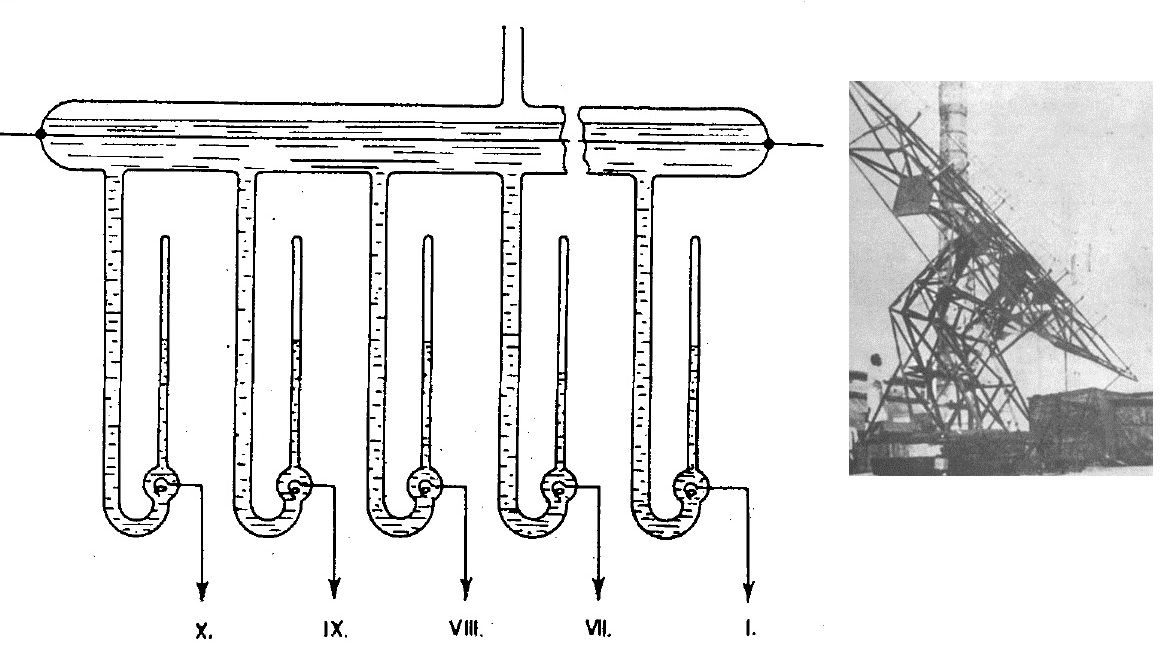
coulometers and antenna

In the years before World War II it was theorized that shortwave radio waves could propagate through the ionosphere relatively undisturbed and allow for a signal to be bounced off the moon and returned. [Zoltán Bay] calculated that the return signal would be too faint to be detected above background noise with the radio receiving equipment of the day. To overcome this receiver dilemma he devised a new receiving element consisting of 10 coulometers sharing a common tank of a water solution. Each of the coulometers had a separate electrical connector and when current flowed through the electrode, hydrogen bubbles would form in an attached glass capillary column. By periodically sweeping through all 10 coulometers using a rotating switch attached to the radar receiver, any radar echo as well as random background noise would be readable by the amount of bubbles in the capillary columns. A single radar echo would be indistinguishable from random background noise in the columns of bubbles, but if the sweep is continued for 30 minutes any periodic radar echo would show as an increased accumulation of bubbles in a respective column. By reading these coulometers and knowing the switching period you could determine that you were receiving a true radar echo from the moon.

What an amazing apparatus to amplify a periodic signal above background noise! Nowadays we would call this a long-time integrator or persistence measurement and it’s a relatively simple task. You can download and read [Zoltán Bay’s] paper on “Reflection of Microwaves From the Moon” dated 1946 in PDF form. His integrator apparatus details start on page 17.

It took some years but in 1946 [Zoltán Bay’s] receiving apparatus was tested and did confirm reception from moon bounce. However, U.S. Army Signal Corps with better crystal frequency stabilized equipment was able to perform the same task earlier as seen in the below video without the use of an integrator. Even though the U.S. Army equipment was superior for this task [Zoltán Bay’s] apparatus enjoyed years of service in the field of planetary radar observation where such a high sensitivity scheme was still necessary.

Continue reading “Retrotechtacular: [Zoltán Bay’s] Moon Bounce Coulometer Signal Amplifier”

Retrotechtacular: Upgrading Train Signaling Before The Information Age

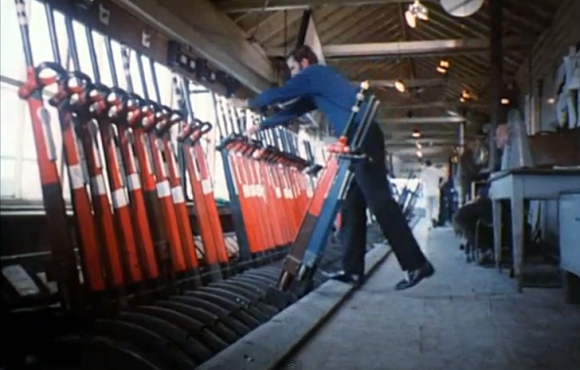
retrotechtacular-british-railway-signaling

What’s surprising about the subject of this week’s Retrotechtacular is that the subject is not from that long ago. But looking at the way in which the work was done makes it feel so far in the past. In 1974 the British Railways Board set out to modernize and interconnect the signaling system. What you see above is one of hundreds of old signal control houses slated to be replaced by an interconnected system.

These days we take this sort of thing for granted. But from the start of the project it’s clear how the technology available at the time limited the efficiency of the development process. We’re not talking about all of the electro-mechanical parts shown during the manufacturing part of the video. Nope, right off the bat the volumes of large-format paper schematics and logic diagrams seem daunting. Rooms full of engineers with stacks of bound planning documents feel alien to us since these days even having to print out a boarding pass seems antiquated.

With fantastic half-hour videos like this one available who needs television? We’d recommend adding this to your watch list so you can properly enjoy it. They show off everything; manufacturing the cables, stringing them between the signal towers, assembling the control panels, testing, and much more.

Continue reading “Retrotechtacular: Upgrading Train Signaling Before The Information Age”

Retrotechtacular: World’s First Color Movie

world's-first-color-movie

It’s surprising how often a brilliant idea is missed out on until years after the fact. In this case the concept was seen publicly within ten years, but the brilliance of the inventor has been appreciated once again after 110 years. It’s a color movie which was filmed around 1901 or 1902 but it sounds like the reel wasn’t shown in its full color grandeur until 2012 when the National Media Museum in the UK started looking into the history of one particular film.

The story is well told by the curators in this video which is also embedded after the break. The reel has been in their collection for years. It’s black and white film that’s labeled as color. It just needed a clever and curious team to put three frames together with the help of color filters. It seems that [Edward Turner] patented a process in 1899 which used red, green, and blue filters to capture consecutive frames of film. The patent description helped researchers put image those frames — also using filters — to produce full color images like the one seen above.

The press release on the project shares a bit more information, like how they determined the age of the film using genealogical research and the fact that [Turner] himself died in 1904. The process didn’t die with him, but actual evolved and was exhibited publicly in 1909. This, however, is the oldest known color movie ever found.

Continue reading “Retrotechtacular: World’s First Color Movie”

Retrotechtacular: Automata

automatonWriter

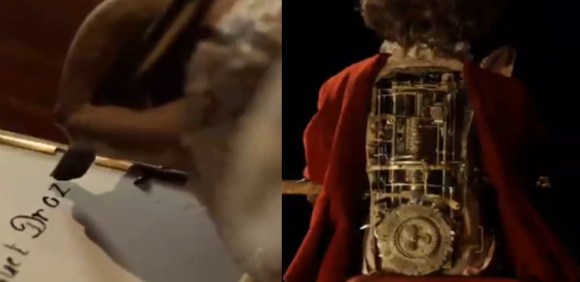
For a moment, suspend your worldview and adopt Descartes’s mechanistic interpretation that living beings are essentially complex machines: a collection of inherently unrelated parts that move and collide. Automata, then, represented the pinnacle of accomplishment in a mechanistic universe, requiring considerable skill to construct. Most of their inventors, such as Pierre Jaquet-Droz, were clockmakers or watchmakers, and automata like the 240-year-old boy writer are packed with moving parts to automate motion.

Jaquet-Droz’s writer is particularly impressive considering all its moving parts—nearly six thousand of them—fit entirely within the boy’s body, and that one can “program” the text that the boy composes. It may sound like a bit of a stretch to claim that these clockwork amusements were precursors to the computer, but they influenced inventors and engineers for centuries.

You’ve likely heard of the other famous automaton: The Turk, (which was actually a hoax, housing an operator inside its base). The Turk, however, managed to inspire Charles Babbage to pursue building a mechanical device capable of performing mathematical functions: the Difference Engine.

Watch some of Jaquet-Droz’s other clockwork masterpieces in a video after the break. Magicians like Robert-Houdin were responsible for building a number of automata, so we recommend you keep the mystical atmosphere flowing by checking out another magician’s performance oddities.

Continue reading “Retrotechtacular: Automata”

Retrotechtacular: Steam Locomotive Construction In The 1930’s

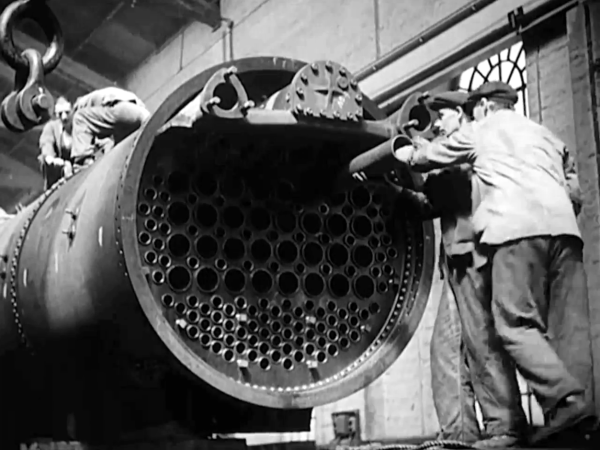
Here’s a fascinating look at high-tech manufacturing in the 1930’s. This week’s Retrotechtacular features the building of a steam-powered locomotive. The quality of the black and white footage, and the audio accompanying it are almost as impressive as the subject material — which is nothing short of a machinist’s wet-dream but also includes much forging and smithing. Digging through the video for a suitable still image was a tough task, as every step in the process was interesting to us. But this image showing some of the 2700 feet of tubing used in the locomotive seems most appropriate.

The build covers all aspects of the build. Huge sheets of steel make up two side plates between which the cast engine block is mounted. The mold for casting was huge, required twelve hours dry time before the pour, and took a day or two to cool before breaking the mold. That yielded a rough block which then headed off for machining.

We were delighted by the crane used to transport steel sheets from the oven to a stamping machine. The counterweight is workers (and lots of them) on the other side of the fulcrum. After a glimpse of the ancillary part fabrication you begin to get a look at the complexity of the machine as it is assembled.

Does anyone feel a deep appreciation for the pedagogy that went into making something like this? What we mean is that the teams building No. 6207 don’t seem to be using skills learned in a book or from a class, but rather those passed down from the masters that have been on the job most of their lives. Watching them all work is nothing short of astounding!

Continue reading “Retrotechtacular: Steam Locomotive Construction In The 1930’s”

Retrotechtacular: Miniseries On The Wright Brothers

retrotechtacular-wright-brothers

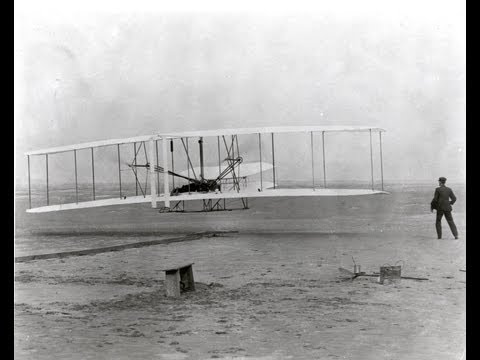
Admittedly we prefer our Retrotechtacular videos to be campy, but sometimes the content is just so cool we have to give up that goal. So is the case with this series on the Wright Brothers’ first manned, powered flight.

Now there is some argument on who actually flew for the first time on earth. And that issue is touched upon right away by sharing the benchmarks used to substantiate the claim:

  • The machine was heavier than air
  • Carried a man
  • Rose from the ground under its own power
  • Flew under control without losing speed
  • Landed safely at an altitude no lower than it took off

The two-part series clocks in at almost two hours. But the combination of images, video footage, and first-hand accounts makes for something incredibly interesting. The original flight happened 110 years ago this December. That doesn’t seem so long ago and it’s incredible to think that air-travel is now common in the developed world and we’re even seeing progress toward human powered flight that itself is doing the same kind of trailblazing the Wright Brothers did.

Continue reading “Retrotechtacular: Miniseries On The Wright Brothers”

Retrotechtacular: Discovering Electronic Music

retrotechtacular-discovering-electronic-music

We take it for granted today that a lot of the music we hear includes synthesized instruments and sounds. But looking all the way back to 1983 for this Discovering Electronic Music video series provides a glimpse of the humble beginnings of the technology. The first five minutes of part one may annoy your aurally, but it’s worth it as that’s the point at which we get into sound generation using equipment like that seen above. All three parts in the series are embedded below; about twenty minutes of video in total.

Mixer boards and other control interfaces used today still have a large area of real estate devoted to knobs and adjustments. But they also include a ton of software processing options which weren’t available until computers became both affordable and ubiquitous. What’s shown in the video is a set of hardware interfaces that process signals from oscillators or alter recorded sound. We’ve spent a lot of time marveling about software defined radio and how it’s making RF hacking accessible to the masses. But who here hasn’t done at least a bit of tinkering in electronic music using any of the myriad of audio software? Would you have done that if you needed to build your own envelope and filter circuitry?

Continue reading “Retrotechtacular: Discovering Electronic Music”