Remote Controlled Glass Block LED Matrix

hive13_remote_controlled_led_matrix

At Hive13, a Cincinnati-based hackerspace, they like to hack everything – even their bathroom. One of the bathroom’s walls faces the street, and is made up of thick glass privacy blocks. A few years ago, they thought it would be a cool idea to install an LED matrix to the back side of the glass wall to spruce things up a bit. After a couple of iterations, they finally had something they were happy to show off, but they wanted to make it even cooler.

While the the Arduino and ShiftBrite shield running the matrix could be controlled over a serial connection, they wanted to use the ProjectBlinkenlights tools to control things over the network. While that didn’t quite work out as planned, it wasn’t necessarily an exercise in futility. While Blinkenlights controls were out of the question, they were inspired to add OSC compatibility to the Processing sketch, which allows them to work the display with an app available for both Android and iOS devices.

The result is pretty slick, as you can see in the video below. Now all they need to do is get Tetris up and running!


Continue reading “Remote Controlled Glass Block LED Matrix”

Swap-O-Matic: An Automat With Recycling In Mind

The Swap-O-Matic is vending machine built for recycling, not consuming. Instead of feeding money into the machine, you can get an item out of the machine by swapping it for something you don’t need anymore. It’s a great concept with a great retro design, probably influenced by the age of the automat.

[Lina Fenequito] and [Rick Cassidy] built the Swap-O-Matic around the time [Lina] was getting her MFA. The build was in Wired in 2005, but the project has been updated since then and has a new home at LaunchPad in Brooklyn, NY. The first version used a separate computer next to the machine that gave out combinations to locks on the doors. It looks like the new version has been improved with an integrated touchscreen and computer-activated locks leaving [Lina] and [Rick] with a very clean build.

It’s a great idea if you have a relatively homogeneous population with similar interests, so we expect to see some of these popping up at a few hackerspaces. Check out the Swap-O-Matic promo video after the break.

Continue reading “Swap-O-Matic: An Automat With Recycling In Mind”

Hack A Day Visits LVL1 Hackerspace In Louisville

We recently had the pleasure of visiting the LVL1  hackerspace in Louisville, Kentucky. Any hackers in the Louisville area who haven’t visited yet are doing themselves a big disservice.  The space recently had its one year anniversary in July, but it’s hard to tell. The space features many of the things you’d only expect in older spaces such as a laser cutter (added while we were visiting), CNC machines, extensive electronics workbenches, and even a section for those who are into music. The best part about the LVL1 hackerspace is it’s members. We’ve all heard horror stories of hacker spaces with drama or overly restricting rules, but the people at LVL1 are extremely friendly and willing to help.

The Micro Colonel (president, if you wanna go that route), [Christopher Cprek], gave us a tour of the space and its current projects. One of the most impressive is the White Star Balloon project, which aims to fly a balloon across the Atlantic. There’s also the Louisville Soundbuilders which meet at the space every other Monday at 8pm to make new instruments. Some other projects include a telepresence robot, a pony that breaths fire, and a power wheels race car for the Detroit Makerfaire. There are also things such as the Kentucky Open Source Society (KYOSS) that meets at the space. Even a few sumobots were scattered around. We were fortunate that at the same time we were visiting [Brandon Gunn], who regularly does video tours of the hackerspaces he visits, was there too; watch his video tour of the space after the break.

The space usually has an open to the public meeting every tuesday at 7:00, but be sure to check out their calendar for more.  If you’ve never been to a hackerspace before you should definitely make an effort. It’s not the tools that make a space, but the people, and LVL1 delivers.

Continue reading “Hack A Day Visits LVL1 Hackerspace In Louisville”

IButton Is Opening Doors At The TkkrLab

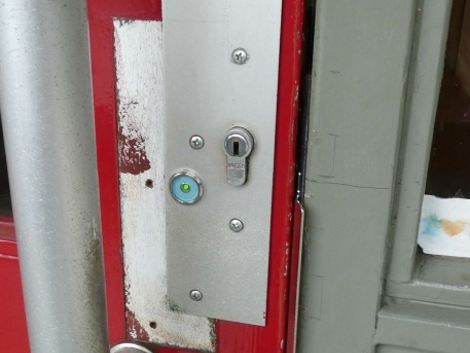
Finding alternative ways to unlock doors is a favorite hacker pastime. TkkrLab recently took on the challenge themselves. The hackerspace, which is located in the Netherlands, faced a problem common to communal workshops; how could they manage keyed access for a large number of members? The metal keys for the door are special, and cannot be cheaply duplicated. To further compound the issue, they are not the only tenants in the building so they can’t replace the lock with one that uses less-expensive keys. So they decided to add an electronic solution.

They first looked at a method for electronically opening the door. Often, this comes in the form of an electronic strike, but rather than alter the door jamb, they replaces the latching mechanism. The electronic latch was compatible with the original cylinder, which means the old keys still work in it. You can see the new assembly above. Just to the left of the lock is an iButton reader. We’ve seen this hardware in projects many times before. It’s cheap, and easy to work with. Now TkkrLab issues an iButton to each member, and can keep track of who is coming in door.

Wireless Hackerspace Status Notifier

space_probe

Hackerspaces are always looking for novel ways to let their members know that they are open for business, and this notifier [Angus] from Make, Hack, Void recently put together is no exception.

While dumpster diving one day, he came across a fantastic-looking lab power supply from the ‘70s. He gutted it, saving the variable transformer for a future project, and started constructing his notifier. When someone enters the hackerspace, they simply set the dial on the “Space Probe” to the amount of time they expect to be there. The built-in Seeduino sends the data over Bluetooth to an OpenWRT-enabled router, which uses a couple of Lua scripts to notify members via email and Twitter.

Since almost all of the processing is done on the router side, it leaves the Arduino in the probe with little more to do than flash an LED and send ASCII status messages any time the knob is turned. [Angus] is well aware that this would probably make most people’s heads spin, but he hopes that other hackerspace members use that untapped potential to further enhance the notifier.

Stick around to see the Space Probe in action, and if you are interested in seeing what other hackerspaces use to keep their members in the know, check out this status switch from Hack42.

Continue reading “Wireless Hackerspace Status Notifier”

ChronoTune: Listen To Radio By Year, Not By Frequency

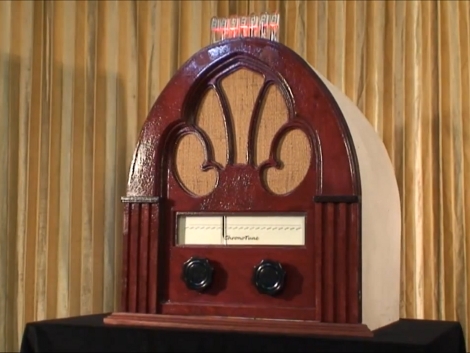
The ChronoTune is a radio that plays sounds from different eras. This project was developed as an entry for the Redbull Creation Challenge by some members of i3Detroit, a hackerspace in the motor city. It allows a user to turn the dial to tune in a new moment in history, but they can also listen in on the present day. They’ll be greeted with the sounds of a tuning radio, followed by music or audio clips common to the period displayed on the dial.

As you know from the last contest entry, each project must use an Arduino to qualify. It reads a rotary encoder attached to one of the knobs on the front of the case. This doesn’t directly move the tuning needle. Instead, it’s attached to the guts of an inkjet printer to move it back and forth. This lets the radio tune itself if need be.

The audio is played from several sources. There is an MP3 module that allows for longer clips, but there are also some ISD voice recorder chip modules that play back shorter clips. If the dial is tuned to present day, an FM radio module tunes in a station over the air.

Having trouble reading that dial? Don’t worry, there’s a simulated Nixie tube display sticking out the top of the case to provide a digital readout of the currently selected time period. Check out the video after the break to see the team walk us through each part of the ChronoTune.

Continue reading “ChronoTune: Listen To Radio By Year, Not By Frequency”

Open Hacker Conference Badge Project Needs Your Help!

[Aestetix] writes in to tell us that the OpenAMD (Attendee Meta-Data) project is working on a new revision of their hardware, to be debuted at CCC Camp this fall.

For the uninitiated, OpenAMD combines an Active RFID tracking system with social networking, and is completely open-source. You walk into the conference, put on the OpenAMD badge, and suddenly you can see yourself as a dot moving around on a map. Or you can log into the social networking site, create a profile, and watch as your personal information is pulled into the mesh, which then tells you talks you might like, people you might like, where those people are, and more. There’s even an open API where you can create your own ‘killer’ apps, which may include games or other interesting aggregates of the attendee information.

Continue reading “Open Hacker Conference Badge Project Needs Your Help!”