Hacking Gets A Cover Story

We do see hacking in mainstream print media from time to time, but you know the movement must be gathering steam when a collection of hacks gets the cover story in a local paper. This week’s issue of The Isthmus – the premiere free newspaper here in Madison, WI – features the local hackerspace and a handful of green hacks.

The man seen riding the pedal-powered plow above is [Kevin Blake], a mechanical engineer for Trek Bicycles which is headquartered in Waterloo, WI. He built the rig with the chassis of a riding lawnmower, adding shovel blades in a V-shape on the front, with cranks and other parts salvaged from bicycles.

The article goes on to feature the local hackerspace, Sector67, by interviewing its founder, [Chris Meyer]. The paper tracked down some other local hackers (and Sector67 members) who have been prototyping wind turbines.

The largest feature in the story goes to [Ben Nelson’s] Geo Metro electric vehicle conversion. The self-employed video producer picked up the diminutive car for about $500 and dropped in a forklift motor which he picked up at a garage sale ($50 + $50 for new brushes makes for a steal at $100). But here’s the best part of the project: after ripping out the unneeded parts for the car he sold them for $550. Anyway, all said and done he’s got about $1300 invested in the project and now has an all-electric car that gets up to 45 mph with a range of twenty miles in between charges. Maybe a big tail cone would help extend that reach.

This is the most interesting stuff we’ve read in the newspaper in years. Maybe you should contact your local journalists for a feature in your area? If they’re not receptive, don’t fret… we’re always looking for great builds to feature here at Hackaday.


Think Geeks Wants You To Have Broken Stuff

Think Geek has a growing pile of returns and damaged product that they’re trying to get rid of. The purveyors of technological oddities, like any other large retailer, sometimes have stuff that doesn’t work right, or has been damaged somewhere between factory and consumer. The broken bits find their way back to the distribution center and now they’re stuck with the task of doing something with it.

They can’t sell it, and we’re happy to say they don’t want to throw it out. So they’re considering giving it away to worth-while causes like Hackerspaces and schools. Looks like no real details have been hammered out as of yet. But if you belong to a Hackerspace or other group that can find a use for this stuff, click-through the link above and sign up to let them know you’re interested. The goldmine of reusable stuff is located in Columbus, Ohio and pick-ups might be available. Otherwise they’re going to need to find a way to cover the cost to ship boxes to those interested.

Don’t forget to document your projects and let us know what you use this stuff for.

[Thanks RenderMan]

DARPA Needs Your Help! Design A Ground Combat Vehicle.

[Joe Schlesinger] of MakeIt Labs wrote in to let us know about an upcoming live chat session march 28th on IRC to discuss DARPA’s latest project, the Adaptive Vehicle Make.

DARPA, in the pursuit of innovative high-risk high-payoff tactical technology is looking to crowd-source the design and construction of the 3000-5000 parts that make up your run of the mill super advanced next generation military hardware. They are even going to distribute about a thousand 3D printers to schools, where students will compete to design some of the complex systems.  The project emphasizes “not traditional” vendors (IE: Hackerspaces) and monetary compensation will be involved in the parts production process.

If you like acronyms (and who doesn’t), or feel like wading through jargon, check out their site. We also found the Wikipedia entry to be helpful in understanding what they are carrying on about.  A briefing PDF (6mb) also contains a lot of information on DARPA’s plans, and pretty pictures.

As per usual DARPA plans on issuing several challenges to make up the entire project, all with huge cash prizes. The first two challenges last 9 months, starting with the Mobility/Drivetrain Challenge in the middle of 2012.   The Chassis/Integrated Survivability Challenge starts in 2013.  These first two also include a cash prize of  500 thousand to one million dollars. The third challenge, the Total Platform Challenge lasts 15 months and begins in late 2013 this carries a prize of one to two million.

[Joe]’s Hackerspace will be there, any chance we could help out?

Redbull Sends Marketing Doodad To Hackerspace Using An Open Source Product

Posts

Looks like Redbull is harnessing the power of open source hardware to market their product to hackers everywhere. We’d say that it worked because here we are, posting up some free advertising for them. It seems that a rep for the company dropped off a package at a hackerspace in LA called Null Space Labs. It came in what is obviously a laser cut wooden box, a material that tends to make hackers salivate. Inside they found the board you see above. It took a bit of time to look over the hardware was eventually identified as an Uzebox. Sure enough, then plugged in an original NES controller to the controller port on the back of the board and were playing a version of  Pac-man in no time.

Marketing and advertising have their place in our lives which can be annoying and intrusive at times. But we have no problem with it when done creatively and targeted to our interests. Good job Redbull, and might we add, that’s a heck of a routing path for your PCB outline!

Geiger Counter A/D Conversion For Radiation Level Crowdsourcing

arduino_geiger_counter

[Akiba] and the crew at Tokyo Hakerspace are still hard at work trying to help out their fellow countrymen after the recent earthquake, tsunami, and ongoing nuclear crisis in Japan. You may remember the group as they are behind the Kimono Lantern project we featured last week. This time around, their efforts are focused on getting usable information out to those who need it.

With all of the talk about nuclear fallout, they wanted to see what sort of measurements they could get in Tokyo, however they could not locate a Geiger counter anywhere nearby. Luckily, they were eventually able to source two old counters from the Reuseum in Idaho. One is being lent out to individuals in order to check if their home’s radiation levels are safe, but it was decided that the other would reside outdoors in order to collect radiation readings from the air.

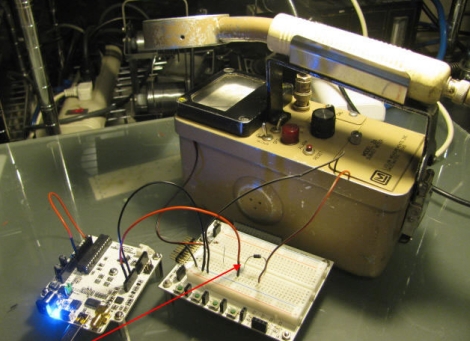
[Akiba] wanted to put the results from the external Geiger counter up on Pachube, however these old units are all analog. He figured that a quick and dirty way to do analog to digital conversion would be to monitor the chirps coming off the counter’s speaker. This was done by wiring up an Arduino to the speaker leads, and keeping track of each time the speaker was activated. This resulted in an accurate digital radiation reading, matching that of the counter’s analog display. The Arduinio wirelessly sends the information to another Arduino stationed inside his apartment, which then uploads the data to Pachube.

A walkthrough of his conversion as well as the source code for both the Arduino counter and the Pachube uploader are available on his site, in case anyone else in the Tokyo area has a Geiger counter handy and wishes to do the same.

Tokyo Hackerspace Helping Disaster Victims

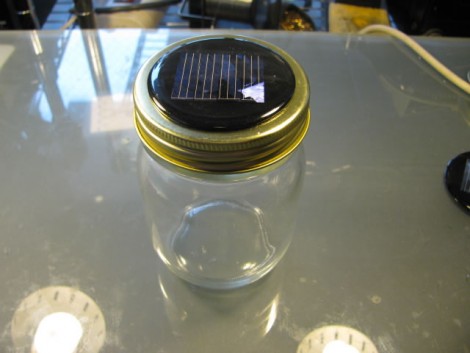
We, like the rest of the world, have watched in horror as footage of the recent earthquake-caused disaster has been reported from northern Japan. It’s easy to watch video and see nothing but distruction, however, life goes on and [Akiba] is looking for a way to help the recovery efforts. He mentions that one of the big needs in the disaster area right now is for light, as the power infrastructure has been heavily damaged. The mason jar seen above is a Kimono Lantern that was meant to accent a garden at night. It has a solar cell – one NiMH rechargeable battery – and one bright LED along with a charging circuit. It was designed in the Tokyo Hackerspace and they released the build files in hopes that a large number can be donated to those in need. With a reasonable amount of daylight, the single cell battery can be charged enough to provide 10 hours of light from the little device.

How can our hacks help others? That question has been on our minds for the last few days. Light is a great first step. But we’ve also wondered about information networks to help coordinate rescue and cleanup workers. There are hacks that bring WiFi using wind power or solar power. What other hacks do you think would be useful to aid in the recovery process?

The Evil Genius Simulator: Kinect Controlled Tesla Coils

The London Hackspace crew was having a tough time getting their Kinect demos running at Makefair 2011. While at the pub they had the idea of combining forces with Brightarcs Tesla coils and produced The Evil Genius Simulator!

After getting the go ahead from Brightarcs and the input specs of the coils they came up with an application in Openframeworks which uses skeletal tracking data to determine hand position. The hand position is scaled between two manually set calibration bars (seen in the video, below). The scaled positions then speeds or slows down a 50Hz WAV file to produce the 50-200Hz sin wave required by each coil. It only took an hour but the results are brilliant, video after the jump.

There are all these previously featured stories on the Kinect and  we’ve seen Tesla coils that respond to music, coils that  make music, and even MIDI controlled coils, nice to see it all combined.

Thanks to [Matt Lloyd] for the tip!

Continue reading “The Evil Genius Simulator: Kinect Controlled Tesla Coils”