Automatic Cat Feeder Made With Recycled Laminator Parts

automatic-cat-feeder

When [Antoine] and his family leave home for a few days, they usually have to find a neighbor who is willing to care for their cats while they are away. Instead of bothering the people who live next door, he decided it would be best to build an automatic cat feeder (Translation) instead.

[Antoine] originally tried building an auger to distribute the food, but it didn’t work as well as he had hoped. He opted to build a dispenser out of wood instead, driving the feeding wheel with an old microwave platter motor. The motor did not have enough torque to do the job, so he dismantled an old laminator, which had a more suitable motor inside.

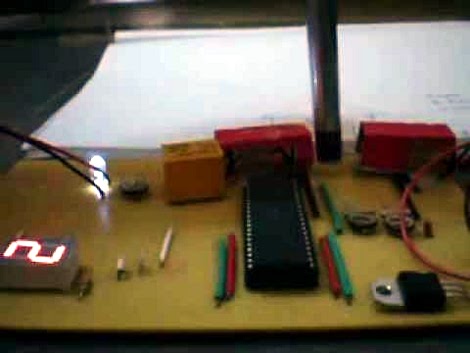
He built a large hopper (Translation) out of wood and left over acrylic sheeting, which stores the cat food and houses all of the electronics used in the feeder. He controls the amount of food and feeding intervals using a pair of buttons and a small LCD display, all of which are controlled by an Arduino Nano.

While [Antoine] has not yet shared the source code that drives the feeder, he does have a demo video which you can watch below.

Continue reading “Automatic Cat Feeder Made With Recycled Laminator Parts”

The Gas Cap Senses Your Flatulence And Displays It On Your Forehead

If you’ve ever found yourself wondering if there’s any possible way to let those with deficient olfactory senses know just how flatulent you are, wonder no more. The Gas Cap is here to fulfill that very need. A bar graph of sorts, located on the front of a hat that will light up to reflect the amount of methane sensed near your, uh, exhaust port. This project cost around $100, though a good portion of that went to the Xbee modules so that the detector could be separated from the hat, allowing for remote fart notifications.

This seems to be a project that is not as uncommon as one might assume. We’ve seen fart intensity detectors as well as tweeting chairs that alert the world when you pass gas.

[via Adafruit]

Fiber Optic Chandelier With Wireless Controls

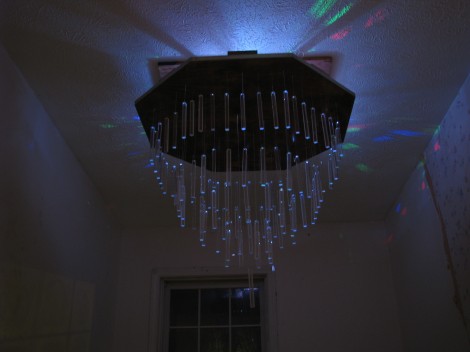
After seeing a cool fiberoptic chandelier on Ebay for over $1,000, [Apex Logic] figured he could build one himself that would not only be cheaper, but have more features. Some of the features he was after were for it to be wirelessly controlled, have the ability for full RGB control, and of course to have a custom look. He pulled it off quite nicely as you can see in the video below. He has a wireless controller with 3 sliders representing RGB that you can catch a glimpse of in the second video below.

His page with the build details and the code seems to have suffered some ill fate this morning. Here it is, for when it returns.

[via Adafruit]

Continue reading “Fiber Optic Chandelier With Wireless Controls”

Using Incandescent Bulbs To Compensate For A Slow Start Cfl

[Dick], like most of us, likes some pretty strong light in his workshop. He’s using CFL flood lamps to save a little energy. Unfortunately, he found that they gradually become brighter instead of that instant light he was accustomed to with his previous incandescent bulbs.

Not wanting to wait around for the lights to reach full power, but still wanting to save electricity, he devised a plan . He would install an incandescent bulb along side the others and fade it out slowly as the others became brighter. He acknowledges that he could have just put a 5 minute timer on it, but the transition would be abrupt and unpleasant. Instead, he built a circuit to get the exact result he wanted.

Just so you don’t miss it, the actual build is available to download at a link toward the bottom of the page.

[via HackedGadgets]

Chicken Coop Door Using Threaded Rod

There’s no rooster to wake them up, and [Steve] and his wife are fine with that. What they’re not fine with is having to get up early anyway in order to let the chickens out of the coop. Like many small-scale egg farmers they sought out an automatic solution for opening the coup in the morning.

[Steve] had seen a bunch of different automatic coup door hacks kicking around the Internet. But all of the ones he could find used a vertical door and pulleys. His setup has a door that opens horizontally and he realized that he needed to build some kind of linear actuator. What he came up with is a system built with hardware store parts. He’s using a plain old piece of threaded rod along with a coupling nut (they’re usually 3/4″ long or so). The nut is held firmly on the door using a conduit mounting bracket, while the threaded rod is turned by an electric screwdriver mounted to the jamb. Two limiting switches are made up of magnetic sensors often used to ring the door entry bell when you enter a store. An Arduino takes care of scheduling and controlling the motor for opening and closing the door. See for yourself in the high-production-value video after the break.

For what it’s worth, we have seen at least one rope and pulley door that slides horizontally.

Continue reading “Chicken Coop Door Using Threaded Rod”

Automated Cat Feeder With A View

[Robovergne] wrote in to share his fantastic automated cat feeder with us. After researching the common commercial products he could find, he decided to build one that utilized a home made linear actuator to pull a certain amount out of a reservoir. Initially, he attempted to use microwave motors but ultimately found them to be too weak to force the bits of cat food should they get stuck. He was afraid this extra strain would cause motor failure before too long. Ultimately, he replaced the microwave motor with a fairly strong servo that seems to do the job just fine. He’s currently using an Arduino to time it all, but he does mention that he feels it is a waste of the arduino for such a simple task.

As you can see in the videos after the break, his mechanism seems quite solid. There isn’t a lot of play in the movement and the amount of food coming out seems to be fairly controllable.

Continue reading “Automated Cat Feeder With A View”

Interactive Table Is Slightly Different Than Most.

[DanNixon] has put together this unique interactive table concept. Usually, when we see the term interactive table, we think of an LED grid. That just happens to be what we see the most of. While this table does, in fact, have an LED grid in the table top, it also has several other features and some very nice construction.

Instead of going the usual boring rectangular route, [DanNixon] decided to build a more visually appealing structure. The build log on that part alone is worth a peek. After that, he has a small LCD screen for displaying headlines and song titles as well as a compact LED matrix for some visualizations.

Great Job [DanNixon]

Continue reading “Interactive Table Is Slightly Different Than Most.”