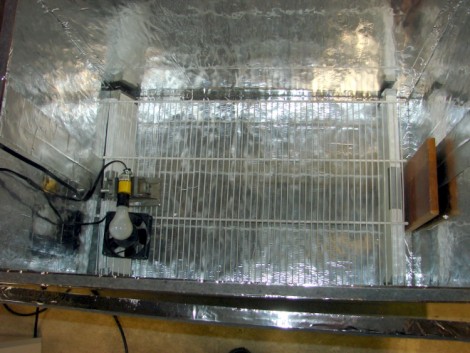
Meat Smoker Texts You When It Is Done

yummmmm

[Peter Rauch] has built this meat smoker that has a touch screen control interface. His system is capable of controlling the cooking by monitoring the internal temperature of the smoker as well as the temperature of the meat itself. His touch screen interface allows him to enter his desired parameters and it basically just takes over from that point and texts him when it is done.  You’ll have to download the pdf to get to the juicy details of his build, but it is an interesting read.

It looks like he’s using a 4-loop Gefran GFX4 temp controller in conjunction with a Modbus remote terminul interface and a TS8010 HMI touchscreen for the bulk of the electronics. It even has protection limits he can set to keep his family from bumping it up to 1200 degrees.

[via Makezine]

Replacing The Driver Board In An Old-school Door Chime

[Dan Kouba’s] parents replaced their doorbell button with one that lights up and found that the chime wouldn’t stop sounding after the button was pushed. These lighted buttons use an incandescent bulb in parallel with the button (a piece of hardware we’ve hacked in the past). It draws a small amount of current which isn’t enough to trigger the chime, but it is just enough that the chime unit reacts as if the button press never stopped. His parents asked what he could do about this and after some investigation he build a replacement board for the chime unit based around an ATtiny26L. The board monitors the voltage drop across a resistor in the doorbell circuit. When the comparator on the AVR detects a rise in the voltage drop across the resistor it rings the chimes, actuating the solenoids with a set of PNP transistors. [Dan] sent us all of the details which you can check out after the break.

Continue reading “Replacing The Driver Board In An Old-school Door Chime”

Needs More LEDs, EMSL Biggified Conway’s Game Of Life

Evil Mad Scientist Laboratories has proven bigger is better with their colossal LED table running Conway’s Game of Life. At the heart of the system is 44 ATmega164Ps controlling 352 LEDs on a 32×44 inch table; and to make it interactive IR LEDs detect the presence of objects.

The display is set up as an exhibit at the San Jose Museum of Art in tribute to [Leo Villareal]. To see a demo, catch a video after the divide.

Related: Colossal LED tables, and Conway’s Game of Life. Why has it taken so long to combine them?

Continue reading “Needs More LEDs, EMSL Biggified Conway’s Game Of Life”

Super Simple Arduino Setup Lowers Electricity Bills

An Arduino with 40 lines of code, a temperature resistor, and servo are all that’s truly needed to save some dough with this thermostat by [Peter Hamilton]. LEDs and a potentiometer are added as well to help set and read the desired temperature. With or without said additional parts, the hack is still ridiculously simple and we’re wondering why we didn’t have a similar setup on our blisteringly cold office AC system before seeing it.

Though, we’re going a bit further with our version, plans are in the making to add timers to turn off the system for extended hours while no one is at the office. What would you add?

Hacked AC And Ash Filter

Moscow is in a bit of a hot spot right now, dealing with a heat wave and enormous wildfires. The combination of smoke, ash, and heat was driving Andrew up a wall so he built a contraption to provide some relief. It has two chambers, the bottom houses ice water, the top is an air baffle. A small DC fan pumps air into the upper chamber where it encounters the water being sprayed in from the lower reservoir. What results is a heat exchange similar to other diy AC setups we’ve seen. But Andrew also notes that after running the device for a while the smell of smoke and ash is gone. Can this setup be seen as an effective way to trap airborne smoke particles?

Adding A Microphone Jack To A HAM Radio Handset

[dajjhman] wrote in to show us how he added a microphone jack to the handset of his Yaesu radio while retaining the DTMF functions. He states that there were some adapters available on the market, but they are non standard and didn’t really fit his needs. The modification itself is pretty simple, especially with his great documentation and clear pictures. For anyone else who might need this setup, this should be a great resource.

Making Home Automation Modules Talk To Each Other


[Danny] has been working on an RNET to Sonos bridge. These are devices from two different manufacturers used to facility whole-house audio systems. Usually there’s a main controller with a large color screen and then several satellite controllers like the one above which have some of the features but at a lower cost. Normally you’re limited to using hardware from one line of devices in order to get them to talk to each other but [Danny’s] saying ‘no way’ to that restriction.

His latest post has some of the details on how he pulls this off. He used an RS232 serial connection with an Arduino to sniff out the data stream from the RNET base unit. Once he figured out the protocol he used the Arduino to parse all incoming commands, format them for the Sonos controller, and send it over the Ethernet cable to that device. He’s got everything tied together and working. Take a look at the proof in the clip after the break.

Continue reading “Making Home Automation Modules Talk To Each Other”