Adding Spice To Your Workbench

Most of us didn’t fight in World War II, drive a race car, or fly the Space Shuttle. But with simulation, you can experience at least some of what it would be like to do those things. Granted, playing Call of Duty isn’t really the same as going to war. No matter what you are simulating, it only goes so far. However, you can get a lot of value from a simulation. I’d bet the average kid who has played Call of Duty knows more about WWII locales and weapons than my high school history teacher.

When it comes to electronics, simulation is an excellent way to get insight into a circuit’s operation. After all, most circuits operate in the abstract–you can’t look at an audio amplifier and see how it works without a tool like a scope. So simulation, when done well, can be very satisfying. You just have to be careful to remember that it isn’t always as good as the real thing.

That’s Spicy

One of the best-known electronics simulators is Spice, which Berkeley created in 1973. In its original form, you had to punch cards that described your circuit and the analysis you wanted to perform. Modern PC versions sometimes replace the deck of cards with a text file. The best modern versions, though, give you a GUI that allows you to draw a schematic and then probe it to see the results.

There are several paid and free versions of Spice (and other simulators) that include a GUI. One of the best for a casual user is the free offering from Linear Technology called LTSpice.

Linear makes LTSpice available and populates it with models for their devices in the hopes you’ll buy components from them. However, the software is entirely usable for anything, and it has a powerful set of features. Linear produces the software for Windows, but I can attest that it runs just fine under Wine on Linux. The Web site will invite you to register, but you don’t have to if you don’t want to.


Continue reading “Adding Spice To Your Workbench”

Good Old-Fashioned Circuit Bending With Patient Alpha

For a lot of us some sort of audio circuit was our first endeavor into electronics. Speak and Spell, atari punk console, LM386 in a mint tin, sound familiar? If not, you should do yourself a favor and knock out a couple of those simple projects. For those of us who have done a bit of what the kids are calling circuit bending, [Nickolas Peter] brings us a familiar hack with his Patient Alpha project. You can see a time-lapse video of the build process and a short demo in the video after the break.

[Nickolas] did a few mods to his 2013 Executor key fob; the obligatory potentiometer for resistor swap is always a crowd pleaser. Adding an audio out via 3.5 mm jack is something that some of us wouldn’t have thought to include, but it lets the Executor scream into your serious audio gear for maximum eargasms. It’s worth mentioning that [Nickolas] does a good job with this hack’s finished look, albeit he started with a product in an enclosure he still goes to the trouble of custom fitting all his bits in an aesthetically pleasing way. And then he made a second.

We have covered circuit bent projects aplenty: from an old school take on circuit bending to one with a ratking of wires built on a proper bit of audio kit. Dig out your soldering iron and dig in.

Continue reading “Good Old-Fashioned Circuit Bending With Patient Alpha”

Hacking Candle Extinguishing

Anyone can put out a candle by blowing on it. According to [Physics Girl], that method is old hat. She made an educational video that shows five different ways to put out a candle using–what else–physics.

You might not need alternate ways to put out a candle, but if you are looking to engage students in STEM (Science, Technology, Engineering, and Math), this video along with others from [Physics Girl] might spark interest.

Continue reading “Hacking Candle Extinguishing”

How A Professional Resin Caster Duplicates Parts

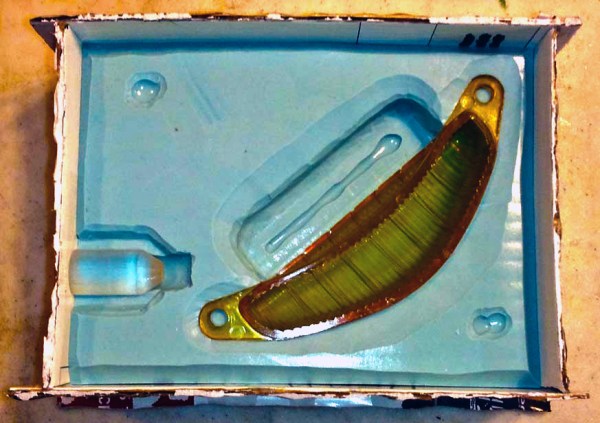
[Gregg Eshelman] reproduces plastic parts for antique car restorations for a living; likewise, he’s very good at it. Greg always chimes in with helpful hints whenever we post about resin casting. Shown above is a lens for a car turn signal. Manufactured in 1941, having [Gregg] cast a few copies is an easy option for replacing the rare part.

[Gregg] uses a similar method to us, but it is easy to see that he has done it more and his process has been refined by lots of experience. We really liked how he avoids using expensive foam core by wrapping cardboard in packing tape, or using the kind that has a plastic coating on it; the kind most retail packaging is made out of. He also has better techniques for keying the part to be manufactured, and prepping difficult geometry between different mold halves. It also never would have occurred to us to use Dremel cutting disks to cut the sprues and air vents in the silicone, a surprisingly tricky material to cut precisely with a knife.

It’s always nice when a professional takes time to write about their processes for the hobbyist trying to emulate it. We hope [Gregg] writes more tutorials, and continues to contribute in the comment section. If you have your own fabrication techniques to share we’d love to hear about it on the tips line.

Learn Resin Casting Techniques: Duplicating Plastic Parts

Resin casting lets you produce parts that would be otherwise impossible to make without a full CNC and injection molding set-up. It costs about as much as a 3d printer, 300 to 600 US dollars, to get a good set-up going. This is for raw material, resin, dye, pressure chamber, and an optional vacuum degassing set-up. A good resin casting set-up will let you produce parts which are stronger than injection molding, and with phenomenal accuracy, temperature resistance, and strength. I will be covering various techniques from the simple to advanced for using resin casting from a hacker’s perspective.

Continue reading “Learn Resin Casting Techniques: Duplicating Plastic Parts”

Repairing Vintage Clock Movements

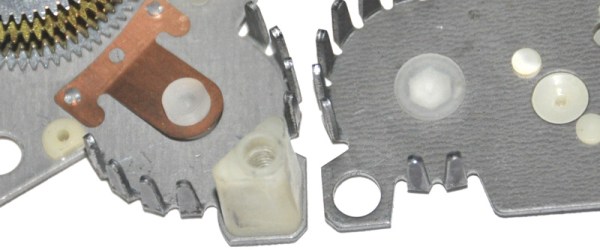
It’s obvious that [Matthew] cares a great deal for vintage electric clocks. He is especially fond of the bedside alarm variety, which in our experience cast a warm orange glow on the numbers and emitted a faint, gentle hum. [Matthew] has written up a thorough treatment of Sunbeam movements in particular that covers identification, disassembly, cleaning, and repair.

These workhorse timepieces are cheap and fairly plentiful if you work the estate sale or thrift store circuit. Sometimes there is a bit of trouble with motor pinions disintegrating or the teeth wearing down on the nylon gears. The decades-old petroleum lubricant combined with heat from the spinning rotor can eat away at the motor pinion, causing it to crumble if disturbed.

Wishing to save some of these clocks from landfills, [Matthew] designed motor pin replacements specifically for Sunbeam electric movements, the relatively  inexpensive alternative that graced many a mid-century household clock. He only had the shaft and a broken original to work with, but was able to design a sturdy acrylic replacement using this involute spur gear builder to generate a DXF file. Then it was just a matter of creating an STL file with Rhino 3D and shipping it off to Shapeways.

If you’ve ever wanted to get into clock or watch repair, this looks like a great way to get your feet wet unless you’re ready for some serious vintage watch repair. There’s no need to reinvent the pinion because [Matthew] sells them through his site. If you have a printer, the STL files await you.

Hard Drive Disassembly Is Easy And Rewarding

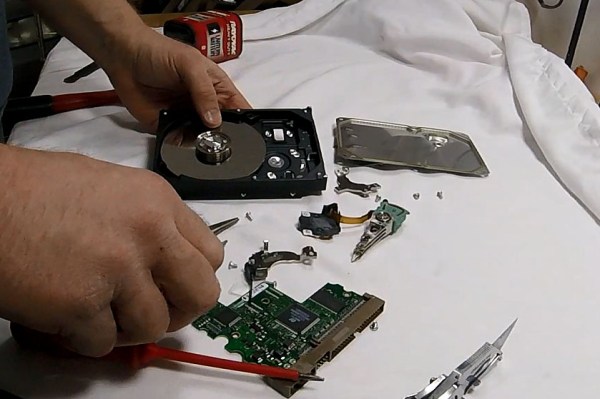
Have any dead hard drives kicking around? Hackaday alum [Jeremy Cook] shows how easy it is to disassemble a hard drive to scavenge its goodies. The hardest part is having the patience and the tools to get past all those screws that stand between you and the treasure inside.

The case screws are frequently of the Torx variety. Any self-respecting hacker probably has one or two of these already, but if you’re in the market, [Jeremy] recommends a nice set that looks way better than ours. Once the case is open, you can find rare earth magnets, bearings, and one or more platters.

Those terrifically strong magnets are good for all kinds of projects. Glue a couple of them to the back of an attractive piece of wood, mount it on the kitchen wall, and you have yourself a knife block. Keep a couple on the bench to temporarily magnetize tools. Use them to build a pickup to amplify a cigar box guitar or thumb piano. Or run the pickup into a small amplified speaker and wave it like a stethoscope near your electronics to hear them hum. As far as liberating the magnets goes, [Jeremy] resorted to clamping his in a vise and using a hammer and chisel to pry it away from the actuator hardware.

You’ve no doubt seen clocks made from old hard drives that were kept mostly intact. Many makers including [Jeremy] will extract the shiny platters to use as bases for clock faces and engrave the numbers, etch them, or glue them on. Those platters also make excellent chimes. Even if you just hang one platter off of a finger and tap it with a fingernail, it sounds really nice.

If simple chimes don’t really butter your muffin, there are all kinds of sonic projects for dead hard drives. How about making a microphone or speakers? Maybe an HDD MIDI controller or a synthesizer is more your speed. Speaking of synths, watch [Jeremy] take a hard drive apart to some sweet sounds after the break.

Continue reading “Hard Drive Disassembly Is Easy And Rewarding”