Acer Aspire One Hard Drive Upgrade


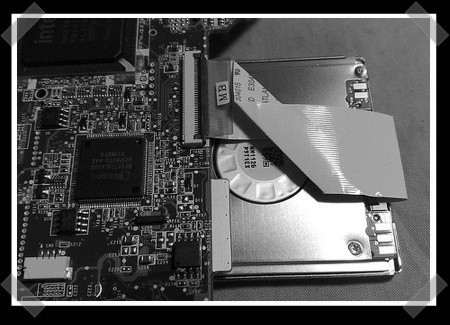
As promised, [tnkgrl] has published part two of Acer Aspire One upgrade. In part one she added Bluetooth and more RAM. This time around she focuses on the storage. The subnotebook comes from the factory with an 8GB SSD. The flash based storage readily unplugs from a small ZIF connector. [tnkgrl] replaced it with a 60GB PATA Samsung drive salvaged from an iPod. It’s a 1.8inch disk and is only 5mm thick, so it can be tucked under the motherboard. Knowing its previous use, it should prove fairly resilient. You can view a video of the swap and more photos on Flickr.

Up next is part three, where she’ll add 3G support.
Modding The Acer Aspire One With Bluetooth


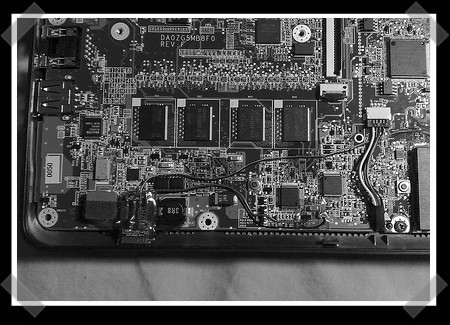
[tnkgrl], a regular around here, is at it again. This time she has modded an Acer Aspire One subnotebook to have internal Bluetooth. She’s released part 1 of a multi part tutorial on beefing up the Aspire One. In this part, she covers disassembly, adding more RAM, and adding the Bluetooth hardware. She suggests that you look at her Bluetooth install on an Asus 701 to find more information as the process is nearly identical.

Part 2 of the tutorial is going to cover upgrading the SSD to a 1.8″ PATA hard drive and putting it back together.

MSI Wind Extended Battery


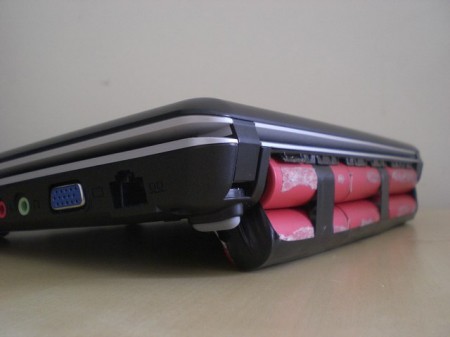
[The Tech Guy] shows us how he added cells to an MSI Wind’s battery. This hack is extremely simple but it may be difficult to get the battery back into your laptop. Also, we’re not too sure how stable it is, and you can definitely forget about taking this thing through an airport. It would be really nice to start seeing people fabricate custom enclosures. Until then, this hack is best reserved for people completely desperate for extended battery life.

[via hypatiadotca]

Adeona: An Open Source Laptop Tracking System


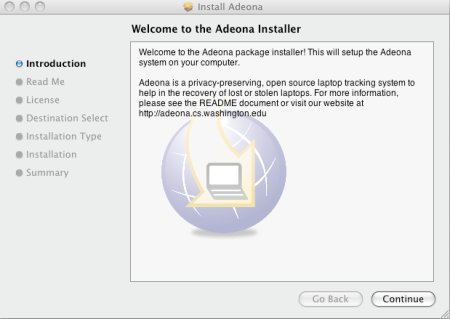
Adeona is an open source internet-based laptop tracking system that is free to use. It’s available for Linux, OSX, and Windows XP/Vista. After installation, Adeona will submit at random intervals, anonymously encrypted updates on the computer’s location to servers on the Internet, specifically to OpenDHT, a free storage service. The information is kept on the servers for one week. If your laptop becomes lost or stolen, you can use the retrieval tool to access information about where your laptop was last used: the external IP address, internal IP address, and nearby routers. If your laptop is a Mac, you can also download isightcapture to grab a picture of the thief. Adeona is designed to protect against common criminals who may not have much technological knowledge, and does not have any protections against events such as disk wipes. The open source nature of Adeona’s system means that there’s ample opportunity to improve upon the release or add extensions. Here’s one user who really likes what he sees.

[via Schneier]

Behead Your Laptop


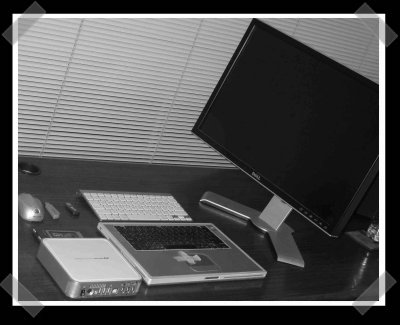
[Mark] sent in this nice trick for breathing new life into an old laptop. [Sarc] had a tibook with a broken LCD. It was still usable with an external monitor, so he simply removed the broken LCD. The tibook (and MacBook) uses a magnetic sensor to monitor the LCD position. To put the machine in the right mode, he taped a magnet in place to make the machine think that the display was in the closed position. To really clean things up, he mounted all the hardware under the desk and used a wireless keyboard and mouse with the machine.

Mac Tablets Made By Fans


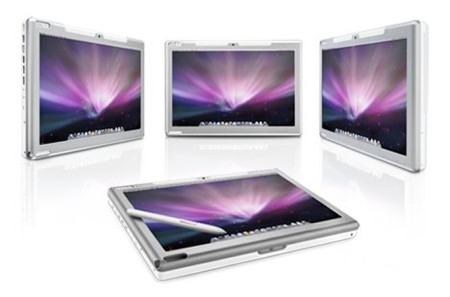
Macintosh makes a lot of wonderful pieces of technology, but they do not make a tablet. Pictured above is the Modbook, the closest you can currently get to a Mac tablet. Though not officially built by Apple, they are an Apple Premier Developer and that isn’t too shabby.

Several people have taken it upon themselves to fashion Mac tablets of their own, varying from extremely professional looking finishes down to duct tape and wire. Lets take a look at some of the more popular ones out there.

Continue reading “Mac Tablets Made By Fans”

Eee PC Tablet Build


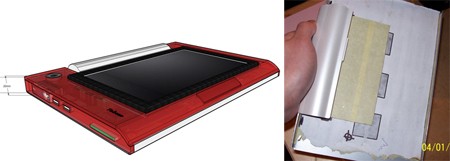
OCAU member [Bismar] was in the market for an e-book reader, but all of his commercial options were too expensive. He decided to build one himself, and what he came up with is the Tabeee MK1, an e-book reader made from a 7″ Eee PC, a touchscreen, and a custom case.

The project is far from completion, still in the midst of its first objective: building the case. [Bismar] cut an old Lian Li case for the aluminum base, then made sure the motherboard from the Eee fit properly. The next major step was bending and cutting an acrylic sheet to form the exterior of the case. He hit a few snags bending the sheet, but forum members offered some ideas on how to do this effectively. The project is still rolling along, and we’ll be sure to show you the Tabeee MK1 when it is finished.