Brainwave-based Assistive Technology In The Home

eeg_smart_house

Amyotrophic lateral sclerosis (ALS) is a debilitating disease that eventually causes the afflicted individual to lose all control of their motor functions, while leaving their mental faculties intact. Those suffering from the illness typically live for only a handful of years before succumbing to the disease. On some occasions however, patients can live for long periods after their original diagnosis, and in those cases assistive technology becomes a key component in their lives.

[Alon Bukai and Ofir Benyamin], students at Ort Hermalin Collage in Israel, have been working hard on creating an EEG-controlled smart house for ALS patients under the guidance of their advisor [Amnon Demri]. The core of their project focuses around controlling everyday household items using brainwaves. They use an Emotiv EPOC EEG headset which monitors the user’s brainwaves when focusing on several large buttons displayed on a computer screen. These buttons are mapped to different functions, ranging from turning lights on and off to changing channels on a cable box. When the user focuses on a particular task, the computer analyzes the headset’s output and relays the command to the proper device.

As of right now, the EEG-controlled home is only a project for their degree program, but we hope that their efforts help spur on further advancements in this field of research.

Continue reading to see a pair of videos demonstrating their EEG-controlled smart house in action.

Continue reading “Brainwave-based Assistive Technology In The Home”

Quick And Dirty Film Dosimeter

With all the talk of radiation in the media today [freddysam] posted a quick Instructable about using standard camera film as a radiation dosimeter. Film is sensitive to other forms of radiation other than visible light, and high speed films are even more susceptible due to their chemistry, which has caused all sorts of headaches to travelers before most people went digital. This uses that headache as a simple way to see if you have been exposed to abnormal amounts of radiation in a  3 step process.

  1. Get some film. Yes they still sell it, it can still be found just about anywhere.
  2. In a dark room unroll a little out of the metal can and put it back in its black plastic container.
  3. Develop it if you think you have been exposed.

The idea is to let a few frames of film to be exposed to normal background radiation and develop it so you have something to compare with in the future, then you can unroll a bit more, and if you think your going into a hot area you can develop that newly exposed film to see roughly how much more radiation there was, maybe helping you sleep better at night.

Zigbee-powered Wireless Scale

[joe] wanted to make it easy to record his weight every day, and added a few bits to decode the weight and send it to his computer. The end result is a ZigBee-powered wireless scale. Additionally, his scale can track more than one person’s data simply by knowing whose previous weight the new measurement is closest to. Now [joe] and his family can spend more time working out, and less time messing with spreadsheets and data entry.

[joe]’s build is not only elegant, but well-documented, too. He walks through the reasons he chose this specific floor scale, reverse engineering it to decode the weight, then provides links to his schematics, source code, and pretty much everything else you would need to play along at home.

Meet Mr. Haas, He Makes Eyes

Here’s a story of an ocularist who makes prosthetic eyes from glass. Obviously here’s a necessary and important service, but we find it surprising that this seems something of a dying art. [Mr. Haas] lives in the UK but notes that most glass eye makers have been German, and tend to pass the trade down to their children. With that father-to-son daughter transfer of knowledge becoming less common these days we wonder just how many people know how to do this any longer.

But don’t despair, it’s not that there won’t be a source for ocular prosthesis, as acrylic eyes are quite common. But what we see in the video after the break is breathtaking and we hate to see the knowledge and experience lost the way vacuum tube manufacture and even common blacksmithing have.

Continue reading “Meet Mr. Haas, He Makes Eyes”

Electrodes Turn Your Eyelids Into 3D Shutter Glasses

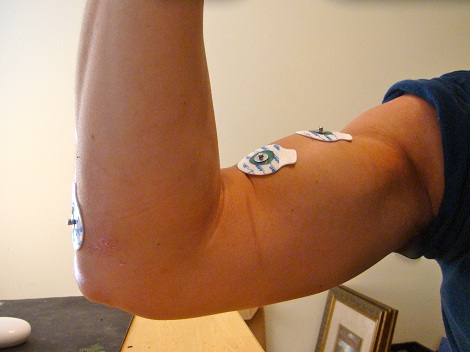
[Jonathan Post] has a way to watch 3D video without wearing shutter glasses but it might be kind of a hard product to break into the market. As you can see above, a pair of electrodes are stuck on a viewer’s eyelids, using electricity to alternately close each eye. The video after the break shows a demonstration of this technology. Obviously a camera can’t capture the image that the viewer sees, but this man describes a perfect 3D image. This reminds us of those ab exercisers that use electrodes to stimulate the muscles. Do you think a 3 hour epic would leave your eyelids tired and sore, eventually resulting and a steroid-esque muscle-ridden face?

Edit from [Caleb]: Judging from the comments, some people believe this to be an absolute impossibility. While we concur that this example is pretty silly (what’s powering those electrodes?), we invite you to watch [Daito Manabe]’s facial electrodes fun.

Continue reading “Electrodes Turn Your Eyelids Into 3D Shutter Glasses”

EEG The Locomotion

The use of brainwaves as control parameters for electronic systems is becoming quite widespread. The types of signals that we have access to are still quite primitive compared to what we might aspire to in our cyberpunk fantasies, but they’re a step in the right direction.

A very tempting aspect of accessing brain signals is that it can be used to circumvent physical limitations. [Jerkey] demonstrates this with his DIY brain-controlled electric wheelchair that can move people who wouldn’t otherwise have the capacity to operate joystick controls. The approach is direct, using a laptop to marshall EEG data which is passed to an arduino that simulates joystick operations for the control board of the wheelchair. From experience we know that it can be difficult to control EEGs off-the-bat, and [Jerky]’s warnings at the beginning of the instructable about having a spotter with their finger on the “off” switch should well be followed. Maybe some automated collision avoidance would be useful to include.

We’ve covered voice-operated wheelchairs before, and we’d like to know how the two types of control would stack up against one another. EEGs are more immediate than speech, but we imagine that they’re harder to control.

It would be interesting albeit somewhat trivial to see an extension of [Jerkey]’s technique as a way to control an ROV like Oberon, although depending on the faculties of the operator the speech control could be difficult (would that make it more convincing as an alien robot diplomat?).

Make Your Own TSA “Naked” Scanner

Have you ever wanted to ability to see through objects? Perhaps you have been looking for something special for your own personal TSA role playing adventures? Well, [Jeri Ellsworth] has your back. She has managed to cobble together her own millimeter centimeter wave scanner using a hacked set of Feed Horns (like from a satellite dish) to create the image. By reversing the power transistor on one of the Feed Horns, one of the horns is made into a transmitter, while one of the other horns stays as a receiver. This data is then fed into a FPGA by way of an A2D converter, where an image is assembled when the scanner is moved over a surface. X and Y axis tracking is handled by an optical mouse also controlled by the FPGA, and the whole setup is output to a monitor.

Right now there is no text write up, or any specific details as the hack will vary by whatever Feed Horn is available. However, the video does a great job of explaining some of the electrical concepts, as well as some very useful schematics. Be sure to watch the whole video after the break, and don’t blame us for any health complications, whether the radiation is ionizing or not.

Continue reading “Make Your Own TSA “Naked” Scanner”