
Diaphragm Air Engine

One of the tricky parts of engineering in the physical world is making machines work with the available resources and manufacturing technologies. [Tom Stanton] has designed and made a couple of air-powered 3D printed engines but always struggled with the problem of air leaking past the 3D-printed pistons. Instead of trying to make an air-tight piston, he added a rubber membrane and a clever valve system to create a diaphragm air engine.

This GIF is worth 115 words

A round rubber diaphragm with a hole in the center creates a seal with the piston at the top of its stroke. A brass sleeve and pin protrude through the diaphragm, and the sleeve seals create a plug with an o-ring, while the pin pushes open a ball which acts as the inlet valve to pressurize an intermediate chamber. As the piston retracts, the ball closes the inlet valve, the outlet valve of the intermediate chamber is opened, forcing the diaphragm to push against the piston. The seal between the piston and diaphragm holds until the piston reaches its bottom position, where the pressurized air is vented past the piston and out through the gearbox. For full details see the video after the break.

It took a few iterations to get the engine to run. The volume of the intermediate chamber had to increase and [Tom] had to try a few different combinations of the sleeve and pin lengths to get the inlet timing right. Since he wanted to use the motor on a plane, he compared the thrust of the latest design with that of the previous version. The latest design improved efficiency by 366%. We look forward to seeing it fly! Continue reading “Diaphragm Air Engine”

Calendar Printer Makes You A Hard Copy On The Daily

We’re blessed to have cloud-based calendars that store all the relevant data on our hyper-busy lives for easy access anywhere and everywhere. However, sometimes a hard copy is nice for when you’re tired of looking at screens. In this vein, [lokthelok] produced a compact device that prints out your schedule on the daily.

The device uses an ESP32 to connect to WiFi, and then query Google Apps for a given user’s calendar details on a daily basis. After grabbing the data, it’s fed out to a thermal printer connected over serial at 9600 baud. As a twist, [lokthelok] has produced two versions of firmware for the project. The master version simply scrapes calendar data and outputs it neatly. The Useless version goes further, jumbling up appointments and printing them out of order. If you’ve got nothing on for the day, it will instead spool out the remainder of the thermal paper on the roll.

It’s a build that would make a handsome desk toy, though we suspect tossing out each day’s calendar could become tiresome after a while. Alternatively, consider a clock that highlights your upcoming events for you. Video after the break.

Continue reading “Calendar Printer Makes You A Hard Copy On The Daily”

DIY Induction Heater Draws 1.4 KW And Gets Metal Hot

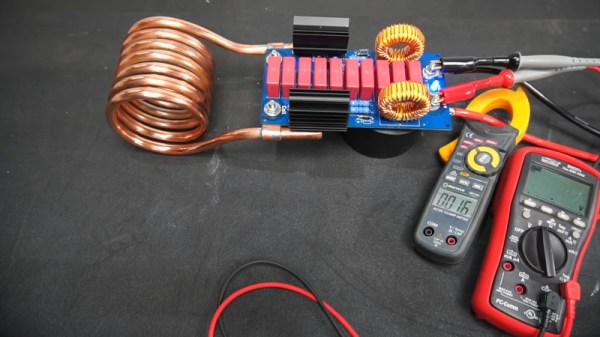
Induction heaters can make conductive objects incredibly hot by generating eddy currents within the metal. They’re used in a wide variety of industrial processes, from furnaces to welders and even heat treatments. [Schematix] whipped up his own design, and put it through its paces on the bench.

The build in question is a fairly compact design, roughly shoebox-sized when fitted with its six-turn coil. Running off anything from 12 V to 48 V, the heater put out at a massive 1.4 kW in testing. At this power level, the high current draw led the power traces to heat up enough to melt solder, and eventually burn out. [Schematix] plans to rebuild the heater with added copper wiring along these traces to support the higher power levels without failure.

The heater is able to quickly heat ferrous metals, though was not able to meaningfully dump power into aluminium under testing. This is unsurprising, as non-ferrous metals primarily undergo only Joule heating from induction, forgoing the hysteresis portion of heat transfer due to being non-magnetic. However, modification to the design could improve performance for those eager to work with non-ferrous materials.

We’ve seen a few induction heaters before, for purposes as varied as soldering and casting. Video after the break.

Continue reading “DIY Induction Heater Draws 1.4 KW And Gets Metal Hot”

A Clap-Activated Machine For All Your Applause Needs

Applause is greatly revered as a symbol of warmth and adoration from a crowd. TV shows that film in front of a live audience often cue their audiences to clap in order to generate the desired auditory atmosphere. Of course, you don’t have to rely on squishy humans to do all the work. [Dillon] built a machine of dubious utility – one which generates mechanical applause when activated by the sound of clapping. (Video, embedded below.)

Somewhat unsurprisingly, the project was built for a Useless Machine contest, but that doesn’t diminish its value as a learning exercise. An Arduino runs the show, using a microphone module to listen out for loud noises such as claps. If two claps are detected in the nominated timeframe, the machine begins to flash its “APPLAUSE” lights and clap its hands. The Arduino achieves this with the help of a relay, which switches on a motor spinning a belt-driven cam which seperates the hands. The hands are then pulled back together to clap via a length of stretchy bungee cord.

With an incredibly noisy drivetrain and somewhat amateur clapping ability, the sound coming from the machine isn’t exactly recognisable as “applause”. However, it’s a start, and it remains the best clapping machine we’ve seen this decade. If you’ve got your own under construction, consider dropping us a line. And if all this has you waxing nostalgic for the vintage Clapper circuit, you can always build one of those, too.

Continue reading “A Clap-Activated Machine For All Your Applause Needs”

Sims-Style Plumb Bob Broadcasts Your Mood

While there are a lot of objects from the Sims that we wish were real, we probably wish more than anything that everyone had a mood indicator hovering above their heads at all times. It would make working from home go a lot more smoothly, for instance. [8BitsAndAByte] made this Bluetooth-controlled plumb bob as part of their Sims Halloween costume, but we think it has real day-to-day value as this pandemic wears on, either as a mood ring or a portable free/busy indicator.

The hardware is about as simple as it gets — an Adafruit Feather nRF52 Bluefruit controls a pair of NeoPixel rings, one for each half of the translucent 3D-printed plumb bob. Power comes from a 500mAh battery, and all the electronics are situated inside of an attractive hat. Check out the build video after the break.

There’s more than one way to use color to convey information. This seven-segment temperature display does it with thermochromic film.

Continue reading “Sims-Style Plumb Bob Broadcasts Your Mood”

TV Head Is Great Replacement For Your Real Head

The head is one of the few parts of the body that it seems impossible to live without. Many people are, of course, not happy with the one they’ve been given. For those dreaming of a more digital replacement, [Vivian’s] TV Head might be just the accessory to meet those needs.

The build starts with an old CRT, which [Vivian] promptly gutted to make room for her head. In place of the original tube, a thin polycarbonate sheet was installed with window tint applied. Behind this, rows of WS2812B are set up in a grid, spaced apart just enough to allow the wearer to see through.  The setup is controlled by a Circuit Playground Express. A small PS/2 keyboard is used to control the light show, and the onboard accelerometer can be used for gravity reactive animations.

For some reason, screens as heads are remarkably emotive, and we kind of want one for daily wear. We can imagine it making a great Halloween costume, too. If you’ve always wanted to cosplay as one of those colorful robots from the Opening Ceremony of the 2002 World Cup, here’s your chance. You will not be surprised that this isn’t the first TV head we’ve featured. Video after the break.

Continue reading “TV Head Is Great Replacement For Your Real Head”

Building A Mask To Induce Lucid Dreaming

While dreams are generally thought of as the unconscious wanderings of the mind, that’s not the full story. Lucid dreams are ones in which the individual is conscious or semi-conscious in the dream state, and may be able to control the dream environment. Over the years, various devices have been used to generate these dream states more reliably. [Ben] decided to have a go at building his own, inspired by designs from the 1990s.

To induce lucid dreaming, the aim is to first detect that the mask wearer is in REM sleep. This is commonly done with an infrared eye tracker, which detects the rapid twitching of the eye. [Ben] used the onboard IR proximity sensor on the Adafruit Circuit Playground Express to pull this off. The accelerometer hardware was then used to detect if the wearer was still, indicating they are indeed fully asleep. Once the user is in the correct state, the mask then flashes LEDs which are intended to be visible to the wearer while dreaming. This allows them to realise they are dreaming, and thus enter a conscious, lucid state.

[Ben] doesn’t report the success rate at using the mask, but we’d love to know more about how well the mask works. We’ve seen others do similar work before, and even a recent Hackaday Prize entry. Video after the break.

Continue reading “Building A Mask To Induce Lucid Dreaming”