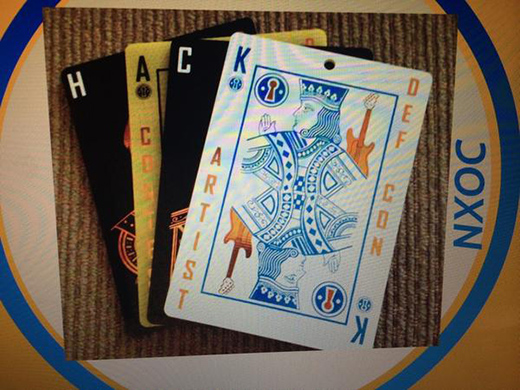
A few weeks ago, [1o57], a.k.a. [Ryan Clarke] gave a talk about puzzles, DEFCON, and turning crypto puzzles into an art form at our 10th anniversary party. Ever the trickster, [1o57] included a crypto challenge in his talk, and a few days after our little shindig, nobody had yet solved the puzzle. Finally, someone bothered to sit down and figure it out. We don’t know what [tahnok] won, but as [1o57] said, solving it is its own reward.
Some of the slides in the presentation had a few characters sitting off to the side for no apparent reason. [tahnok] put these together and came up with:
DOXIYLDCYVDKIKNKUMKRYDNBYGONYMNXOC
In cases like this, you might try a Caesar cipher, or just shifting characters to the left or right a certain number of places. Since [1o57] noted this was the tenth anniversary of Hackaday, [tahnok] tried that first:
TENYOBTSOLTAYADAKCAHOTDROWEDOCDNES
It doesn’t look like much, but that’s only because the string is backwards. Tricky, tricky. tricky. With instructions to send a codeword to an email address, [tahnok] now needed to find a code word. There was one picture [1o57] put up on twitter that was still an unsolved part of the puzzle:

With no idea what these little stickmen are, he scoured google with variants of ‘stickmen code’ and ‘semaphore’ until he hit upon the Sherlock Holmes story, The Adventure of the Dancing Men. It’s a simple substitution cypher, translated to, “codeword psychobilly ciphers”
And that’s the entire puzzle. As far as we know, this took about a month to solve, and compared to the DEFCON challenges, was fairly simple. [1o57] will probably chime in down in the comments to tell everyone how many people have picked up on the clues and sent an email.
 Three days ago on October 21, 2014 it was announced to the world the Back to the Future hoverboard was real. It’s a Kickstarter, of course, and it’s trending towards a $5 Million dollar payday for the creator. Surprisingly for a project with this much marketing genius, it’s a real, existing device
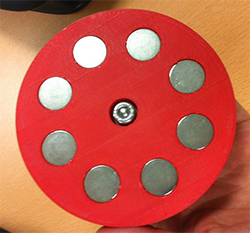
 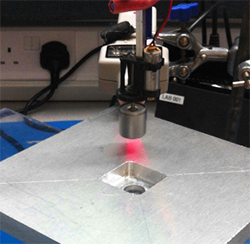 Like the Kickstarter hoverboard, [jelly] is using an array of magnets rotating in a frame above a non-ferrous metal. For the initial test, eight neodymium magnets were arranged in a frame, suspended over 3/4″ aluminum plate, and spun up with a drill. With just this simple test, [jelly] was able to achieve 2kg of lift at 1cm and 1kg of lift at 1 inch of separation. This test also provided some valuable insight on what the magnets do to the aluminum or copper; the 3kg aluminum plate was nearly spinning, meaning if this device were to be used on small plates, counter-rotating pairs of magnetic lifters would need to be used.
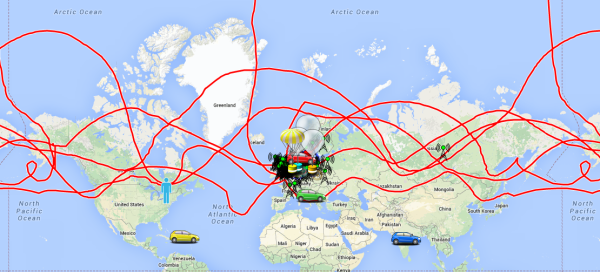
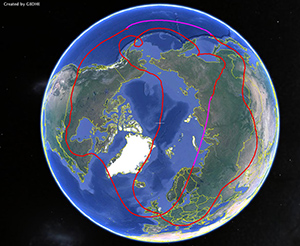 The balloon was launched July 12, 2014 from Silverstone, UK. In the 100 days since then, this balloon has covered 144168 kilometers and has crossed its launching longitude six times. Even if this balloon weren’t trapped at high latitudes (including coming within 9 km of the pole), this balloon has still travelled more than three times the equatorial circumference of the Earth.