High Voltage: Using Enclosed Relays For HV Switching


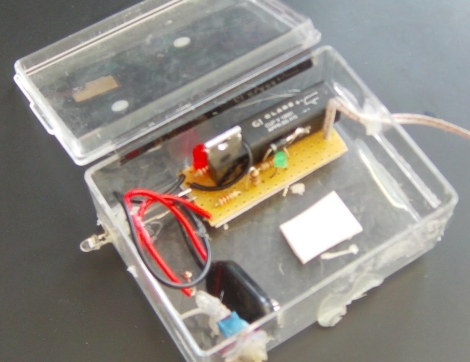
After seeing many projects that use microcontrollers to switch mains voltages [Rob Miles] decided to share his preferred method. The shots you see above are an enclosed relay, part number RIBTU1C manufactured by Functional Devices Inc.

This in itself is not the full control scheme that he uses, but it takes care of the bulk of the hardware. He uses a triggering circuit based on a 555 timer (PDF). [Rob] mentioned that if you shop around, you can get the relay, 555 timer, and other components for under $15. This is a great solution for the money when you consider that you get an enclosure meant for handling high voltage and a nice terminal block to which you can connect the mains wiring. The relay itself can be triggered by a 9V battery via the transistor in the control circuit.

Notice the protoboard in the image above. There’s plenty of room for your driver circuit to rest inside the box, protected by that barrier from the HV circuitry. Check out the rest of the images he sent us after the break.

Continue reading “High Voltage: Using Enclosed Relays For HV Switching”

Robotic Artist Listens To Your Criticism

[Ben Grosser] built an interactive painting robot that’s pretty far removed from the LED and Arduino builds we usually see. The robot is adapted from one of the many CNC routers we’ve featured over the years. The control system is written in Python and uses genetic algorithms and a microphone to decide what to paint next.

Robot artists have been around for decades now. When [Harold Cohen] exhibited his robotic artist AARON, gallery patrons lined up to watch a robot paint. The paintings were originally just a monochrome line drawing that was later colored in by [Cohen]. [Ben] made his robot paint directly onto canvas with oil paints, so there’s no question of what the computer intends the final product to be.

[Ben] came up with a really neat build, but we’re wondering about having this robot artist on display inside a cavernous exhibition hall. Surely the echos from the servos and stepper motors would be picked up by the mic and interpreted by the painting algorithm. Barring some control systems, it would probably be the robot’s commentary on its own decent into madness.

Check out a video of the robot in action after the break, followed by a violin/robot duet the shows how the audio is interpreted.

Continue reading “Robotic Artist Listens To Your Criticism”

High Voltage Plasma Lamp Is Also Tasteful Steampunk

Instructables user [Admiral Aaron Ravensdale] just finished a high voltage plasma bulb build that makes creative use of off-the-shelf parts. As a self-described steampunk, [Adm. Ravensdale] also earned some cred by included working gears in his build.

The heart of the build is a “flicker flame” candle light bulb. These light bulbs have two flame-shaped plates inside the bulb to act as electrodes. Instead of the Argon that normally fills an incandescent light bulb, the candle bulb is filled with Neon. When excited, Argon gives off a rather unnatural purple glow – not very convincing for a simulated candle and certainly not steampunk. The Neon in the flickering candle bulb gives off a brilliant orange, perfect for simulating a flame and will surely impress the duchess during afternoon tea.

After the right plasma bulb was found, [The Admiral] scavenged the rest of the high voltage electronics from disposable cameras. Attaching three electrodes to a brass gear, the entire mechanism was made to spin using parts from an old clock and a CD drive motor. We’re always impressed with the scavenging abilities of steampunkers – we’d still be waiting for our gears to arrive if we attempted this. Check out the video of this really cool and very inexpensive plasma bulb after the break.

Continue reading “High Voltage Plasma Lamp Is Also Tasteful Steampunk”

Who Knew Jacob’s Ladder Builds Had So Many Options?

[Grenadier] has a thing for the high voltage and, as you can see, he’s found multiple ways to build the icon of HV toys – a Jacob’s Ladder.

The three look similar, but they use different means of generation the voltages necessary to get a spark to jump through the air. The exhibit on the left uses a neon sign transformer, the one in the middle is based on a transformer from an X-ray machine, and the example to the right uses a microwave oven transformer. [Grenadier] discusses the pros and cons of each method, then links to his in-depth posts about working with each one them. There are also videos for all three. We’ve embedded the video for the microwave oven transformer after the break. That version of the Jacob’s Ladder requires some way to start the spark and in the video he’s doing it manually. There is always the option to add a solenoid to do the job but he does mention that you can’t just let it run because that cheap transformer will burn out before long.

If you like what you see here, perhaps you’ll be entertained when he runs HV through some soda cans.

Continue reading “Who Knew Jacob’s Ladder Builds Had So Many Options?”

Simple Device Answers Questions Just Like Your Boss Does

executive_decision_maker

Like many of us, [Bertho] has had plenty if interaction with “Executive” types who seem to make decisions randomly, and most certainly not based upon any sort of reason. As he was picking through parts bins at his local hackerspace, he thought it would be fun to build an “Executive Decision Maker”. The device he had in mind would answer questions at the push of a button, with the kind of randomness that could only be carefully honed through years of barking orders from a corner office.

Constructed from third-rate LEDs and old CMOS chips that were lying around, the operation of the device is quite simple. Much like a Magic 8 Ball, a question is posed, and as [Bertho] states, “The Executive Decision maker automatically tunes into the aether and the subconscious of the user” pressing the “Decide” button. The device then makes a judgement, relaying its answer to the user via an LED display.

We definitely got a good laugh out of this one, so be sure to check out the video after the break to see the Executive Decision Maker in action.

Continue reading “Simple Device Answers Questions Just Like Your Boss Does”

Obama-1 Desk Spy Satellite Aims For High Approval Ratings

This miniature “spy satellite” may not gain the ire of the Chinese People’s Army, but it will certainly look rad on your desk.  Besides looking cool, this “satellite” is able to transmit video up to 300 feet away and has sun tracking solar panels for battery recharging. Additionally, it has a LED “thruster” and speakers.

One cool thing about this build is that the body was made out of a lamp from Goodwill. Recycled/thrift store enclosures always make a good addition to your project as they won’t break the bank. Additionally, they may yield some other bonus parts when taken apart. In this case, the lamp fit into the project scope perfectly, but anyone trying to duplicate it might not be so lucky.

Creative use of other household materials rounds out this build, with solar panels taken off home garden lights, and part of a nose hair trimmer used as the “thruster” body. This well-build project is a great example of how to convert household items into something totally different and unique.

[youtube http://www.youtube.com/watch?v=pGqTmnSP71U&w=470&h=349%5D

Impressive Lighting Console Offers Professional Features For A Fraction Of The Price

diy_dmx_lighting_control_panel

Hackaday reader [Michael] wrote in to share the build details of an impressive lighting console he has been working on for some time. He says that the 36+ channel console is on par with lighting rigs costing upwards of $5,000, but his was constructed for just around $1,000 – quite the substantial savings.

The console was constructed around an old IBM desktop computer, which handles all of the DMX output as well as preset management. An array of 20 ATMega 328Ps running the Arduino bootloader are scattered throughout the device, 18 of which are used to manage the six fader panels, while the remaining two handle management tasks. Aside from the fader banks, the console features a main control board featuring several LCD screens along with 17 capacitive touch buttons used for menu navigation and console control.

While [Michael] is finished building the board, he has just begun the documentation of the construction process. His blog should be updated regularly with more details, so be sure to check back often. Code, as well as hopefully tons of pictures and videos are all forthcoming.

[Edit: Cost comparison update]