Fog Horn Built From Plumbing Supplies

diy_plumping_supply_fog_horn

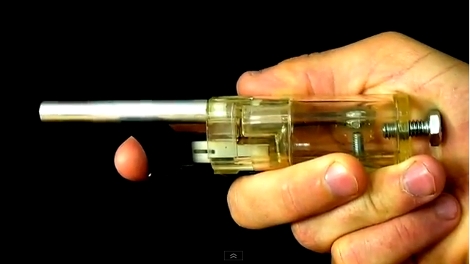
Instructables user [rog8811] was looking to build a fog horn that resembled hand-pumped units found on small ships in the early to mid 1900s. His budget was a bit limited, so he set off to build the cheapest replica possible.

While the original horns were likely constructed from steel, copper and wood, he opted to use cheap plumbing components he found at his local hardware store. He used a simple double-acting air pump to drive the horn, combining it with a slightly modified bottle trap. The trap was shortened, and a diaphragm cut from a dish washing glove was added to generate sound.

He added a few more pieces of PVC piping to enhance the output, giving him the results you see in the video below. He says that the best thing about his design is the ability to easily tweak the pitch and volume of the horn by simply adding different drain components to the pump.

Watch out vuvuzela, there’s a new cheap and annoying horn on the block!

Continue reading “Fog Horn Built From Plumbing Supplies”

Boobie Board Powered Twitter Notifier

boobie_board_twitter_notifier

The team over at Archonix frequently challenge themselves to create a full working project in under 20 minutes. [Andrew Armstrong] put together a blog post detailing their most recent “Quickproject” – a simple Twitter notifier built using their Boobie Board.

They started by putting together a small notifier breakout module that could later be attached to their Boobie Board. The module is pretty simple and includes a trio of LEDs to alert you to activity across several online services, though only the Twitter notification module is currently complete. The notifier’s code was written in LUA, and primarily designed to interact with Linux desktops. They do not currently have a Windows compatible version of the code available, but they are more than happy to host it if someone desires to port their code over.

The notifier was put into an old candy tin with a plastic window, which is perfect fit for their project. All in all, the entire thing took them about 40 minutes, with half spent on hardware, half on code. The notifier does just what it was intended to do, but they have a healthy list of improvements that they would like to add, including the use of the other two notifier LEDs.

Tour Of Advanced Circuits – A PCB Manufacturer

Although not a hack in itself, many of you may be interested in seeing how a printed circuit board is made in the manufacturing world.  This tour of Advanced Circuits does a good job of explaining the process. The article explains how a PCB will go through a CAD/CAM review, drilling, deburring, and the various chemical etch, plating, and curing processes.

Although many hackers make their own PCBs, having it professionally done can be a good option depending on how many copies are needed. One benefit of this is that PCBs can be checked by an optical inspection process, or even by a “flying lead” machine which works by contacting leads automatically in a computer controlled setup.

A video of this incredible machine is included after the break.  Around 0:26 is when it really starts to get going. Continue reading “Tour Of Advanced Circuits – A PCB Manufacturer”

The PixBoard

Many hacks are, of course, interesting in their own right. Hacks like this one, however, fulfill a much greater purpose by helping people overcome their disabilities. The PixBoard is “an illuminated board adapted for disabled people, especially for people with cerebral palsy, giving them access to games using shift technology.”

This device was developed for a girl that has cerebral palsy and can’t control her arms or legs effectively. In order to interact with the world more effectively to play board games and the like, this system was developed. The PixBoard scans an 8×8 matrix of LEDs allowing her to select the piece to be moved and where to move it. This is done using only simple buttons and the processor’s timer.

The system is controlled using an Arduino, so anyone is free to create their own games for this system depending on the situation. The following video is in Spanish, but shows this device in action around 1:20. Continue reading “The PixBoard”

Measuring RPM With Reflective Sensors

[Arao] wanted to measure the RPM of a spinning wheel using parts that he could scavenge from his junk box. A bit of thought led him to build a reflective sensor which can measure the spinning of a wheel (translated).

He got his hands on an infrared phototransistor which had been used as part of the remote control for some consumer electronics. Snooping around with his multimeter helped him establish the pin out of the device. By positioning an IR LED inside of a shroud, yet adjacent to the phototransistor, he can measure the intensity of the LED’s light as it is reflected off of nearby surfaces. The pulley seen above has a piece of electrical tape on it. When this passes by the LED, less of the infrared light is reflected and the drop in intensity is picked up by the phototransistor. [Arao] made the system rock-solid by rolling an LM358 op-amp into the circuit. He’s posted the schematic as well as some screen shots from an oscilloscope during testing.

Keeping Tabs On Your Pets’ Busy Lives

mouse_wheel_tracking

[Stephen’s] daughter has a pair of mice she keeps as pets, who happen to be quite active at night. After they kept her awake for an entire evening by running like mad in their treadmill, they were moved from her bedroom. Since they were so active in the treadmill, [Stephen] thought it would be cool to try measuring how much the mice actually ran each night.

To keep track of their activity, he built a simple circuit that records how many rotations the treadmill makes. He fitted it with a rare earth magnet, installing a reed switch on the outside of case that ticks off each spin of the wheel. Any time the wheel starts moving, his PIC begins counting the rotations, displaying them on a 7-segment LED display. To mitigate data loss in the event of a power outage, the PIC stores the current number of rotations in its EEPROM every 10 seconds or so.

The counter keeps track of the total number of rounds the mice have completed, which his daughter uses to manually calculate their running sessions. Since they started tracking the mice, they have run over 700,000 rounds, sometimes completing as many as 20,000 in an evening.

We think it’s a pretty cool project, especially since it makes it fun for his daughter to stay involved in her pets’ lives.