Making A Real Instrument Out Of A Kaoss Pad And Ribbon Controllers

swinger

MIDI guitars have been around since the 80s, and nearly without exception they are designed as direct, one-to-one copies of their acoustic and electric brethren. [Michael] has been working on turning this convention on its head with the Misa Tri-Bass, a MIDI guitar designed to be the perfect guitar-shaped synthesizer interface.

The tri-bass doesn’t produce any sound itself; instead, it’s a polyphonic MIDI controller with three channels controlled by three ribbon controllers on the neck. The body contains a huge touch screen divided into four MIDI channels, essentially turning this guitar into an instrument designed for electronic music first, and not an acoustic instrument kludged into filling an electronic role.

Unlike a whole lot of other digital guitar-shaped MIDI controllers, the tri-bass is actually made out of wood. Yes, the neck is made out of maple (inlaid with the three ribbon controllers, of course), and the body comes directly from a tree, with the styling inspired by a forgotten retro-modern design. It’s an impressive piece of kit, and we can’t wait to see [Michael]’s handiwork in the hands of digital guitarists the world over.

You can check out a video of [Michael] rockin out below.

Continue reading “Making A Real Instrument Out Of A Kaoss Pad And Ribbon Controllers”

FLAMEnco Guitar

flamenco

[John] says, “I noticed an unfortunate lack of many flamethrower guitars on the web so I filled the need. ” That’s just awesome by us.

This series of guitar-mounted flamethrowers started with a small build, able to shoot a six-foot flame for about 40 seconds. Yes, very theatrical, but not something you’d want to change out after every song. From there the builds progressed to systems with more barrels, more fuel tanks, and a huge system that shoots 18-foot long flames colored with standard pyrotechnic supplies.

It should go without saying that this stuff probably isn’t something you should try at home. That being said, you really have to admire the craftsmanship and tenacity to make a guitar mounted flamethrower. Just don’t bring it to an indoor gig.

Continue reading “FLAMEnco Guitar”

Touch Control For Every Key On The Keyboard

keys

Of all the musical instruments out there, the keyboard is among the worst for changing the pitch and timbre of individual notes. Wind and stringed instruments can do this easily in the hands of a skilled player, but outside the wheel and joystick controls of a few electronic keyboards, tickling the ivories means the only thing you can really change about how something sounds is the volume.

TouchKeys wants to put an end to this severe lack of dynamics available on keyboard instruments. Basically, it turns every single key on a keyboard into a multi-touch sensor, allowing any keyboardist to change the pitch, filter, timbre, or any other parameter of their instrument simply by moving their finger around on a key.

TouchKeys works by overlaying all the keys on a keyboard with circuit boards that plug into a module hidden under the hood. These boards are studded with capacitive sensing points, allowing a computer to recognize where the player is touching each key, and modifying filters or volume for each key independently.

The TouchKeys Kickstarter is offering a kit to equip a 25-key keyboard with these sensors for about $550. A hefty price tag, but hopefully we’ll see this tech in real production keyboards in the future.

Popup Book Includes A Playable Piano Keyboard

pop-up-book-has-playable-piano

This popup book contains several interactive electronic elements. It’s the creation of [Antonella Nonnis] using mostly scrap materials she had on hand. Of course there are some familiar players behind the scenes that take care of the electronic elements.

Her photo album of the build process sheds light on how she pulled everything together. Instead of adding switches for interactivity she built capacitive touch sensors on the backs of the pages. Strips of copper foil serve as flexibly traces, moving the connections past the binding and allowing them to be jumpered to the pair of Arduino boards which control the show. That’s right, there’s two of them. One is dedicated to running the pop-up piano keyboard seen above. The other deals with Art, Math, and Science elements on other pages.

This continues some of the multimedia work we saw popping up in popups a few years back.

Continue reading “Popup Book Includes A Playable Piano Keyboard”

Prosthetic Spines Become Musical Instruments

spine

[Joseph] and [Ian] have been working on a project that turns physical objects into bendable, snake-like controllers

This build is the culmination of an earlier project that digitally modeled a flexible object with accelerometers, gyroscopes, and IMUs. When we first saw this build, we wondered what it could actually be used for, but it seems [Joseph] and [Ian] came up with a pretty cool use for it: turning prosthetic spines and ribs into musical instruments.

These flexible devices are loaded up with sensors along their joints and are connected to a microcontroller with a Zigbee radio transceiver. The positioning data from these devices is transmitted to a computer where it’s turned into audio, effectively turning a dancer into a musical instrument.

For an art piece, it’s pretty cool, but as a new means of interacting with a computer, we’re thinking this might be a game changer. Imagine a gauntlet loaded up with IMUs being turned into a waldo, or precisely controlling virtual objects naturally with your hand.

The Perils Of Cheap MIDI Adapters

MIDI

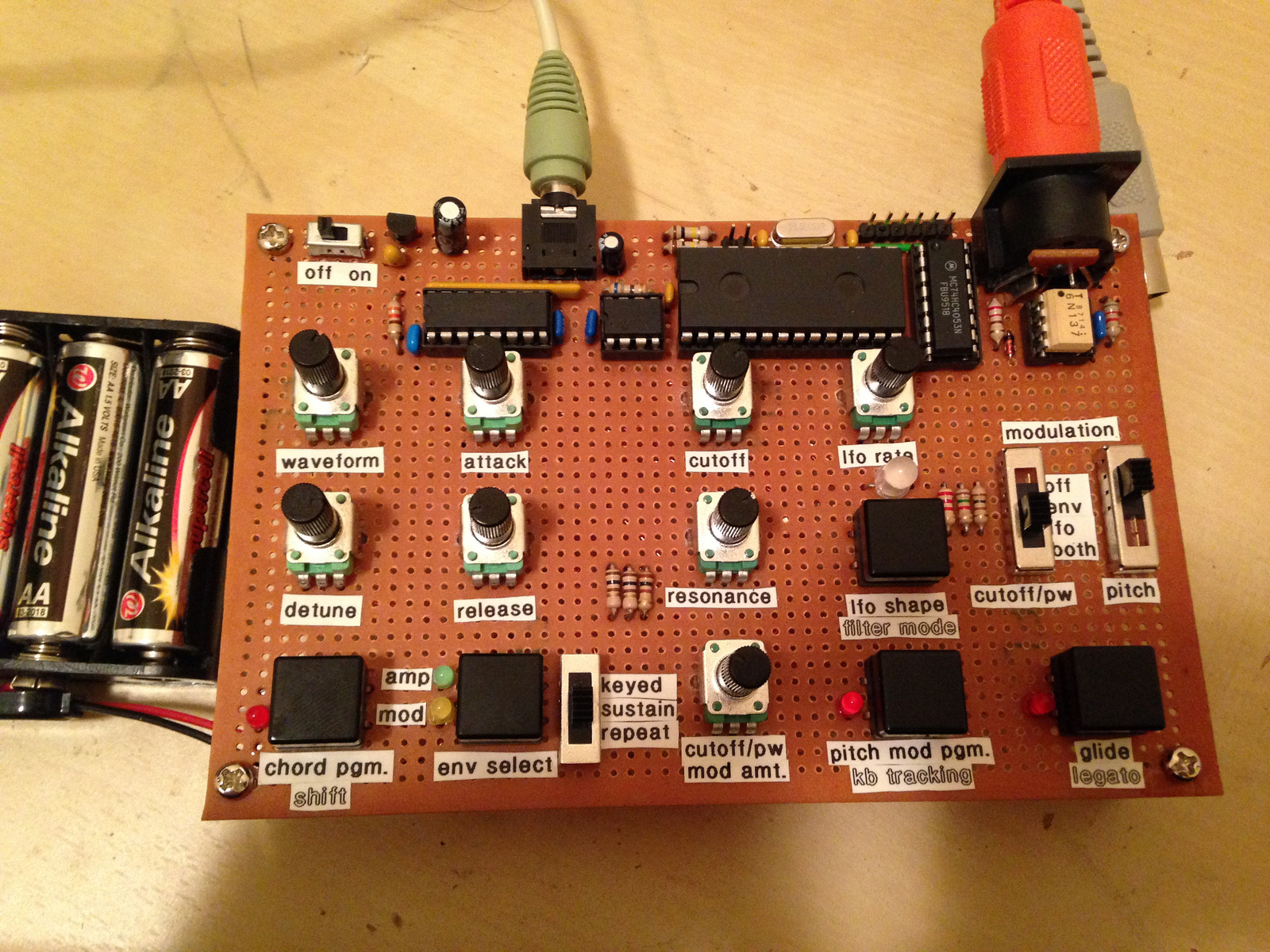
[Arvydas] recently bought a Rock Band 3 Wii keyboard thinking it would be an excellent and very inexpensive (£9.99) MIDI controller. The keyboard has a proper DIN-5 MIDI out port, so theoretically the only thing needed to plug this into a computer is a USB to MIDI adapter. Unlike the keyboard, the MIDI adapter was a cheap piece of Chinese cruft, but given some ingenuity and a handful of components, he was able to get everything working.

The 30-year-old MIDI specification includes a few schematics on how to properly connect MIDI devices together. The most important part of these schematics is an optoisolater on the MIDI in, a valuable addition considering early MIDI keyboards cost thousands of dollars. It seems [Arvydas]’ MIDI to USB adapter didn’t include this vital component, instead replacing it with a simple resistor. Anything to keep costs down, right?

To get the MIDI adapter working, [Arvydas] headed over to Maplin and bought an optioisolator, With everything wired up on a breadboard, he got it to work and eventually transplanted the circuit to the adapter’s PCB.

It’s a great piece of work to get this MIDI adapter functioning, especially since it’s doubtful the cheap adapter would have worked with any MIDI device.

From Maple And Spruce To An Archtop Guitar

archtop

While the violin maker gets most of the acclaim and prestige for turning lumber into musical instruments, you can’t deny the sheer beauty and grandeur of a jazz-style archtop guitar. Much larger than a violin or viola, the scale of a guitar can still lend itself to the exacting artistry of a master luthier, while adding some interesting engineering challenges not found in smaller stringed instruments.

Last year, [Bert van der Meij] built an archtop guitar for his daughter by following the bible written by a modern master, [Robert Benedetto]. The build began by sourcing huge blocks of quartersawn maple and spruce, carefully carving the spruce for the top and the maple for the back. The neck is made of three laminated strips of maple, carefully contoured with only hand tools.

In [Bert]’s video, there’s some interesting examples of the tools used in the creation of this fine instrument. Instead of carving the inside and outside of the top independently, [Bert] only carved the top and used a drill press set to a certain depth to rough out the back. With only a minimum of planing, this ensures the top has a constant thickness with a minimum of work.

The end product is  a fine enough instrument to find its way onto the stage of any jazz club, as shown in a demo video of a few different musicians rocking out. A magnificent piece of work, and a wonderful gift to [Bert]’s daughter.