Air Harp Using The Leap Motion

leap-motion-air-harp

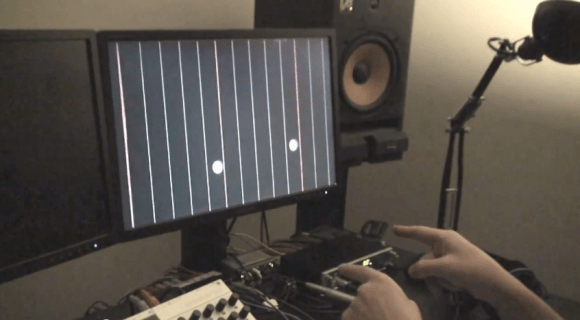
He’s just pointing in this image, but this Air Harp can be played using many fingers as once. It’s a demonstration which [Adam Somers] threw together in one weekend when working with the Leap Motion developer board. We first heard about this slick piece of hardware back in May and from the looks of it this is every bit as amazing as first reported.

Part of what made the project come together so quickly is that [Adam] had already developed a package called muskit. It’s a C++ toolkit for making music applications. It puts the framework in place what we hear in the video after the break. The weekend of hacking makes use of the positional data from the Leap Motion and handles how your digits interact with the virtual strings. You can watch as [Adam] adds more and more strings to the virtual instrument for his finger to interact with. The distance from the screen is what decided is your finger will pluck or not. This is indicated with a red circle when your fingertip is close enough to interact with the phantom string.

Get your hands on the code from his repositories.

Continue reading “Air Harp Using The Leap Motion”

Japanese Drumming Sensei

taiko-drum-tutor

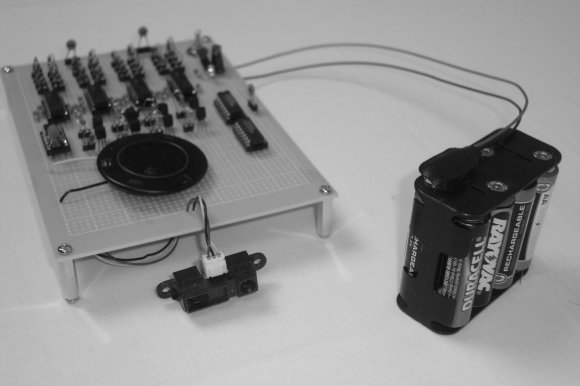
If you’re looking to learn the art of playing Japanese drums, or Taiko, this hack, done as a school project by [Cornell] students, could be a really helpful aid. The project write-up is very impressive and includes a detailed explanation of their work, the source code, and a bill of materials if you’d like to try to duplicate this device.

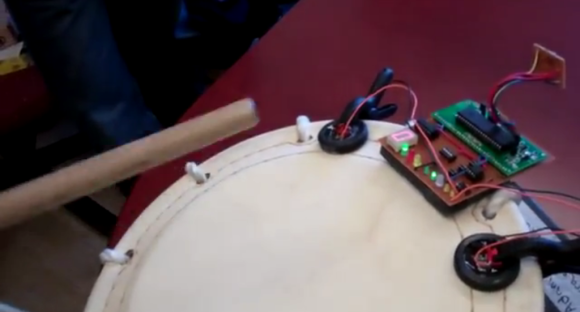
The tutor device is able to tell between soft hits, hard hits, and rimshots using a piezoelectric sensor hooked up to an ATmega1284P microcontroller. This data can then be transmitted to the “follower” drum using an infrared transmitter. These beats can be used in several modes including: follow the leader, metronome, repeat after me, and drum battle mode.

Ok, maybe there’s no drum battle mode, but be sure to check out the demonstration of the Taiko teaching aid after the break.  There’s a lot of details about the build, but they start some calibration drumming around 4:00 if you’d just like to see it in action. Continue reading “Japanese Drumming Sensei”

Guitar Foot Controller Uses DSP For Audio Effects

guitar-pedal-dsp1

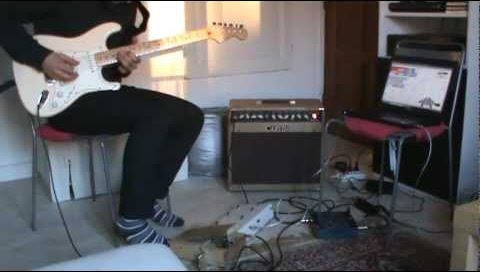
This a screenshot taken from [Pierre’s] demonstration of an electric guitar effects pedal combined with DSP and Pure Data. He pulls this off by connecting the guitar directly to the computer, then feeds the computer’s audio output to the guitar amp.

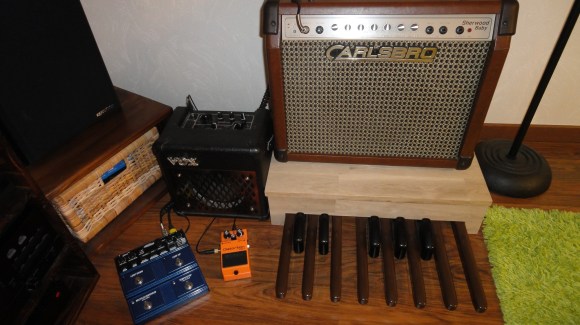
The foot controls include a pedal and eight buttons, all monitored by an Arduino. Pure Data, a visual programming language, interprets the input coming from the Arduino over USB and alters the incoming audio using digital signal processing. [Pierre] manages the audio connection using the JACK Audio Connection Kit software package.

In the video after the break he’s using a laptop for most of the work, but he has also managed to pull this off with a Raspberry Pi. There’s no audio input on the RPi board, but he’s been using a USB sound card anyway. The other USB port connects the Arduino and he’s in business.

Continue reading “Guitar Foot Controller Uses DSP For Audio Effects”

100 Meter Spring Reverb Makes Us Hear Satanic Voices

Spring reverb is something we’re used to hearing about when it comes to guitar amplifiers. It’s a coil spring stretched the length of the amp’s housing. One end is fed the guitar signal, with a pickup at the other to capture the output. But this spring reverb is on a much grander scale. [Jochem van Grieken] strung up 100 meters of coiled steel wire in a long hallway and the results sound a little bit evil.

A simple piezo element is used as a pickup to amplify the sound coming off of the spring. Above [Jochem] is using what looks like a jeweler’s saw to make some sound on the 3.5mm wire. It’s this portion of the video that sounds demonic to us. In the second half of the demonstration he strikes the wire with a ruler to produce the pew-pew effect from many a sci-fi movie.

This isn’t his first experiment with the concept, it’s just his largest. Also found after the break are a pair of links to his other installations.

Continue reading “100 Meter Spring Reverb Makes Us Hear Satanic Voices”

Turning Toy Pianos Into MIDI Keyboards

Building a MIDI device is always a great microcontroller project, and nearly everyone has an old toy keyboard lying around in the back of a closet or in the basement. [JenShen] decided to take one of these toy keyboards and build a MIDI keyboard.

The keyboard [JenShen] used was a simple Casio keyboard with built-in voices. After tearing out the guts of the keyboard, the only thing that remained is the row of push buttons underneath the keys. These buttons were laid out in a row/column matrix, so [JenShen] needed to decode this matrix before sending the result to an Arduino for processing.

A 74HN595 shift register was used to read the 8 rows of buttons underneath the keys, while the rows were tied to different input pins on the ‘duino. This allowed [JenShen] to scan the keyboard matrix with an Arduino and generate MIDI notes and send them to other synths.

In the video after the break, you can check out [JenShen]’s circuit and code that allowed him to turn a toy keyboard into a proper 32-note MIDI keyboard. It’s not velocity sensitive, but he says he’ll show everyone how to accomplish that in a future post.

Continue reading “Turning Toy Pianos Into MIDI Keyboards”

Glockentar: A Guitar + Glockenspiel Mashup

This unique electronic instrument combines a chopped up guitar and a hacked apart glockenspiel with an Arduino. [Aaron]’s Glockentar consists of guitar hardware and glockenspiel keys mounted to a wood body. Solenoids placed above the keys actuate metal rods to play a note.

Under the hood, an Arduino connects the pieces. The conductive pick closes a circuit, which is a digital input into the Arduino. This actuates the corresponding solenoid to play the glockenspiel key, and sends a character to a computer over serial.

On the computer, an openFrameworks based program creates lighting that is projected onto each string. MadMapper is used for projection mapping, which maps the openFrameworks output to each string. Video is passed between applications using the Syphon framework.

[Aaron] has provided a write up that goes into details, including the Arduino and openFrameworks source for the project. There’s also a video overview and demo of the Glockentar after the break.

Continue reading “Glockentar: A Guitar + Glockenspiel Mashup”

MechBass: A Robotic Bass Guitar That Sounds Fantastic

[James] wrote in to show us his honors project for his fourth year at Victoria University of Wellington. He designed and built this robotic bass guitar. You can hear it performing “mass hysteria” by the band Muse after the break. It sounds great, but we’d love to hear it without the full accompaniment.

[James] doesn’t have a site up for the MechBass, so we’ve included details below.

Continue reading “MechBass: A Robotic Bass Guitar That Sounds Fantastic”