Theremin Takes The Touch Out Of Multitouch

Multitouch builds are all the rage now, so it’s not surprising someone would come up with a multi-touchless interface sooner or later. [Hanspeter] did just that; his Multi-touchless ribbon controller, a.k.a. Polymagnetophonic Theremin is multi-touch without the touch.

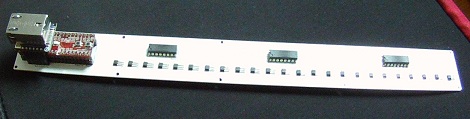
[Hanspeter]’s touchless ribbon controller uses an array of 24 Hall effect sensors that activate whenever a magnet mounted on a thimble is placed near a build. These sensors go to an ARM-equipped Maple Mini to record multitouch events and send them out over Ethernet.

Even though [Hanspeter] is only using his “multi-touchless ribbon sensor” as a theremin, there’s no reason why it couldn’t be put to other uses. It’s entirely possible to place several of these magnetic sensors in an array and build a real Minority Report interface where the user interacts with a computer without touching anything.

After the break is a video demo showing off how much control [Hanspeter] can get with the thimble/magnet setup. There’s also a few demo songs made with SuperCollider showing off a trio of sitar/Moog/harpsichord synths.

Continue reading “Theremin Takes The Touch Out Of Multitouch”
Update: Many Improvements To Optical-sensor-based Piano

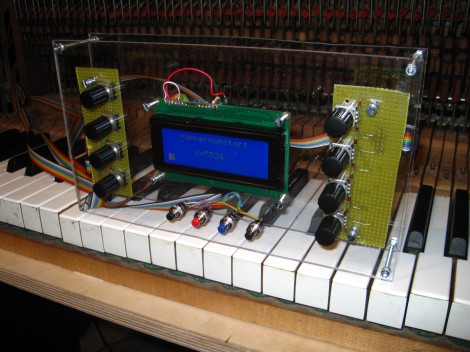
[Sebastian] wrote in to update us about the optical sensor project he started a couple of years ago. You’ll find his most recent update here, but there are four different post links after the break that document various parts of his progress.

You may not recall the original project, but he was looking to add resolution and sensitivity to the keystroke of an electric keyboard. With the sensors built, he started experimenting with using the force data to affect other parts of the sound. His post back in January shows this bending the pitch as the keys receive more force from the player.

In March he installed the sensor array in an old piano. The video he posted where he plays the piano, but we hear the sound generated from the sensor inputs. We’ve embedded it after the break.

Last week he published two posts. They cover a redesign of the sensor boards, and the panelization work he’s done to help bring down manufacturing costs. The base unit was redesigned to use an AT90USB microcontroller which consolidates the separate chips used in the previous version.

Continue reading “Update: Many Improvements To Optical-sensor-based Piano”

How To Make A Whamola

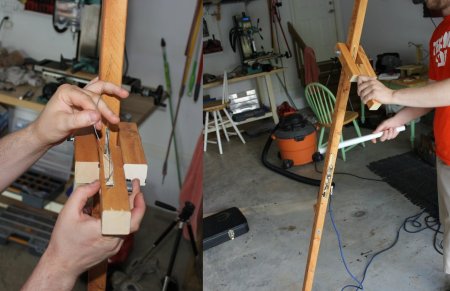
whamola stringing and playing

If you’ve ever wanted to combine the extreme note-bending capability of a trombone with the obvious awesomeness of a bass guitar, maybe a whamola like this one could be for you!  I’d never heard of one until recently, and haven’t picked up my bass in years, but my much more musically inclined cousin and I decided to build one.

It should be noted that this instrument is quite prone to string breakage if the handle is used too forcefully, so caution should be used both when building and playing.  As with many hacks an old piece of equipment, a bass guitar in this case, was partially sacrificed to make it.

The build itself, outlined here for the main assembly, or this post for mounting the electronics, was quite simple.  It took an afternoon of milling machine and miter saw work to get the 1 3/8 inch square piece of wood cut to size.  Cavities for the electronics and a slot for the handle axis (components for a screen repair tool and a bolt) were cut with the milling machine – a router could also be used.  It turned out to be a ton of fun to play, especially with an amp and distortion pedal.  Check out the video after the break to see us playing it, as well as one of the whamola going together! Continue reading “How To Make A Whamola”

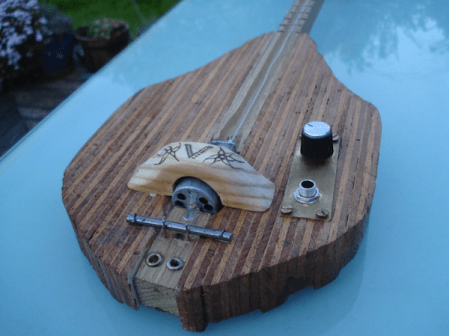
The Dronitar; A Scrap Made Motorized Sitar

This peculiar instrument, called the Dronitar,  is completely made from scrap. Interestingly, it sounds pretty good. You can hear the dronitar in action in the video after the break.The call this a  “2 stringed” instrument,and most who are instrumentally savvy will find a bit of confusion here. They are referring to the string that you play as well as a small string that is struck against the other by a motor to create the droning effect. The result sounds very much like a sitar mixed with a bit of surfer rock styling.  You’ll note that they’re even using a second motor as the pickup!

Continue reading “The Dronitar; A Scrap Made Motorized Sitar”

Moppy Lets You Play Your Floppy Drives

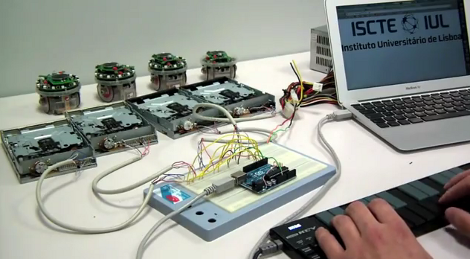
Get ready to join a band. Just follow the guide over at the Moppy project page and you’ll have your very own floppy drive instrument.

The name is a mashup between Musical and Floppy. By using an Arduino UNO as a translator, you can command an array of floppy drives with a musical keyboard (think piano). The head on each floppy drive is controlled by a stepper motor which will put out some sweet sounds if driven at just the right frequency. The lower notes tend to fair a bit better than the high range. One great example of this is the Imperial March theme as heard after the break.

Once you get the base system up and running, it’s time to think of some alternate interfaces. Sure, you can obvious things like toy keyboards. But wouldn’t it be more fun to make it fruit controlled?

Continue reading “Moppy Lets You Play Your Floppy Drives”

Making A Digital Delay From A Simple Microcontroller

If you’d like to start experimenting in DSP, or just want to build a guitar pedal, here’s the project for you. It’s an audio echo using just a microcontroller from the fruitful workshop of [Vinod].

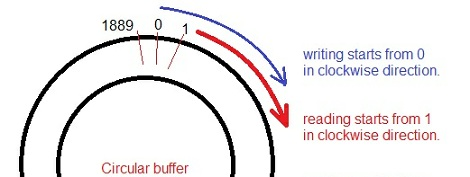
For his circuit, [Vinod] fed the output of a small electret microphone into a small amplifier, and then into the ADC of an ATMega32. Inside the microcontroller, [Vinod] set up a circular array which writes the voltage from the microphone and sends it out to a speaker. Because the array is circular (i.e. it loops around when it gets to the end), [Vinod] has a digital version of a loop of magnetic tape, perfect for recording sounds and playing back echos.

Because [Vinod] is using an ATMega32, he only has a limited amount of RAM to record audio samples. The delay time could be lengthened with a more capable microcontroller, or even the addition of a large RAM chip. With his setup, [Vinod] can do some really interesting experiments with audio and DSP, so we wouldn’t be surprised if an enterprising musician used this project as the basis for a digital delay stomp box.

You can check out [Vinod]’s demo of his echo machine after the break.

Continue reading “Making A Digital Delay From A Simple Microcontroller”

Making Music With Radiation

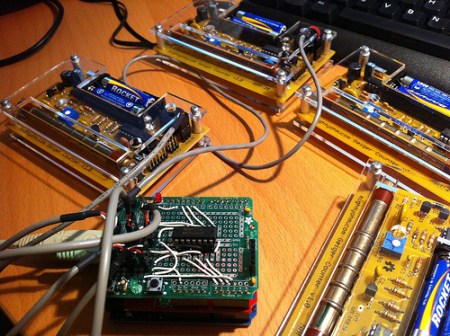
[Jeff Keyser] from mightyohm.com got a chance to show off this interesting take on ambient music. He’s using his geiger counter kit to detect beta and gamma radiation. This then sends a pulse down the line to an Arduino to turn it into a musical note. The geiger counters put out a 1.ms 3v pulse though, so he first has to run this through a 74Ls04, which spits out the 5V the arduino wants. He’s admittedly no musician, but you can hear in the video it sounds fine. Especially considering they are all just C in different octaves. Those of us that are musicians probably would have gone with a B#.

The ambient noise is interesting, but when you realize it is due to radioactive decay, it becomes somehow more attention getting. We often forget about the invisible world around us. He even drops a few Uranium marbles onto the geiger counters to spice things up.

Continue reading “Making Music With Radiation”