Oscilloscope Piano Tuning 101

fft on scope

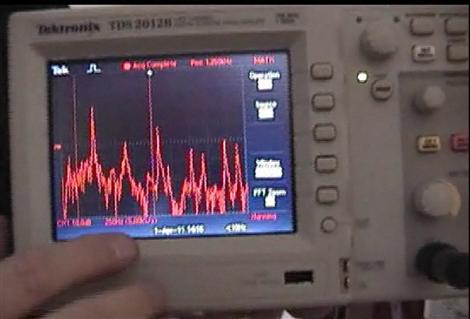
[Todd Harrison] recently wrote in to tip us off on his submission to the Tektronix oscilloscope contest – using a scope to tune a piano. In his video he demonstrates how a Fast Fourier Transform can be used to determine the fundamental frequency of the note being played. This is a quick and easy way to determine if that key is in tune, and if not, how far off it is from the desired frequency and in which direction.

He goes on to explain that a scope can only be used as a starting reference point since “mathematically correct” tuning on a piano doesn’t sound right to the human ear. It turns out that when struck, the stretched wires in the piano behave less than ideally. In the case of a piano, the overtones (the other peaks shown on the scope higher in frequency than the fundamental) are actually slightly sharper (higher in frequency) than the expected harmonic whole-number multiple of the fundamental frequency.  As a result, the frequency ranges of each octave must be “stretched” in order to accommodate this and sound correct when multiple notes are played together across octaves.

Typically, only the A4 key is actually tuned to its correct frequency of 440Hz and all of the other keys are manually tuned off of this baseline. The amount of necessary stretch applied to each octave increases as you get further away from this initial reference point in either direction and is unique to each and every individual instrument – thus there is no universal device capable of perfect tuning. Although [Todd] admits that he won’t attempt to tune the entire piano himself using this technique, he finds it a convenient way to keep the most heavily played center sections of the piano closer to true between professional tunings.

If you have any interesting or unique uses for your Techtronix scope, you can enter the contest here. Just don’t forget to tip us off too!  Thanks [Todd]!
Pidato Box Adds Vibrato Effect To Digital Pianos

piano_vibrato_box

[Joren] likes his digital piano, but it was missing one key component that he wanted to use: the ability to produce vibrato while playing. Vibrato can be done in several different ways on regular pianos, but it seemed as if there was not a lot of consideration given to the effect when designing digital pianos.

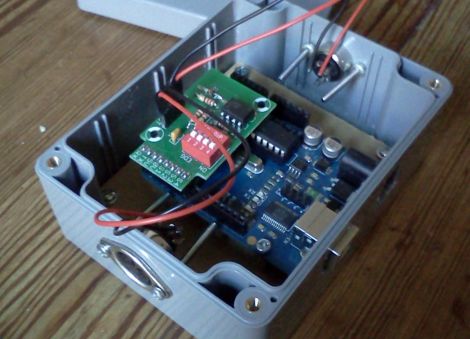
He enjoys playing all sorts of music, including solos from Franz Liszt which suggest using vibrato at times, so he decided to build himself a vibrato box. Constructed with a bit of assistance from the friendly folks at Hackerspace Ghent, his “Pidato” incorporates an Arduino and three-axis accelerometer to get the job done.

The Arduino is connected to both the MIDI output of the piano as well as to the accelerometer, which he has mounted on his wrist. While playing, all he needs to do is simply move his hand rapidly to produce the vibrato sound as you can see in the video below. The Arduino code filters out any other sorts of movements to ensure that he does not accidentally trigger the effect when it is not desired.

Check out the video below for a quick demonstration of the Pidato box.

Continue reading “Pidato Box Adds Vibrato Effect To Digital Pianos”

Feel Like We Do With A Bass Guitar Talk Box

dino_comes_alive

Hacker [Dino Segovis] wrote in to share the latest hack from his HackAWeek series, and this time around he has constructed a talk box for his bass guitar. Providing you are old enough, you probably remember when the talk box made its way into mainstream music, on the “Frampton Comes Alive” album.

The concept of a talk box is pretty simple. A small speaker is built into a sealed enclosure, which carries the sound from the musician’s guitar to his mouth via a plastic tube. The tube is placed in the musician’s mouth, near the microphone. When his mouth is moved, the sound from the guitar is modified and reflected into the microphone.

[Dino] built a similar system using his bass guitar and an amplifier hacked together from an old tape deck. He initially ran into problems with the sound not making it all the way up the tube due to the bass’ low frequency. He had an ‘Aha!’ moment and mounted the speaker on the mic rather than down on the floor, which seems to have fixed the issue.

Be sure to check out the video below to see his talk box in action.

Continue reading “Feel Like We Do With A Bass Guitar Talk Box”

DIY MP3 Player Shows That No Hack Is Ever Obsolete

wacken_death_box

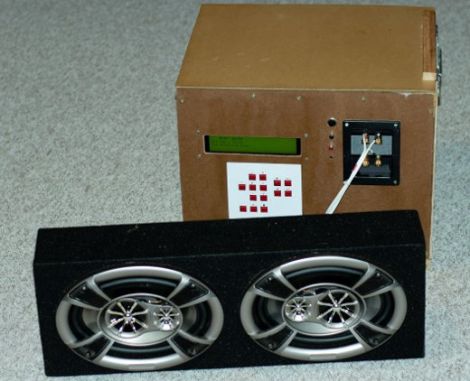
[Ole Wolf] wrote in to tell us about a project he has been working on for several years now. The Wacken Death Box serves as a reminder that once you start a DIY project, it’s probably a good idea to finish it in a reasonable amount of time, lest it risk becoming obsolete.

His Death Box is an MP3 player that he takes along on his annual trip to the Wacken Open Air Festival. His goal was to construct a portable amplified music player that could be powered from either a car battery or charger. A Via EPIA Mini-ITX computer serves as the brains of the device, blaring his tunes from a set of car loudspeakers via a two-channel 100W amp.

[Ole Wolf] used the music player for a few years, improving it as he went along. He does admit however, that with the continually dropping prices of MP3 players, he decided to bring a small portable unit along with him to the 2010 festival, leaving his box at home.

Given the fact that far smaller and more portable devices make his music box seem clunky and obsolete in comparison, you might ask why he even keeps it around. We think that every hack has its place, and while you won’t be strapping the Death Box on your back for your morning jog, it fits quite well in a variety of situations. This rugged music box would be an appropriate choice to use in your workshop, at the beach, or even on a construction job site – places where you might not want to use your comparatively fragile iDevice.

MIDI Drum Interface Helps You Step Up Your Game

rb_drum_trigger

[Dan] likes Rock Band, but playing it makes him feel as useful as a one-legged man in an ass-kicking a drumming contest. He says that even using his friend’s ION kit leaves him searching out excuses as to why he’s not as good as he should be on the drums.

Eventually, he decided that he would settle things once and for all. The final excuse he came up with was that it is too difficult to press the drum pedal rapidly without getting tired, as the Rock Band gear does not properly simulate real drum equipment. Bass pedals on professional kits are weighted and balanced to allow the drummer to exert the least amount of work for the most return, resulting in a less tiring experience.

To give him a leg up while playing the game, he decided to rig a trigger to his Yamaha MIDI bass pedal, which is properly weighted. He consulted the Rock Band forums, and after looking at a couple of different circuit diagrams, he designed his own. He etched a PCB, mounted his SMD components, and was well on his way to becoming a drum legend.

He says that the pedal interface works quite well, and despite a couple of tiny soldering setbacks, he has yet to see any errant hits register in-game.

Be sure to check out the video below of his drum trigger undergoing some tests.

Continue reading “MIDI Drum Interface Helps You Step Up Your Game”

Baking Pan Tube Amp Sounds Better Than You’d Expect

baking_pan_tube_amp

A few years back, [Gio] decided to try his hand at building a couple of tube amplifiers.

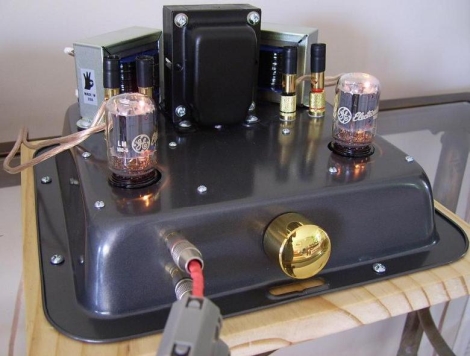
The first amp was more of an experiment to see how well a DIY single-ended tube amp would sound. The amp is based off the 6T9 design created by Spare Time Gizmos, and incorporates a pair of 6T9 vacuum tubes, hence the name.  He wired things up in an afternoon, then got busy drilling holes in a baking pan, where he mounted the amp. Bear with us for a second, it’s not as bad as it sounds. The amp actually looks pretty good mounted in the dark black steel, and this sort of enclosure is far cheaper than most DIY amp enclosures. He says that he was sure to be extra careful in isolating all of the electronic components from the metal chassis.

The second amp was built to test the performance differences between Pentode-mode and Ultra-Linear mode configurations. While both amps share a substantial amount of the same components, his UL amp benefits from slightly better capacitors and an uprated power supply, not to mention a more conventional case.

Both amps sound great, according to [Gio], but should be paired with efficient speakers for the best experience. He does note that the ultra-linear amp is the better choice, mounting options aside.

[Thanks, Philippe]

[via RetroThing]

Bluetooth Headset Battery Swap Keeps Going And Going…

bluetooth_headset_battery

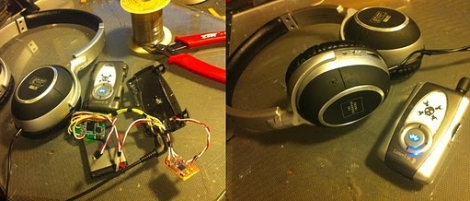
[Reginaldo] purchased a cheap Bluetooth headset adapter, and while it worked well with all of his devices, he was disappointed to find that the battery life didn’t quite live up to the manufacturer’s claims. Advertised as capable of operating for 10 hours, he discovered that the device would typically die after only 7. He wanted more from the headset, so he took things into his own hands and replaced it with a much larger battery (Google Translation).

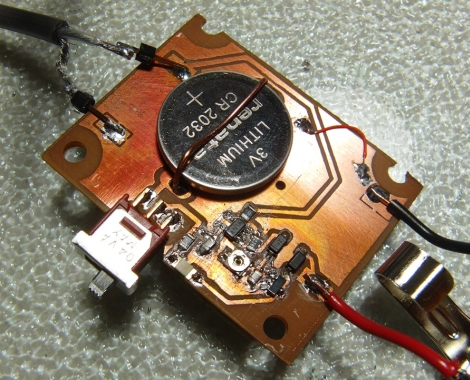
His goal was to keep the modifications as cheap as possible, so he repurposed a lot of items he had sitting around the house. He used a battery out of an old cell phone, with a capacity over six times greater than that of his original headset battery. He built a charging circuit using a MCP73863 microchip, specifically designed for managing Li-Ion/Li-Poly batteries. The Bluetooth headset was dismantled and repackaged in the shell of a cheap “audio amplifier” that he had on hand, along with the new battery and charging circuit. A nifty Hackaday logo was included on the outside of the new battery case, and the project was deemed complete.

[Reginaldo] reports that he is quite happy with his battery retrofit. The new power brick only takes about half an hour longer to charge, but can now be used for approximately 44 hours before requiring a recharge – not too shabby!