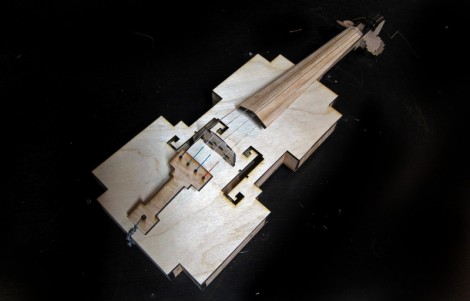
Laser-cut Noise Maker Resembles Violin

This looks very much like a violin but it sounds very much like someone abusing a family of cats. [Ranjit] came with the idea of building a violin using laser cut parts. It doesn’t follow the normal curved shape we’re used to seeing with string instruments. This is because the parts were all cut from flat stock, including the sides of the instrument. The boxy shape that resulted invokes visions of early video game objects and is why this is called the 8-bit violin.

After the break you can see a video of [Bre Pettis] playing the laser-cut instrument. It’s pretty bad, but not in that five-year-old picking up an instrument for the first time sort of way. Yes the best violinists spend a lifetime honing their craft, but they also play on instruments hand carved by master Luthiers who also spend a lifetime perfecting their skills. Don’t get us wrong though, we think it’s just as much fun as that 3D printed guitar.


Continue reading “Laser-cut Noise Maker Resembles Violin”

A 555 Synthesizer

Inspired by the memory of a childhood electronics kit, [Frank] decided to make a new 555 Synthesizer and enter it into the 555 contest. [Frank’s] remake is played with a stylus, and sports an attack and release envelope circuit, housed in a quick but effective acrylic case.

Using a single 555 timer, a hand full of capacitors, two transistors, and a healthy dose of resistors and potentiometers, the sound is quite impressive thanks to optional filtering, enveloping, and a lot of fine tuning. Full schematics, bill of materials, formulas, and board files are all available along with sources for some of the more specialized potentiometers.

Join us after the break for a ~13 minute long video, which is pretty cool, as it shows the device from prototype, and does some fast forward action though to the final product pictured above, though if you just want a demo of the 555 synth fast forward to 10:44

Continue reading “A 555 Synthesizer”

These Apple-inspired Speakers Would Make Steve Jobs Envious

isound_speakers

Reader [Brett] sent in the build log of his beautiful set of Apple-inspired computer speakers for us to look over. Having seen our recent post on DIY speakers, he thought he would throw his hat into the ring as well, and we’re glad he did.

He wanted a nice set of speakers to complement his iMac, but couldn’t find anything he liked that would provide the sound quality he was looking for while closely matching the design of the computer. The speakers are constructed out of MDF with CNC milled acrylic front and back panels. Hand-built crossovers reside inside the speaker boxes, which provides for a clean, polished look. He originally planned on building a pair of subwoofers into his desk, but ultimately settled on building a single subwoofer to sit on the floor.

The finished product is simply stunning, and we would have a hard time believing they were a DIY project if we didn’t see them come together piece by piece. Do you think you can match [Brett’s] handiwork?  If so, feel free to share your speaker builds in the comments.

Micro Audio Player Can Hide Behind A Postage Stamp

The original iPod shuffle was a pretty small device, there’s no doubt about that. However, in the world of miniature audio players, [Chan] is no slouch either.

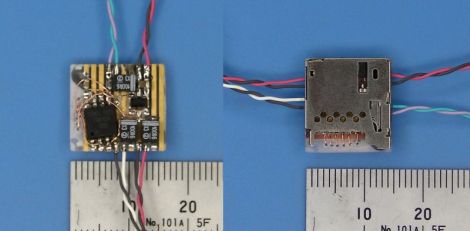
A few years ago, he set out to construct a micro audio player that used little more than a small microcontroller and a microSD memory card. He chose an ATinyX5 series microcontroller to run the show, utilizing its pair of PWM output pins to directly drive the speakers. Since there is no built-in amplifier, the audio volume is not loud, but it does sound reasonable if you use a set of high efficiency desktop speakers. He does mention that the sound can easily be amplified after passing the signal through a filter, so there is hope for those of you who like your music turned up to 11.

The only downside we can see is that the audio player can only process Wave files, but it’s hard to expect more from a DIY audio player smaller than a postage stamp. It would be great to see what sort of micro-handiwork [Chan] could perform if he were to update his design and build a full-functioning MP3 player based upon this project.

Audio Two-fer – Sneaker Speakers And DIY Mid-Fi Woofers

speakers

Nike Air Force 1 shoes are probably some of the most well-recognized sneakers around the world, aside from the always timeless Chuck Taylor All Stars. So when [Alex Nash] was asked to create some art using something ordinary with a goal of turning it into something special,  he immediately grabbed a pair and got to work.

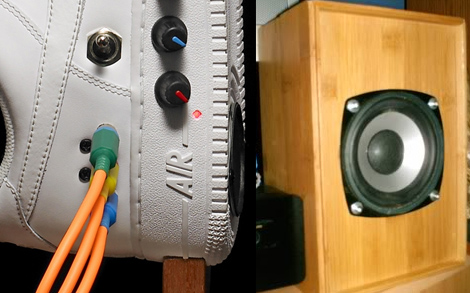
His vision was to build a set of PC speakers by embedding a small amplifier and speakers into a pair of Air Force 1s. As you can see from the pictures on his site, they look awesome. He doesn’t say how good they sound, but we’re betting they perform better than that old pair that came with your last computer.

When [Stacy] was in college, she didn’t have a ton of room or money for a nice audio setup, so she decided to build a pair of speakers rather than buying them. She admits that these “Mid-Fi” woofers won’t be the centerpiece of your Hi-Fi setup, but they still sound pretty darn good for $50 DIY speakers. She compares them to units you would find in the store for $300+, and they sound so good she continues to use them as a compliment to the rest of her Hi-Fi setup now that she has a place of her own.

Fun Slide Whistle Synth Toy

slide_synth

[Dino] recently sent us some info on his latest project, a 555 timer-based slider synthesizer. The synth was built to emulate the sound made by playing a slide whistle, and also as an entry into the 555 Design Contest, which is quickly coming to a close. If you’re not familiar with a slide whistle, just spend a few minutes on YouTube looking for clips of Sideshow Bob – it’s ok, we’ll wait.

The circuit is pretty simple, though the implementation is quite clever. While traditional slide whistles require the user to blow in one end, this electronic version operates using a LED and photo cell. When the main switch is closed, the 555 timer is activated, and a tone is produced. The pitch of the tone is controlled by the LED as it slides in and out of the tube. The more light that hits the photo cell, the higher the pitch, and vice versa.

Continue reading to see a quick demonstration of [Dino’s] slide synth, and be sure to check out his other 555 contest entry we featured a short while back.

Continue reading “Fun Slide Whistle Synth Toy”

Alien Life Form Synth Toy

space_bug_in_a_bottle

We were sent [Dr. Offset’s] most recent project, a kid’s toy that is half sculpture/half noisemaker, but 100% cool. The device uses several 555 Timers and is his entry into the 555 Design Contest, which wraps up in just a few days. To really enjoy his creation, you need to suspend disbelief for a moment, and indulge the space fantasy he creates. In other words, let yourself be a kid again, if only for a few minutes.

What he has built is a containment unit for an alien life form found during an outer space exploratory mission. The creature has fused its organic bits with electronic components in order to survive in the stark, empty world it used to call home. The containment unit allows you to zap the “bug” with various frequencies to see how it reacts. The “bug” is light sensitive, so it always offers a varying experience, day or night.

It’s definitely one of the most artistically creative entries into the 555 Design Contest we have seen yet. Continue reading to see a thorough walkthrough and demonstration of his project.

[Thanks Rich Decibels]

Continue reading “Alien Life Form Synth Toy”