Mega-Plate Petri-Dish Lets You Watch The Evolution Of Bacteria

Rearchers of the Harvard Medical School built a 2 feet by 4 feet (61 x 122 cm) large petri-dish to visualize the evolution of bacteria. Their experiment induces mutations in E. coli bacteria by exposing them to gradually increasing concentrations of antibiotics.

Continue reading “Mega-Plate Petri-Dish Lets You Watch The Evolution Of Bacteria”

MIT Researchers Can Read Closed Books (and Defeat CAPTCHA)

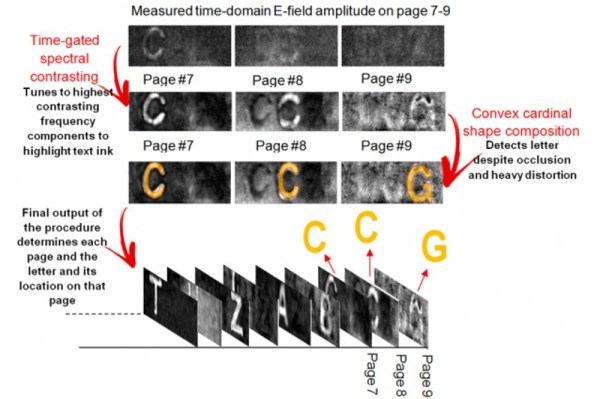
Ten years ago, MIT researchers proved that it was possible to look through an envelope and read the text inside using terahertz spectroscopic imaging. This research inspired [Barmak Heshmat] to try the same technique to read a book through its cover. A new crop of MIT researchers led by [Heshmat] have developed a prototype to do exactly that, and he explains the process in the video after the break. At present, the system is capable of correctly deciphering individual letters through nine pages of printed text.

They do this by firing terahertz waves in short bursts at a stack of pages and interpreting the return values and travel time. The microscopic air pockets between the pages provide boundaries for differentiation. [Heshmat] and the team rely on these pockets to reflect the signal back to a sensor in the camera. Once they have the system dialed in to be able to see the letters on the target page and distinguish them from the shadows of the letters on the other pages, they use an algorithm to determine the letters. [Heshmat] says the algorithm is so good that it can get through most CAPTCHAs.

The most immediate application for this technology is reading antique books and other printed materials that are far too fragile to be handled, potentially opening up worlds of knowledge that are hidden within disintegrating documents. For a better look at the outsides of things, there is Reflectance Transformation Imaging.

Continue reading “MIT Researchers Can Read Closed Books (and Defeat CAPTCHA)”

Wazer: The Waterjet For Your Garage

Most hobbyists don’t have waterjets in their garage, but they would if they could! A Waterjet (or Water Jet Cutter) is a marvelous tool. Simply mount a high-pressure stream of grit and water on an x-y gantry, and the pressure generates enough erosion to cut through just about any thin material. Unfortunately, claiming your own waterjet will erode away a nice big hole in your pocketbook too. Machines up to this point start at about $75K, not to mention that they’d claim the better part of your workspace in a two-car garage.

Most of us everyday hackers that want to play with the benefits of this tool send their parts out to a professional shop. Consequently, we don’t often hear about everyday hackers using waterjets, or waterjet-cut parts all that often, with one exception. Back in 2014, a crew of students from UPENN built a functional waterjet with a parts-list that could make it affordable for about $5000. Now that same team is back. This time, they’ve spun together not just a one-off, but a fully-featured product called Wazer, which just launched its Kickstarter campaign minutes ago and has already nearly quadrupled the $100k goal. How could it do that? The full package starts at modest $3599-$4499. This is crowd-funding, after all, but a 20x undercutting of price is a powerful motivator.

Continue reading “Wazer: The Waterjet For Your Garage”

Hackaday Links Column Banner

Hackaday Links: September 11, 2016

You know about the Hackaday Superconference, right? It’s the greatest hardware con ever, and it’s happening on November 5+6. Details incoming shortly.

The Hackaday Retro Edition exists. It’s the Hackaday blog, HTML-1-izized for weird and old computers? Why did I do this? Because Google is the quickest page to load on a Powerbook 180. There’s a new Retro Success, this time coming from @LeSpocky and his Nokia 3109c phone from 2008.

This is your official notice. The Open Hardware Summit is less than a month away. It’s going down in Portland, OR. Why Portland? The Vaporwavescene, of course. Hackaday, Tindie, and the rest of the crew will be out in Portland next month getting the latest news on the state of Open Hardware. We won’t be sitting in church pews this year, but then again there is no lady made out of soap.

Speaking of OHS, [Dave] just solved all their problems. The ‘problem’ with Open Hardware, if you can call it that, is that people use it as a bullet point on a sales deck. That neat gear logo can be marketing wank, without any of the sources, schematics, or anything else that makes a project Open Hardware. Last year, OSHWA announced they would be creating a certification process, with a trademarked logo, so they can sue people who don’t post schematics and mechanical designs (slightly inaccurate, but that’s the jist of the program). [Dave] is suggesting keeping the cool gear logo, but adding letters the teeth of the gear to designate what makes something Open Hardware. Add an S for schematic, add a B for a BOM, sort of like the creative commons logo/license. Is it a good idea? If OSHWA keeps using the gear logo for the ‘official’ Open Hardware logo/designation, there’s no recourse for when people misuse it. I’m of several minds.

[Colin Furze] is famous for his zany builds. His latest Youtube is anything but. It’s a shed. Of course, it’s the entry for his underground bunker, but this is a quality shed with a concrete pad, a few bits to keep it off the ground, and insulation. The roof is slate (because why not?), but if your design decisions are based on the phrase, ‘you only live once,’ copper may be a better choice.

The ESP32 has been released. The ESP32 is the follow-on to the very popular ESP8266. The ’32 features WiFi and Bluetooth, dual core processors, and a few undisclosed things that will make it very interesting. You can buy ESP32 modules right now, but no one has them on their workbench quite yet. To get you started when they finally arrive, [Adam] created an ESP32 KiCad Library for the ESP32 chip, and the ESP32-WROOM and ESP3212 modules.


VW Engineer Pleads Guilty To Conspiracy

[James Liang], an engineer at Volkswagen for 33 years, plead guilty today to conspiracy. He was an engineer involved in delivering Diesel vehicles to market which could detect an emissions test scenario and perform differently from normal operation in order to pass US emission standards.

A year ago we talked about the Ethics in Engineering surrounding this issue. At the time we wondered why any engineer would go along with a plan to defraud customers. We may get an answer to this after all. [Mr. Liang] will cooperate with authorities as the VW probe continues.

According to information in the indictment, none of this happened by mistake (as we suspected). There was a team responsible for developing a mode that would detect a test and pass inspection after the company discovered the engine could not otherwise pass. It’s not hard to see the motivation behind this — think of the sunk cost in developing an engine design. The team responsible for cheating the tests went so far as to push software updates in 2014 which made the cheat better, and lying about the existence of these software “features” when questioned by authorities (again, according to the indictment).

31415926 (That’s Roughly Π Times 10 Million Raspberries)

The Raspberry Pi Foundation founder Eben Upton has announced that their ten millionth eponymous single-board computer has been sold since their launch back in February 2012. It’s an impressive achievement, especially so since their original sales expectations were for a modest ten thousand. For those of us who watched the RS and Farnell websites crumble under the strain of so many would-be purchasers on that leap day morning four and a half years ago their rapidly exceeding that forecast came as no surprise, but still, it’s worth a moment’s consideration. They passed the Sinclair ZX Spectrum’s British record of 5m computers sold back in February 2015, leaving behind the Pi’s BBC Micro spiritual ancestor on 1.5m sold long before that.

Critics of the Pi will point out that its various versions have rarely been the most powerful small single board computer on the market, or even at times the cheapest. They will also point to the closed-source nature of the Broadcom binary blob that underpins Pi operating systems, and even the sometimes unpredictable nature of the Pi Foundation with respect to its community, product availability and launches. But given that the Pi Foundation’s focus is not on our side of the community but on using the boards as a tool to introduce young people to computing, it’s fair to say that they’ve done a pretty good job of ensuring that a youngster can now get their hands on a useful and easily programmable computer much more easily than at any time in the past.

Would we be in the same position of being able to buy a capable Linux computer for near-pocket-money prices had the Raspberry Pi not been released? Probably so, in fact certainly so. The hardware required to deliver these products has inevitably fallen into a more affordable price bracket, and we would certainly have plenty of boards at our fingertips. They would probably have Allwinner or maybe Mediatek processors rather than the Pi’s Broadcom part, but they would be very likely to deliver equivalent performance at a similar cost. Where the Raspberry Pi’s continued success has come from then has not necessarily been from its hardware but from its community and software. The reliability and ease of use delivered by the Raspbian Linux distribution that Just Works for the parent putting a Pi in front of their child, and the wealth of expert information on the Raspberry Pi forums to get them through any Pi-related troubles are what has given the Pi these sales figures. The boards themselves are almost incidental, almost any hardware paired with that level of background information would likely have met with similar success. Comparing the Pi software experience with for example one of their most capable competitors, it’s obvious that the software is what makes the difference.

It’s likely that Raspberry Pi sales will continue to climb, and in years to come we’ll no doubt be reporting on fresh milestones on ever more powerful revisions of their product. But it’s also likely that their competition will up their software game and their position in the hearts and minds of single board computer users might be usurped by a better offering. If this increased competition in the single board computer market delivers better boards with more for the hardware developer community, then we’re all for it.

Nintendo Wields DMCA Ax On Fan Games

In a move that may sadden many but should surprise nobody, Nintendo of America has issued a DMCA takedown notice for 562 fan-created games created in homage to Nintendo originals and hosted on the popular Game Jolt site. Games affected include Mario, Zelda, and Pokémon based creations among others, and Game Jolt have responded, as they are required to, by locking the pages of the games in question. They state that they believe their users and developers should have the right to know what content has been removed from their site and why the action has been taken, so they have begun posting any notices they receive in their GitHub repository.

It is likely that this action won’t be appreciated within our community, however it’s important to note that while there are numerous examples of DMCA abuse this is not one of them. Nintendo are completely within their rights over the matter, if you use any of the copyrighted Nintendo properties outside the safe harbor of fair use then you will put yourself legitimately in their sights.

Something that is difficult to escape though is a feeling that DMCA takedowns on fan-created games are rather a low-hanging fruit. An easy way for corporate legal executives to be seen to be doing something by their bosses, though against a relatively defenseless target and without really tackling the problem.

To illustrate this, take a walk through a shopping mall, motorway service station, or street market almost anywhere in the world, and it’s very likely that you will pass significant numbers of counterfeit toys and games copying major franchises including those of Nintendo. A lot of these dollar store and vending machine specials are so hilariously awful that their fakeness must be obvious to even the most out-of-touch purchaser, but their ready availability speaks volumes. Unlike the fan-created games which are free, people are buying these toys in huge numbers with money that never reaches Nintendo, and also unlike the fan-created games there’s not a Nintendo lawyer in sight. Corporate end-of-year bonuses are delivered on the numbers of violations dealt with, and those come easiest by piling up the simple cases rather than chasing the difficult ones that are costing the company real sales.

We’ve covered many DMCA stories over the years, and some of them have been pretty shocking. Questions over its use in the Volkswagen emissions scandal, or keeping John Deere tractor servicing in the hands of dealers. Let’s hope that the EFF and Bunnie Huang’s efforts pay off and dismantle section 1201, one of the most nonsensical parts of the law.

Via Engadget. Dendy Junior unauthorised Nintendo Famicom clone image, By Nzeemin (Own work) [CC BY-SA 3.0], via Wikimedia Commons.