GE Garage And Chicago Ideas Week

IMG_0443

I’ve been on vacation and managed to get a day to play at the GE Garage mobile fab lab currently setup in downtown Chicago. GE has partnered with Chicago Ideas Week to bring the future of fabrication technologies to a space where the community can walk in off the street and work with some amazing hardware like CNC mills, laser cutters and 3D printers. The group is also giving classes at select times on using the equipment and general electrics. Unfortunately I was in town near the end of this event which will be Oct 20th. If you are in the area I do recommend jumping on the excellent transportation you’ll find in Chicago and have some fun at the space. Here are more details on location, classes and times.

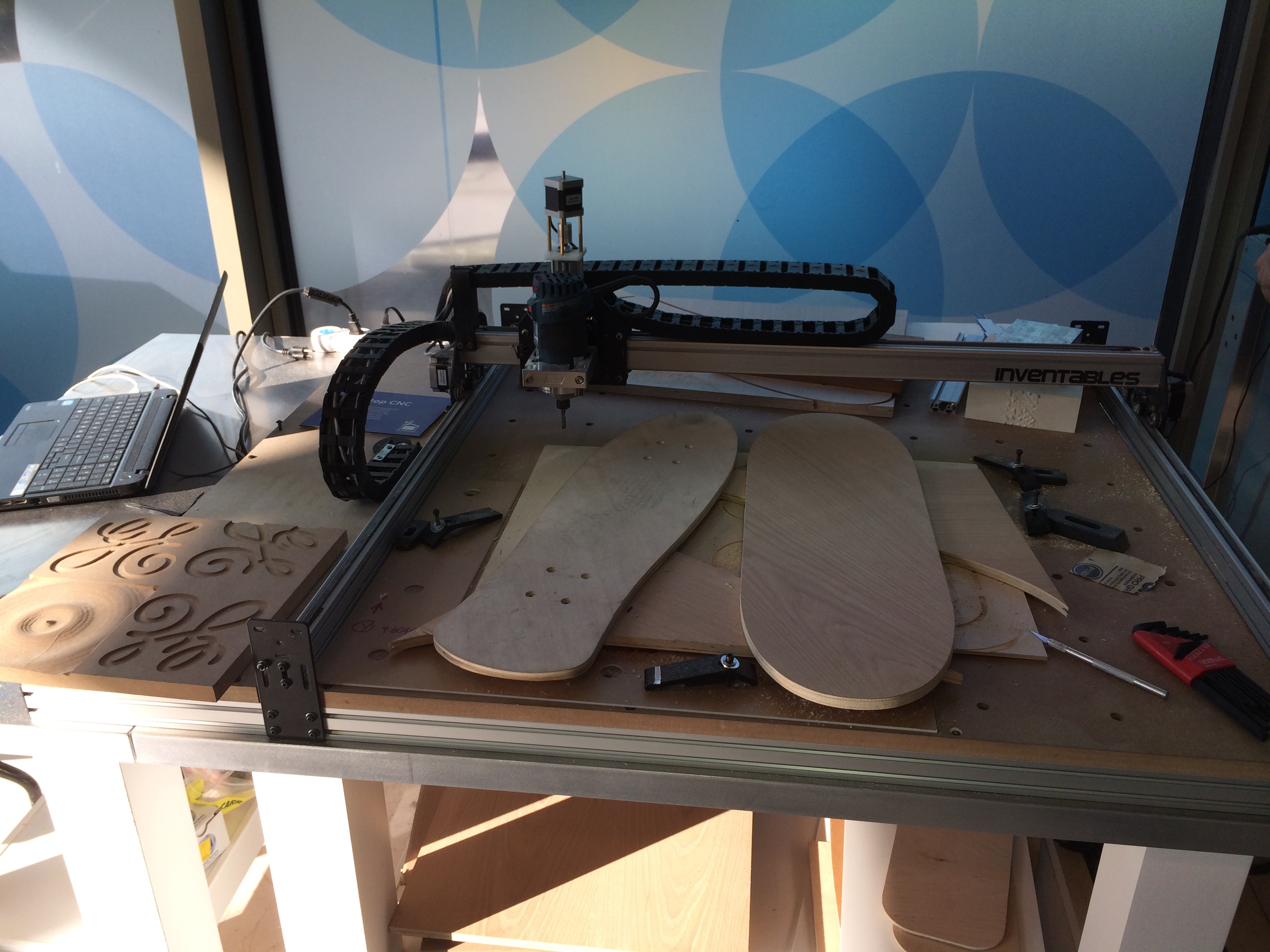
I didn’t expect to squeeze any work into my vacation but I did take a guided tour of the fab space with my iPhone 5s.  You can join me after the break to watch the tour, which is a bit rough but still covers a lot of fun topics. Get at look at their line-up or Replicator 2 3D printers. See some fantastic prints from metal made on industrial scale printers. Learn more about the up-scaled CNC seen above that was cutting out skateboard decks. And finish up with an injection molding machine.

Continue reading “GE Garage And Chicago Ideas Week”

Hackaday Is Broken

hackaday-mister-yuckWe’re sorry for the page styling problems. This seems to be caused by a server-side upgrade issue — our incomplete stylesheet depended on another that just changed and broke everything. We’re trying to do a roll-back which will give us time to fix our theme. Thanks for your understanding. Feel free to unleash your rage in the comments below ;-)


Pro Tip (or should that be a website fail tip?): Hit CTRL-A (select all) in order to read the white text on white background comments below.

Update: Things look mostly back to normal again. Sorry again for the troubles…. but I’m actually having some fun reading the comments on this one!

Boston Dynamics Takes WildCat Outside

wildcat

[Boston Dynamics] has released a video of their latest robot, which means it’s time to go hide in bed before this thing comes to get us. The new video features WildCat, which is apparently the evolution of the Cheetah robot we saw last year. Cheetah was an indoor cat, tethered by power, data, and hydraulic lines while running on a treadmill. WildCat has been released to terrorize people explore the great outdoors

Reminiscent of the early videos of BigDog, WildCat is currently powered by an internal combustion engine. The engine drives a hydraulic system, which then actuates the robot’s legs and front/rear pods. The beauty of a system like this is that switching to an electric motor is simple – just replace the IC engine. While we’re sure this would make a much more stealthy cat, weight and run time could be issues. Moving the power system onboard has also slowed down WildCat a bit. Cheetah was able to reach 28 MPH while WildCat can only muster 16 MPH.

WildCat is part of DARPA’s maximum mobility and manipulation program. The research appears to be focused on improving the gaits the robot uses to move at various speeds. The video highlights both bounding and galloping.  Slo-mo sections show all four of WildCat’s legs leaving the ground, which is the suspension phase of a classic gallop gait. Control isn’t perfect yet, as WildCat tumbles at one point in the video.  It gets right back up though – ready for more.

Continue reading “Boston Dynamics Takes WildCat Outside”

Tre: When Arduino Meets Beagle Bone

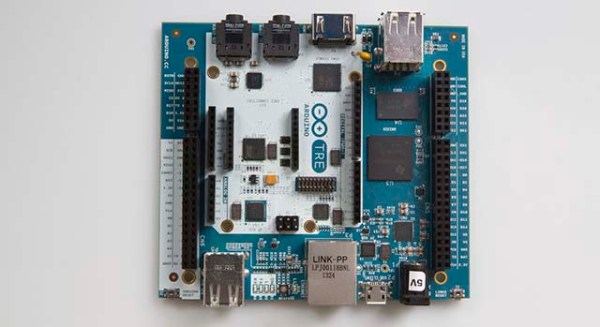
Although yesterday saw the announcement of an x86-based Arduino powered by an Intel chip. This may have not been the big story to come from [Massimo] at Maker Faire Rome. Announced along with the x86 Arduino Galileo was the Arduino TRE, a collaboration between Arduino and the BeagleBoard foundation.

The TRE is really two Arduinos in one: in the center is basically an Arduino Leonardo with the standard Arduino headers and an ATmega32u4. Elsewhere on the board is a TI Sitara ARM Cortex A-8 processor running at 1GHz with 512 MB of RAM, 10/100 Ethernet, HDMI out, USB host and device ports, and a bunch of connectors intended for an LCD and a ZigBee.

There is, of course, the obvious comparison between the TRE and Raspberry Pi. Hardware-wise, the TRE is very close to the BeagleBone Black, a bit more powerful than the Raspberry Pi, and able to do some very cool stuff (i.e. OpenCV) the Pi just can’t handle.

There is – I think – no official price for the Arduino TRE quite yet. It will be available in spring, 2014, though. You can check out all the press release photos in the gallery below.

Continue reading “Tre: When Arduino Meets Beagle Bone”

Make The World Takes On Crowdsourcing Prosthetics

adafruit-make-the-world-prosthetics

Tonight marks the launch of a new program from Adafruit focused on improving the availability of prosthetic designs. The program will be highlighted in four Google+ Hangouts over the coming month. Mark your calendars for 8pm Eastern Time to join in on the one-hour launch.

We’ve seen a fair number of prosthetic hacks over the years, and every time one is featured we try to drive home the importance of sharing information in order to build upon the advances of others. The power of this is clear, shown in a $150 3D printed hand for a child, hackers that are replacing their own limbs or digits, and the sharing of diy fabrication techniques to help bring prostheses to the developing world. So get excited, get involved, and get hacking!

Safety Warning: Arduino GSM Shield May Cause Fires

Be careful with those Arduino GSM cards. As [James] reports, they may turn into fire starters. One person has reported a small explosion and fire already on the Arduino forums.
Now before we go any further – You may be asking yourself who the heck [James] is, and what gives him the ability to second guess the Arduino team. Well, here is [James’] blog disclaimer:  “James is a Senior Technical Expert for Technology and Applications at KEMET Electronics, a capacitor manufacturer. The content of this post are his and in no way reflects opinions of his employer.”

Senior Technical Expert?  That’s a good enough reason for us to believe him.

[James] states the problem is a tantalum capacitor used to decouple the GSM radio power supply from the main Arduino supply.
Tantalum capacitors are great for their low ESR properties. However, they have a well known downside of getting very hot, or even exploding when stressed. It’s not the Tantalum Anode that is burning. The Manganese Dioxide used as a cathode in some Tantalum capacitors is the culprit. Continue reading “Safety Warning: Arduino GSM Shield May Cause Fires”

Announcing Adafruit’s Bluefruit

adafruit_2098

You always meet the most interesting people wandering around Maker Faire, but by far the most interesting was Hackaday’s founder, [Phil Torrone] and bubblegum-haired compatriot [Limor] from Adafruit. They were out in full force checking out the sights and gave us the scoop on a new piece of hardware they’re releasing called Bluefruit.

Bluefruit is a very tiny and very cheap Bluetooth module breakout board that allows anyone to take 12 digital inputs and turn them into a Bluetooth HID device. If you’re planning a portable battery-powered arcade controller, just plug in a Bluefruit, set up your keypresses in your software, and rock out.

On board the Blufruit are an FTDI programming connector, 12 input pins, a few power pins, a custom FCC and CE certified CSR Bluetooth module, and that’s about it. If you’re looking for a simple GPIO to Bluetooth adapter without an overwrought Arduino setup, this is the best solution we’ve seen by far. Adafruit is also rocking their own custom firmware for the device, so this will be extremely hacker-friendly.

The price will be $20 and should be available in the Adafruit store in a bit. If you’re looking for an easy way to put a Bluetooth HID controller in your next project, this is the one.

Pictures of the Bluefruit and Adafruit crew below.

Continue reading “Announcing Adafruit’s Bluefruit”