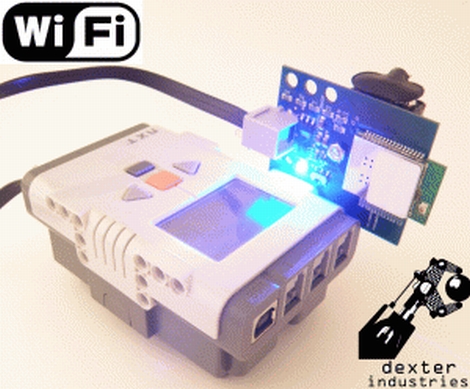
Lego NXT Creations Are Even Cooler With WiFi On Board

nxt-wifi

The folks at Dexter Industries have just wrapped up a week of Lego NXT projects, most of which centered on the use of their NXT WiFi sensor. Developed over the last few months, the group has been hard at work refining their design and getting some of the kinks worked out, so now you too can control your NXT creations sans wires.

The demonstrations have covered various topics throughout the week, starting out with a short tutorial on how to use a computer to communicate with the NXT device using the TCP protocol. After taking a look at WiFi power-saving capabilities, they touched on pinging other networked machines as well as querying DNS records from an NXT device. An NXT-based webserver was the next project on the list, as was remote robot control over the Internet. Finally, they wrapped the week up by configuring their Lego robot to send a tweet.

If getting your NXT creations on the move with full-fledged network access is something that sounds interesting, be sure to check out their site for downloads, a WiFi manual, and more.


Video: Working With The 3pi Robot’s Line Sensors

This week, we are serving up part five in our series where we are using the Pololu 3pi robot as a fancy development board for the ATmega328p processor. This week we are taking a quick break from working with the perpherals specific to the processor and will show how to work with the 3pi’s line sensors. A quick look at the schematic for the 3pi might lead you to think that you should be reading the line sensors with the A2D peripheral. Even though they are wired to the A2D pins, they need to be read digitally. In the video, [Jack] will show how to read raw values from the sensors and then how to calibrate the results so that you can get a nice clean 8-bit value representing what the sensors are seeing. Of course, that would happen under normal circumstances. Murphy had his way in this video and it turned out that our studio lighting was interfering a bit with the sensor readings when we were shooting so we didn’t get as good of a calibration as we would have liked when we shot.

Video is after the break.

In case you have missed the previous videos here are some links:

Part 1: Setting up the development environment
Part 2: Basic I/O
Part 3: Pulse Width Modulation
Part 4: Analog to Digital conversion

Continue reading “Video: Working With The 3pi Robot’s Line Sensors”

Weekly Roundup 11/12/11

In case you missed them the first time around, here are our most popular posts from the past week:

In the #1 spot, we had a post about a tri-color laser projector that really is a well-done project. This projector sweeps the lasers around in vector mode using a pair or mirror galvanometers so would be perfect for playing asteroids in vivid full color!

In at #2 is a post about a PVC pipe gun that can shoot AA batteries at 600 batteries per minute!

Next up we have a post about the US military finding that due to Chinese counterfeit electronics, some of its weapon systems are defective. This has become a more serious issue in recent years. It has effected hackers too as shown in this Sparkfun post from last year.

After that, we had a post about a novel and somewhat scary way to post bulletins on a board without using tacks. How do they do that? By carefully using 20,000 Volts! Yikes. We’ll stick to tape next time we run out of tacks thank you very much.

Finally, we have one about a spot welder built out of some super capacitors and carbon rods. This one probably produces equally large sparks where it is welding and at the triggering mechanism!

LUFA Open Source USB Stack Now For NXP ARM Processors

Looks like the Lightweight USB Framework for AVRs (LUFA) has just been ported for ARM microcontrollers. NXP recently released a package for their LPC Cortex M3 family of ARM controllers. You won’t find a reference to LUFA on their nxpUSBlib description page (which we think is kind of sad), but if you grab a copy of the beta code the Version.h header file shows that it is indeed a port of the project. This is further backed up by the LUFA creator, [Dean Camera], who consulted with the NXP team doing the work.

The package provides an open-source USB stack that you can use in your projects as a USB host or USB device. We’re advocates of open source packages like this one as it makes it much easier for hobbyists to get help using the tools, and it allows the community to give back through bug fixes and feature additions.

We’ve highlighted a few LUFA projects, like this keyboard remapper and this AVR programmer. We’re looking to seeing the first set of NXP LUFA projects roll through!

[Thanks Johnny]

Thailand Residents Use Hacks To Make The Best Of A Horrible Situation

Thailand is dealing with horrible flooding right now. Despite the hardship, people still need to get around and go on with life so many have come up with clever hacks to make this disaster more manageable. [Jan] wrote in to let us know about this collection of flood-related hacks which he’s put together. They are wide-ranging, and many brought a smile to our faces, starting this the plastic-bag enclosed cars (not pictured).

We pulled out three of them to highlight above. On the top left is a canine life vest fashioned out of empty drinking bottles mounted on some type of harness. We hope the pets can stay out of the flood waters but this is a nice precaution. Speaking of precautions, the rubber-ducky to the right of that image is an electrical hazard detector. Float it in the water and an alarm and LED will go off if AC current is detected.  Finally, the image on the bottom shows a bridge constructed in front of a shopping center by turning carts on their backs and lining the pathway with wooden pallets.

There are several floating and amphibious vehicle hacks in the collection. So far we haven’t seen any drill-powered trolling motors though.

mykeepon-hacking

Reverse Engineering MyKeepon

[qDot] recently got his hands on a MyKeepon toy and after messing with it a bit, decided to tear it down to see what was inside. He had hopes of easily modding the toy, but like most adventures in hacking, things might take a while longer than he first imagined.

In his teardown you can see the various components that make up the MyKeepon, including a trio of motors for movement, along with a series of buttons and a microphone used to interact with the toy. Of course, the part that interested him the most was MyKeepon’s circuit board, since that’s where the real work would begin.

There, he discovered two main processor Padauk processor chips, described as “Field Programmable Processor Arrays” in their data sheets. He says that the brand is well known for lifting text verbatim from PIC data sheets, so he doesn’t have a ton of faith in what’s printed there. Sketchy documentation aside, he poked around on the I2C bus connecting the two chips and was able to sniff a bit of traffic. He is documenting his findings as he goes along, which you can see more of on his Github project site.

He has made a few simple modifications to the toy already, but there’s plenty more to do before he has complete control over it. His work is bound to make tons of MyKeepon fans happy, including our own [Caleb Kraft], whose love for the toy can be seen in the video below taken at last year’s CES.

Continue reading “Reverse Engineering MyKeepon”

A Tesla Coil That Delivers Shocking Candy

shocking-candy-tesla-coil

Even though Halloween was a week ago, we are still seeing plenty of cool stuff coming our way. Take for instance this Tesla coil that [JJ] sent us.

He got the idea to build a coil for his Halloween display about a week before the event, but he figured it would be easy enough to do since he had a lot of the parts on hand already. He originally started with some neon transformers and a primary/secondary pair he used in a previous Tesla coil build, but when things were fully assembled he wasn’t completely happy with the results.

He returned to the drawing board, winding a new primary/secondary coil pair, which performed much better. The rest of the coil was pieced together with random parts he procured at IKEA along with other items he had sitting around.

He donned a mad scientist’s outfit, and with a large set of grounded tongs acting as a Faraday cage he proceeded to electrocute trick or treaters’ candy with his Tesla coil, much to the delight of the neighborhood children.

Be sure to swing by his page to see more construction details, and for a sneak peek at the candy zapping process, check out the video below.

Continue reading “A Tesla Coil That Delivers Shocking Candy”