It’s neat how a project from 2004 can still be relevant if it’s done really well. This is the case with AVRcam. It uses an Atmel AVR mega8 and can do some pretty impressive things, like track up to eight objects at 30fps. The hardware and software is also open source, so it should be possible to build one yourself. There are many projects like it on the internet, though often they require much beefier hardware. Although, these days you can fit a computer inside a match box, so we see more and more projects just throwing a full USB camera on a robot to do simple things like line following. It’s debatable which solution is more elegant, but maybe not which one is more impressive.
News3657 Articles
Stripping DRM From OverDrive Media Console EBooks

[Armin Tamzarian’s] local library recently started lending eBooks via the OverDrive Media Console system. He checked out a couple of books, which got him thinking about how the copy protection scheme was implemented. He wondered what recourse users had if they wanted to view a book they have already checked out on a different, or unsupported piece of hardware.
His research centers around Adobe’s ADEPT digital rights management scheme, which is used to protect the books offered on loan by OverDrive. The topic is broken down into three parts, starting with an introduction to the EPUB file structure, the OverDrive Media Console, as well as the aforementioned ADEPT DRM scheme.
The second part takes a close look at the OverDrive Media Console itself, where he uses the ineptkey and ineptepub utilities written by [I♥CABBAGES] to pull the RSA cipher keys from the EPUB data he uncovered. When he then tries to strip the ADEPT DRM layer from his books however, he discovers that OverDrive is using a non-compliant version of the ADEPT standard, which renders existing tools useless.
The final part of [Armin’s] discussion digs even deeper into the OverDrive Console’s inner workings, where he finds that the OverDrive Media Console stores quite a bit of information in an SQLite database. After a bit of digging, he finds all the data he needs to strip the DRM from his books. [Armin] also took the time to wrap all of his findings up into a neat little tool called OMCStrip, which as you may have guessed, strips the DRM from ADEPT-protected eBooks with ease.
Wireless Mouse Li-Poly Retrofit With USB Charging

It’s no secret that wireless mice can eat through batteries pretty quickly. Rather than keep a fresh supply of AAs on hand at all times, [Phil] decided he would convert his mouse to use a rechargeable lithium polymer battery instead.
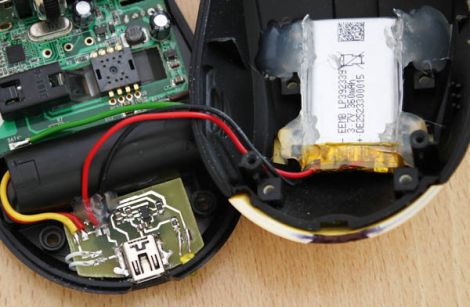
This isn’t the first time we’ve seen a cell phone battery crammed into a mouse to increase capacity, but we think this one has been done quite nicely. [Phil] managed to fit a 2.7 – 4.2v Li-Poly battery in the mouse’s palm rest, where there was a little extra empty space. The battery can be charged from any USB port via a custom-built charging module, which he constructed using a MAX1555 charge controller. Another custom-built circuit resides in the space previously occupied by the AA batteries, which uses an MC340063 DC to DC converter to drop the battery’s voltage down to the 1.25v required by the mouse.
The only part of the build that [Phil] is not pleased with is the power switch on the bottom, but since you rarely see that, we could care less. We think it is quite well done, and with a second version already in the works, we anticipate that it will get even better.
Be sure to check out [Phil’s] video tour of the hack, which you can see below.
Continue reading “Wireless Mouse Li-Poly Retrofit With USB Charging”
Help 2600 Magazine Compile A List Of Dates For Their Hacker Calendar!

2600, the magazine familiar to many as a preeminent hacking quarterly, is publishing a calendar. While, according to the 2600 site, most calendars only mark holidays, 2600 intends to “provide as complete a guide to milestones in the hacker world as humanly possible.” Not an easy task considering that, depending on your definition, hacking could extend to the discovery of fire, or at least the wheel.
2600 gives some examples in which they only list events back to March 3, 1885, when AT&T was founded. If this example is followed, that “only” gives one 126 years to work with, but compiling a full list of hacking dates is still a daunting task. If you can think of any dates worthy of consideration, email them to: calendar@2600.com. We think maybe September 5th, 2004 might be a notable date to include. We’ll leave it up to figure out what that date is, in case it wasn’t painfully obvious.
Trick Mouse Keeps The Screen Saver At Bay

[Jerry] wrote in to share a little device he built to solve a problem he was having at work. You see, every computer in his office has a policy-enforced idle timeout, requiring the user to enter a password in order to regain access to their desktop.
This is a huge pain, since he sporadically uses an old computer for the sole purpose of monitoring some applications running in his data center. With the computer timing out every 10 minutes, he is constantly required to enter his password in order to take a 10 second glance at the screen to ensure everything is OK.
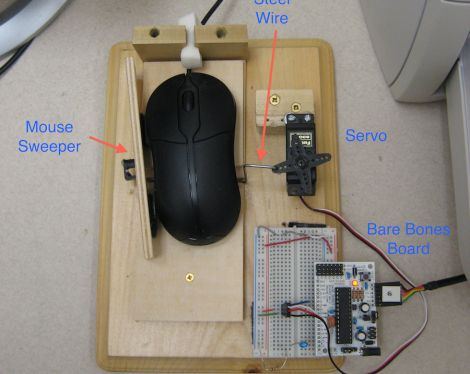
Rather than circumvent the screen saver using a local security policy or by implementing a microcontroller-based signal generator, he opted to create a mechanical solution instead. His computer’s optical mouse resides inside a wooden frame, and is periodically swept from side to side by an ATmega-controlled servo, keeping the screensaver permanently at bay.
Call it a hack, call it a kludge, call it what you will. All we know is that while we might have done it a little differently, it works just fine for [Jerry], and it generates all sorts of interesting conversation to boot.
Stick around for a quick video demonstration of his mouse wiggler box.
Continue reading “Trick Mouse Keeps The Screen Saver At Bay”
Kickstarter Roundup: Wednesday, June 1st
We have been getting tons of emails lately recommending we take a look at various Kickstarter projects. We used to ignore them since they all boil down to a request for project funding, but since there are so many cool projects out there, we figured we might as well share a couple. Some of these projects have already met their funding goals, but we thought they were worth a mention anyhow.
Solar Powered Coffee Roasting

We’re all about both coffee and alternative energy, so this one caught our eye right away. While this coffee roaster won’t exactly fit on your back porch, it would be perfect for a coffee shop located in a sunny locale. Based off “power tower” solar concentrator systems, this rooftop-mounted solar harvester has big potential. Pair this with sopme sustainably-grown coffee, and you’ve got quite the tasty combo.
HexBright – an open source flashlight

What do you get when you combine milled aluminum hex bar and a Cree XM-L LED? A lightweight, extremely bright flashlight that won’t roll away on you. The HexBright puts out 500 lumens and sports a built-in rechargeable battery that can be topped off via your computer’s USB port. Not only that, the high-end version can be programmed to support any pattern or brightness that you choose. We’ll take two, thanks.
Arduino Project Board

[Randy Sarafan] of Clap-off bra fame is working on a slimmed-down Arduino board for use in the final stages of project development. He really doesn’t see the need to put an entire Arduino development board into his finished projects and often makes a quick perfboard circuit for his builds once he is finished prototyping. He’s grown tired of the process and developed a small circuit board that has all the connectivity he needs, without all the extra bits found on Arduino development boards.

Hidden Device Distorts News On Wireless Networks, Brews Beer, Is Time Machine

We covered the Newstweek, a wall-wart sized box that injects fake news stories over public WiFi connections last February, but now there’s a great walk through and it seems our doubts about this project were disproved.
The Newstweek uses ARP spoofing to change the text displayed on several news sites. After doing some field research, placing and configuring the device, there’s a simple web frontend that configures the man-in-the-middle hack. Right now, the Newstweek only allows a few news sites to be targeted, but the team is working on allowing anyone to add their own targets.
Aside from the relatively simple build, we’re wondering about the social engineering aspects of the Newstweek. In our previous coverage of the Newstweek, we couldn’t decide if this was a social commentary art project, or a real device. It looks like it’s both now. Would hackaday readers succumb to injecting, “President Bacon addressed the nation last night…” or would you do the responsible thing and put the “(D)s” and “(R)s” in their proper places?
The Newstweek team posted a video of a short demonstration, but check out the video after the break for the “incredibly geeky and thorough demo.”
Continue reading “Hidden Device Distorts News On Wireless Networks, Brews Beer, Is Time Machine”