Programmable Game Boy Cartridge Walk Through

We looked at [Gerry’s] PLCC based programmable Game Boy cartridge back in May and mentioned that he was working on a how-to video. He did quite a bit more than that. He’s made a PDF version of the instructions but went into deep detail with a collection of four videos on his YouTube channel. We’ve embedded all four after the break. They include an introduction and background about the cartridges, desoldering the ROM chip, preparing sockets and wire, and making the solder connections. Whether you’re interested in this particular hack or not, seeing [Gerry’s] soldering practices make the videos worth watching.

Continue reading “Programmable Game Boy Cartridge Walk Through”

PLCC Replaces Game Boy Cartridge ROM

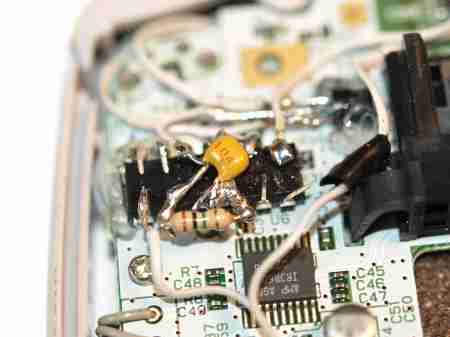
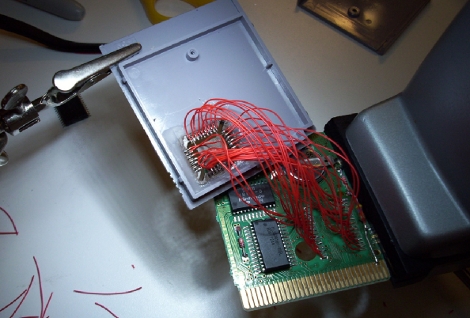
[Gerry] sent us pictures and a few details on replacing the Game Boy cartridge chip with a flash chip. For the prototype he used a PLCC and a little wire porn to interface a flash chip with the cartridge’s PCB while still having access to it for programming. In retrospect he plans to use a 32-pin ZIF socket on the next version to make things easier. It does work and he’s had some success loading his own code and getting it to run. There are other cartridge hacks that let you load code onto a cartridge but if you have the knowhow and the parts this makes for a fun weekend project. We’ve posted the rest of the photos that [Gerry] sent us after the break.

Update: Gerry is working on a video and a pinout. We’ll post info once we get a hold of it.

Continue reading “PLCC Replaces Game Boy Cartridge ROM”

Original NES Plays Game Boy Games?

[Bunnyboy] pulled off some wizardry with this custom NES cartridge. Inside is the mainboard for a Game Boy as well as his own custom PCB with the comb connector needed to interface with an original Nintendo Entertainment System. In his own words it’s “a Super Game Boy without the Super”. The expansion port to for the handheld is still accessible for some head-to-head Tetris or use with the obscure Game Boy printer.

[Thanks Maxym]

Hacking Game Boy For Sound

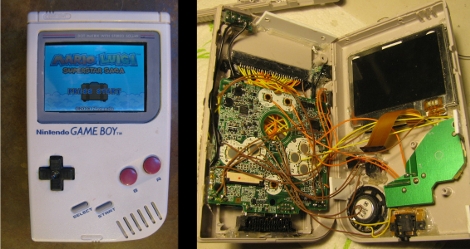
[Gijs] cracked open his Game Boy and added some parts to give him more sound synthesis control. He uses Little Sound Dj (LSDj), a popular Game Boy program used to pump out those classic 8-bit sounds. The unit seen above and heard in the clip after the break has an added potentiometer and circuit board. He’s got a few other hacked Game Boys on his site as well, including an Arduino generating random music on the handheld.

Continue reading “Hacking Game Boy For Sound”

Game Boy Video Out Adapter

[youtube=http://www.youtube.com/watch?v=JRKB5FT3Feg]

A bit light on the details, but we enjoyed seeing this video out device for the Nintendo Game Boy. A parallel cable connects to a modified Game Boy and transmits signals to the adapter which is housed in an old VHS cassette. We gather that some Super Game Boy hardware does the signal processing but from there your guess is probably better than ours.

[NeX] mentions that he originally wanted a screen to be included in the cassette. We’ve seen custom portables with small screens before, but he’s also developed a bare bones hand-held without a screen so that’s where the inclusion in the cassette would have been handy. We also wonder how the images will look on a big TV of the 50+ inch size. [NeX] has been pretty busy with the hacking lately, don’t miss the wire porn of his homemade Game Boy project.

[Thanks Jose]

Arduino Based Multiboot Cable For Game Boy Advance

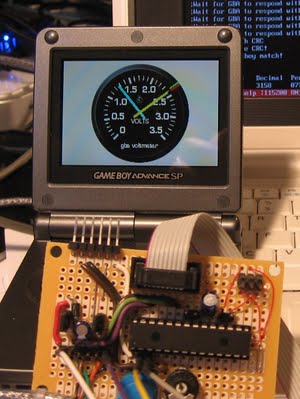
[Steve] wanted to do some ARM development and set his sights on the Game Boy Advance as a development package. In order to get his code onto the device he build an Arduino-based communications cable. It is necessary to have a microcontroller involved because the GBA uses a peculiar 16-bit serial communications protocol. This cable is an adaptation from the 8051-based cable developed by [Matt Evans] several years ago. [Steve’s] got it working by porting the 8051 assembler over for the Arduino, but we’d recommend adding a level converter to his hardware setup to step down from the Arduino’s 5v logic to the 3.3v logic the GBA expects.

He didn’t make up a wiring diagram, but in the code comments [Steve’s] laid out the connections as follows:

Arduino 8 to GBA SO
Arduino 9 to GBA SI
Arduino 10 to GBA SD
Arduino 11 to GBA SC

That’s it, follow the README in his source code package and you’re on your way to some ARM development.

Update: Most Interesting Game In 64 Pixels

[Brad] has continued working on the Super Pixel Bros game. We saw a glimpse of this a few months ago but he’s added a lot since then. The game now has enemies; one type is similar to Bullet Bill, another type drops from the sky and walks toward you, kind of like a Goomba. Game play is quite responsive and it’s amazing what he has accomplished with such low resolution. In the video after the break [Brad] mentions that a friend is working on sound effects for jumps and block breaking. We’re assuming that the audio track in the background is already coming from the LEDBOY speaker.

Which reminds us, if you haven’t checked out the hardware, do so now. That enameled wire mess makes us shudder just a bit. There many be a kit version coming that will save you the point-to-point soldering madness. If that’s part of the fun for you keep an eye out for the forthcoming release of the hardware schematics.

Continue reading “Update: Most Interesting Game In 64 Pixels”