Wago’s Online Community Is Full Of Neat Wago Tools

Wago connectors are somewhat controversial in the electrical world—beloved by some, decried by others. The company knows it has a dedicated user base, though, and has established the Wago Creators site for that very community.

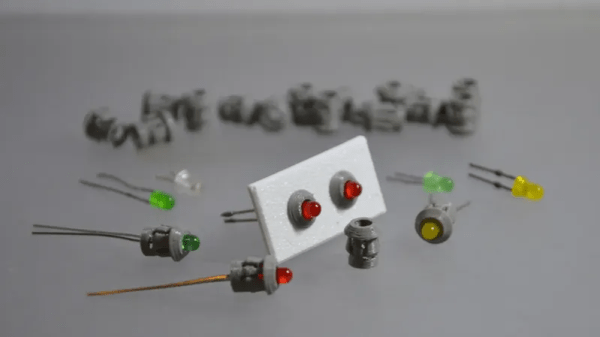
The idea behind the site is simple—it’s a place to discover and share unique little tools and accessories for use with Wago’s line of electrical connectors. Most are 3D printed accessories that make working with Wago connectors easier. There are some fun and innovative ideas up there, like an ESP8266 development kit that has a Wago connector for all the important pins, as well as a tool for easily opening the lever locks. Perhaps most amusing, though, is the project entitled “Hide Your Wago From Americans”—which consists of a 3D-printed wire nut lookalike designed to slide over the connectors to keep them out of view. There’s also a cheerful attempt at Wago art, that doesn’t really look like anything recognizable at all. Oh well, they can’t all be winners.

It’s great to see Wago so openly encouraging creativity among those that use its products. The sharing of ideas has been a big part of the 3D printing movement, and Wago isn’t the first company to jump on the bandwagon in this regard. If you’ve got some neat Wago hacks of your own, you can always let us know on the tipsline!

[Thanks to Niklas for the tip!]

Benchmarking Chinese CPUs

When it comes to PCs, Westerners are most most familiar with x86/x64 processors from Intel and AMD, with Apple Silicon taking up a significant market share, too. However, in China, a relatively new CPU architecture is on the rise. A fabless semiconductor company called Loongson has been producing chips with its LoongArch architecture since 2021. These chips remain rare outside China, but some in the West have been benchmarking them.

[Daniel Lemire] has recently blogged about the performance of the Loongson 3A6000, which debuted in late 2023. The chip was put through a range of simple benchmarking tests, involving float processing and string transcoding operations. [Daniel] compared it to the Intel Xeon Gold 6338 from 2021, noting the Intel chip pretty much performed better across the board. No surprise given its extra clock rate. Meanwhile, the gang over at [Chips and Cheese] ran even more exhaustive tests on the same chip last year. The Loongson was put through typical tasks like  compressing archives and encoding video. The outlet came to the conclusion that the chip was a little weaker than older CPUs like AMD’s Zen 2 line and Intel’s 10th generation Core chips. It’s also limited as a four-core chip compared to modern Intel and AMD lines that often start at 6 cores as a minimum.

If you find yourself interested in Loongson’s product, don’t get too excited. They’re not exactly easy to lay your hands on outside of China, and even the company’s own website is difficult to access from beyond those shores. You might try reaching out to Loongson-oriented online communities if you seek such hardware.

Different CPU architectures have perhaps never been more relevant, particularly as we see the x86 stalwarts doing battle with the rise of desktop and laptop ARM processors. If you’ve found something interesting regarding another obscure kind of CPU, don’t hesitate to let the tipsline know!

Photo of [DENKI OTAKU] with his test circuit and oscilloscope

Exploring The Performance Gains Of Four-Pin MOSFETs

Over on YouTube [DENKI OTAKU] runs us through how a 4-pin MOSFET works and what the extra Kelvin source pin does.

A typical MOSFET might come in a 3-pin TO-247 package, but there are 4-pin variants which include an extra pin for the Kelvin source, also known as source sense. These 4-pin packages are known as TO-247-4. The fourth pin provides an additional source for gate current return which can in turn lessen the effect of parasitic inductance on the gate-source when switching current, particularly at high speed.

In the video [DENKI OTAKU] uses his custom made testing board to investigate the performance characteristics of some 4-pin TO-247-4 MOSFETs versus their 3-pin TO-247 equivalents. Spoiler alert: the TO-247-4 MOSFETs have better performance characteristics. The video takes a close look at the results on the oscilloscope. The downside is that as the switching speed increases the ringing in the Vds waveform increases, too. If you’re switching to a 4-pin MOSFET from a 3-pin MOSFET in your design you will need to be aware of this Vds overshoot and make accommodations for it.

If you’d like to go deeper with MOSFET technology check out Introduction To MOSFET Switching Losses and MOSFETs — The Hidden Gate.

Continue reading “Exploring The Performance Gains Of Four-Pin MOSFETs”

2025 Component Abuse Challenge: The Slip Ring In Your Parts Bin

If you’re familiar with electrical slip rings as found in motors and the like you’ll know them as robust assemblies using carefully chosen alloys and sintered brushes, able to take the load at high RPM for a long time. But not all slip ring applications need this performance. For something requiring a lot less rotational ability, [Luke J. Barker] has something from his parts bin, and probably yours too. It’s an audio jack.

On the face of it, a 1/4″ jack might seem unsuitable for this task, being largely a small-signal audio connector. But when you consider its origins in the world of telephones it becomes apparent that perhaps it could do so much more. It works for him, but we’d suggest if you’d like to follow his example, to use decent quality plugs and sockets.

This is an entry in our 2025 Component Abuse Challenge, and we like it for thinking in terms of the physical rather than the electrical. The entry period for this contest will have just closed by the time you read this, so keep an eye out for the official results soon.

2025 Component Abuse Challenge: Glowing Neon From A 9 V Relay

Most of us know that a neon bulb requires a significant voltage to strike, in the region of 100 volts. There are plenty of circuits to make that voltage from a lower supply, should you wish to have that comforting glow of old, but perhaps one of the simplest comes from [meinsamayhun]. The neon is lit from a 9-volt battery, and the only other component is a relay.

What’s going on? It’s a simple mechanical version of a boost converter, with the relay wired as a buzzer. On each “off” cycle, the magnetic field in the coil collapses, and instead of being harvested by a diode as with a boost converter, it lights the neon. Presumably, the neon also saves the relay contacts from too much wear.

We like this project for its simplicity and for managing to do something useful without a semiconductor or vacuum tube in sight. It’s the very spirit of our 2025 Component Abuse Challenge, for which there is barely time to enter yourself if you have something in mind.

2025 Component Abuse Challenge: Pushing A 555 To The Limit

The humble 555 timer has its origins back in the early 1970s as the NE555, a bipolar integrated circuit. Over the years it has spawned a range of derivatives, including dual versions, and ones using CMOS technology. Have these enhancements improved the performance of the chip significantly? [MagicWolfi] has been pushing the envelope in an effort to see just how fast an astable 555 can be.

The Microchip MIC1555 may be the newest of the bunch, a 5-pin CMOS SOT-23 which has lost the frequency control and discharge pins of the original. It’s scarcely less versatile though, and it’s a fine candidate for an oscillator to push. We see it at a range of values for the capacitor and resistor in an astable configuration, each of which is tested across the supply voltage range. It’s rated as having a maximum frequency of 5 MHz, but with a zero Ohm resistor and only the parasitic capacitance of an open circuit, it reaches the giddy heights of 9.75 MHz. If we’re honest we find this surprising, but on reflection the chip would never be a first choice for super-fast operation.

We like it that someone’s managed to tie in the 555 to the contest, and given that it still has a few days to run at the time of writing, we’re hoping some of you might be inspired to enter one of your own.

2025 Component Abuse Challenge: The Ever-Versatile Transistor As A Temperature Sensor

One of the joys of writing up the entries for the 2025 Component Abuse Challenge has come in finding all the different alternative uses for the humble transistor. This building block of all modern electronics does a lot more than simply performing as a switch, for as [Aleksei Tertychnyi] tells us, it can also function as a temperature sensor.

How does this work? Simple enough, the base-emitter junction of a transistor can function as a diode, and like other diodes, it shows a roughly 0.2 volt per degree voltage shift with temperature (for a silicon transistor anyway). Taking a transistor and forward biasing the junction with a 33 K resistor, he can read the resulting voltage directly with an analogue to digital converter and derive a temperature reading.

The transistor features rarely as anything but a power device in the projects we bring you in 2025. Maybe you can find inspiration to experiment for yourself, and if you do, you still have a few days in which to make your own competition entry.