A Previously Unknown Supplier For A Classic Chip

It’s common enough for integrated circuits to be available from a range of different suppliers, either as licensed clones, or as reverse-engineered proprietary silicon. In the case of a generic circuit such as a cheap op-amp it matters little whose logo adorns the plastic, but when the part in question is an application processor it assumes much more importance. In the era of the 486 and Pentium there were a host of well-known manufacturers producing those chips, so it’s a surprise decades later to find that there was another, previously unknown. That’s just what [Doc TB] has done though, finding a 486 microprocessor from Shenzhen State Micro. That’s not a brand we ever saw in our desktop computers back in the 1990s.

Analysis of a couple of these chips, a DX33 and a DX2-66, shows them to have very similar micro-architecture but surprisingly a lower power consumption suggesting a smaller fabrication process. There’s the fascinating possibility that these might have been manufactured to serve an ongoing demand for 486 processors in some as-yet-unknown Chinese industrial application, but before any retrocomputer enthusiasts get their hopes up, the chips can’t be found anywhere from Shenzhen State Micro’s successor company. So for now they’re a fascinating oddity for CPU collectors, but who knows, perhaps more information on these unusual chips will surface.

Meanwhile we’ve looked at the 486’s legacy in detail  before, even finding there could still just be 486-compatible SoCs out there.

As Cheap As Chips: The MiFare Ultra Light Gets A Closer Look

If you take public transport in many of the world’s cities, your ticket will be an NFC card which you scan to gain access to the train or bus. These cards are disposable, so whatever technology they use must be astonishingly cheap. It’s one of these which [Ken Shirriff] has turned his microscope upon, a Montreal Métro ticket, and his examination of the MiFare Ultra Light it contains is well worth a read.

The cardboard surface can be stripped away from the card to reveal a plastic layer with a foil tuned circuit antenna. The chip itself is a barely-discernible dot in one corner. For those who like folksy measurements, smaller than a grain of salt. On it is an EEPROM to store its payload data, but perhaps the most interest lies in the support circuitry. As an NFC chip this has a lot of RF circuitry, as well as a charge pump to generate the extra voltages to charge the EEPROM. In both cases the use of switched capacitors plays a part in their construction, in the RF section to vary the load on the reader in order to transmit data.

He does a calculation on the cost of each chip, these are sold by the wafer with each wafer having around 100000 chips, and comes up with a cost-per-chip of about nine cents. Truly cheap as chips!

If NFC technology interests you, we’ve taken a deep dive into their antennas in the past.

Injection Molding Using A 3D Printer

Recently [Stefan] of CNC Kitchen took a gander at using his gaggle of 3D printers to try injection molding (IM). Although the IM process generally requires metal molds and specialized machinery, 3D printers can be used for low-volume IM runs which is enough for limited production runs and prototyping before committing to producing expensive IM molds. In the case of [Stefan], he followed Form Labs’ guidance to produce molds from glass-infused Rigid 10K resin (heat deflection temperature of 218 °C). These molds are very rigid, as the ceramic-like noise when [Stefan] taps two together attests to.

Injection molded bolt, with imperfections on the head. (Credit: Stefan, CNC Kitchen)

The actual injection process is where things get more hairy for [Stefan], as he attempts to push the clamped-shut mold against the nozzle of the FDM printer to inject the molten plastic, rather than using an IM press. With PLA at standard extrusion temperature the plastic barely gets into the mold before solidifying, however. Following this, higher temperatures, different materials (PETG, TPU) and high flow-rate extruders are attempted, with varying results.

Many of the struggles would seem to be due to poor mold design, rather than fundamental issues with using an FDM. The Form Labs document details some of the basics, such as opening up the injection gate (to decrease pressure inside the mold), adding air vents to improve flow and so on. Commentators to the video with professional experience point out many of these issues as well, along with the benefits of preheating the mold.

With the caveat that most of the challenge is in making a good mold, we’ve even injection molding done with nothing more exotic than a hot glue gun. If you’ve got a friend, or a long enough lever, you can even inject the plastic by hand.

Continue reading “Injection Molding Using A 3D Printer”

Bit Of OpenSCAD Code Caps Off Wiremold

Wiremold is great stuff — it’s relatively cheap, easy to work with, and offers all sorts of adapters and angle pieces which take the hassle out of running (and hiding) wires. But [Dr. Gerg] found a shortcoming of this otherwise very flexible product: since each run is intended to start and end in a surface mounted box, he couldn’t find an end cap that would let him close off a section.

The solution? A desktop 3D printer and a chunk of OpenSCAD code telling it what to extrude. When you break it down, the Wiremold profile is fairly straightforward, and can be easily described with geometric primitives. A handful of cylinders, a cube or two, tie it all together with the hull() function, and you’re there.

We’d say this would be a fantastic project to cut your OpenSCAD teeth on, but since [Dr. Gerg] was kind enough to share the source code, you don’t have to figure it out on your own. Though there’s still benefit in reading over it if you’re looking for some practical examples of how the “Programmers Solid 3D CAD Modeller” gets things done.

So why would you want a Wiremold endcap? In the case of [Dr. Gerg], it sounds like he was trying to cover up a short run of wire that was running vertically. But we could imagine other applications for this basic design now that it’s out in the wild. For example, a short length of Wiremold outfitted with a pair of printed caps could make for a nice little enclosure if you’ve got a small project that needs protecting.

Thumb Nuts For Not A Lot

Sometimes it’s the most straightforward of hacks which are also the most satisfying, and so it is that we’d like to draw your attention to [mikeandmertle]’s PVC thumb nuts. They provide a cheap an easy to make way to create thumb-tightenable nuts for your projects.

Starting with a PVC sheet, a series of discs can be cut from it with a hole saw. The hole in the centre of the disc is chosen such that it’s a bit smaller than the required nut, so that it can be pressed into the space with a bolt and a washer. Then a second PVC disc is glued over one side of the first before being sanded to a regular shape, resulting in a captive nut at the centre of a finger-sized and easily turnable handle.

We like this project, and we think that quite a few of you will too. We wonder how much torque it will take, but we’re guessing that a threaded insert could easily be substituted for the nut in more demanding applications. And of course, for more demanding applications you could always try knurling.

How Good (Or Bad) Are Fake Power Semiconductors?

We all know that there’s a significant risk of receiving fake hardware when buying parts from less reputable sources. These counterfeit parts are usually a much cheaper component relabeled as a more expensive one, with a consequent reduction in performance. It goes without saying that the fake is lower quality then, but by just how much? [Denki Otaku] has a video comparing two power FETs, a real and a fake one, and it makes for an interesting watch.

For once the fact that a video is sponsored is a positive, for instead of a spiel about a dodgy VPN or a game involving tanks, he takes us into Keysight’s own lab to work with some high-end component characterization instruments we wouldn’t normally see. A curve tracer produces the equivalents of all those graphs from the data sheet, while a double pulse tester puts the two transistors through a punishing high-power dynamic characteristic examination. Then back in his own lab we see the devices compared in a typical circuit, a high-power buck converter. The most obvious differences between the two parts reveal something about their physical difference, as a lower parasitic capacitance and turn-on time with a higher on resistance for the fake is a pointer to it being a smaller part. Decapping the two side by side backs this up.

So it should be no surprise that a fake part has a much lower performance than the real one. In this case it’s a fully working transistor, but one that works very inefficiently at the higher currents which the real one is designed for. We can all be caught by fakes, even Hackaday scribes.

Continue reading “How Good (Or Bad) Are Fake Power Semiconductors?”

Studying The Finer Points Of 3D Printed Gears

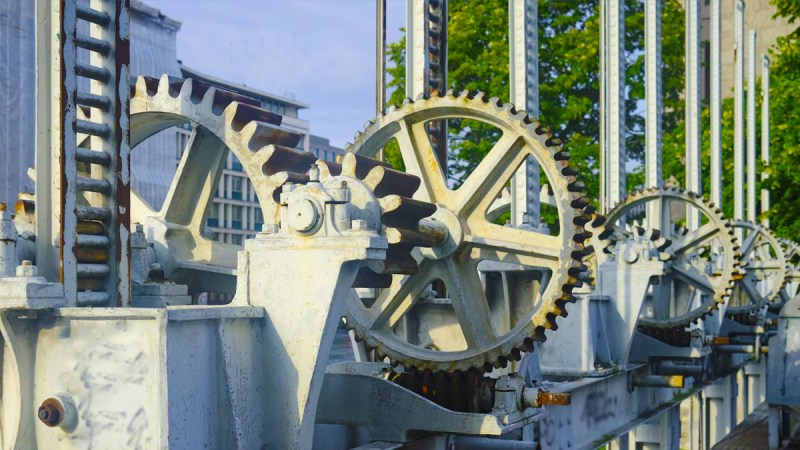
[How to Mechatronics] on YouTube endeavored to create a comprehensive guide comparing the various factors that affect the performance of 3D printed gears. Given the numerous variables involved, this is a challenging task, but it aims to shed light on the differences. The guide focuses on three types of gears: the spur gear with straight teeth parallel to the gear axis, the helical gear with teeth at an angle, and the herringbone gear, which combines two helical gear designs. Furthermore, the guide delves into how printing factors such as infill density impact strength, and it tests various materials, including PLA, carbon fiber PLA, ABS, PETG, ASA, and nylon, to determine the best options.

The spur gear is highly efficient due to the minimal contact path when the gears are engaged. However, the sudden contact mechanism, as the teeth engage, creates a high impulse load, which can negatively affect durability and increase noise. On the other hand, helical gears have a more gradual engagement, resulting in reduced noise and smoother operation. This leads to an increased load-carrying capacity, thus improving durability and lifespan.

It’s worth noting that multiple teeth are involved in power transmission, with the gradual engagement and disengagement of the tooth being spread out over more teeth than the spur design. The downside is that there is a significant sideways force due to the inclined angle of the teeth, which must be considered in the enclosing structure and may require an additional bearing surface to handle it. Herringbone gears solve this problem by using two helical gears thrusting in opposite directions, cancelling out the force.

Continue reading “Studying The Finer Points Of 3D Printed Gears”