Building A Crystal Oven

Radio communications depend on stable oscillator frequencies and with that in mind, [Scott Harden] built a module to regulate temperature of a crystal oscillator. The process is outlined in the video after the break but it goes something like this: A small square of double-sided copper-clad board is used as a base. The body of the crystal oscillator is mounted on one side of this base. On the other side there is a mosfet and a thermister. The resistance of the thermister turns the mosfet on and off in an attempt to maintain a steady temperature.

This is the first iteration of [Scott’s] crystal oven. It’s being designed for use outdoors, as his indoor setup uses a styrofoam box to insulate the oscillator from ambient temperatures. He’s already working on a second version, and mentioned the incorporation of a Wheatstone bridge but we’ll have to wait to get more details.

Continue reading “Building A Crystal Oven”

A Simple FM Transmitter

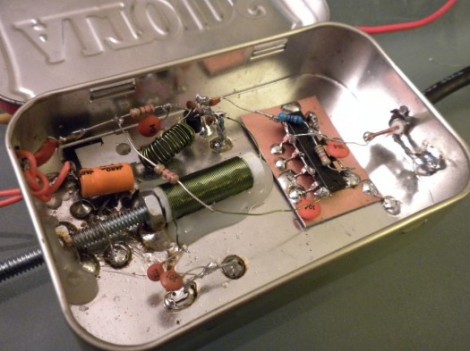
Here is a low component count FM transmitter. It sacrifices some features, like the ability to adjust the frequency, for simplicity’s sake. The build method is fairly common with amateur radio but we don’t see it around here too much. Each component gets a 5mm-by-5mm copper clad pad which is super glued to the ground plate as an insulator. There’s even a pictorial example of this method if you need some help with visualization.

One of the schematics included in the article shows how to incorporate a condenser microphone into the unit. We guess that makes it pretty easy to add an FM ‘bug’ to your arsenal of covert listening devices. Just make sure to check your local laws before building and using this. We’re not sure what the FCC would think of it here in America so we’re hoping some well-informed readers will educate us with a comment.

[Thanks Bart]

Codec2: GNU Low-bitrate Speech Codec

Low bandwidth speech compression is a desirable concept for amateur radio enthusiasts. Unfortunately there isn’t a great open-source option out there, but that’s changing with the low-bitrate speech compression package called Codec2. It manages to transmit and decode at 2550 bits per second with results comparable to proprietary solutions like MELP and very near the initial goal of 2400 bit/s. [David Rowe], who spearheads the project, has been simulating communications using a Linux box and has posted audio snippets at the first link above for comparison. They’re looking for feedback and testing so if you interested give them a helping hand.

[Thanks Robomo]

Small And Simple FM Radio

[gpsKlaus] built this little FM radio (translated) based on the AR1010 IC. That chip is controlled via I2C by an ATtiny45 microcontroller. His tuning implementation relies on presetting 16 stations in the firmware and selecting them with the white potentiometer.

The FM chip came on a breakout board from SparkFun. Not bad at around $15 as it includes the crystal, some caps and a few resistors, and you don’t have to try and solder to the fine pitched pads on that minuscule package. We’re a little unsure of the features included in the part as the datasheet is lacking in detail and the reference datasheet that SparkFun includes in the description is obviously for a much more full-featured chip. Still, this would be a fun thing to play around with if you’ve grown tired of blinking LEDs.

If you don’t want to let an integrated circuit do all the heavy lifting try this post for a guide on building your own radio tuner.

Terminal Node Controller In A Router

[Andrew] used a DSL router to make his own Terminal Node Controller. This will become part of an APRS-IS network, an Internet-based network built by amateur radio operators. The router used here is a Dlink DSL-502T with an AVR based TNC module attached to the serial port header. The phone line connector and its accompanying hardware have been removed to make room for the TNC module, which is supplied with 12V via that red wire. When the router boots up it sends data to the serial port header so the firmware on the TNC needed some tweaking to accommodate this (yay for open source).

Want some more APRS goodness? Check out this AVR APRS tracker.

Texting With Some Walkie-talkies

[Travers Buda] is giving new life to his abandoned childhood toys. He cracked open a set of Family Radio Services radios he had received for a birthday which work up to 2 kilometers apart. With just a bit of extra circuitry he was able to get them to act as wireless modems. The system functions but it looks like it would benefit from some more refinement, including error correction. In the end [Travers] manages to send and receive ASCII based messages at a whopping baud rate of 10.

Adding Motion Control To An RC Transmitter

If your soldering skills are up to snuff you can add a motion control feature to your radio controlled transmitter. [Starlino] used a combination accelerometer and gyroscope module as an alternate source of analog control information. He built a filter to dial in the analog voltage range to match that of one of the sticks on the controller. A switch is used to disconnect the signal when motion input is not desired. This would be a nice addition to one of those more creative aerial hacks.