Light Following Robot Does It The Analog Way

If you wanted to build a robot that chased light, you might start thinking about Raspberry Pis, cameras, and off-the-shelf computer vision systems. However, it needn’t be so complex. [Ed] of [Death and the Penguin] demonstrates this ably with a simple robot that finds the light the old-fashioned way.

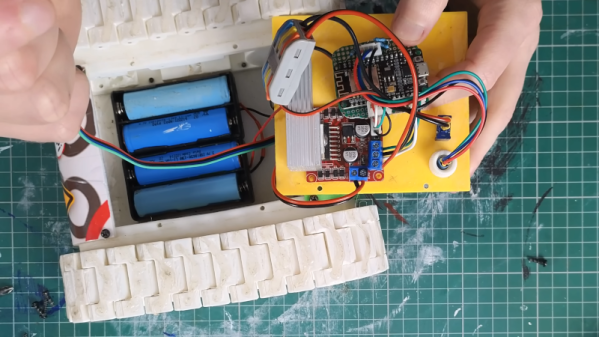
The build is not dissimilar from many line-following and line chasing robots that graced the pages of electronics magazines 50 years ago or more. The basic circuit relies on a pair of light-dependent resistors (LDR), which are wrapped in cardboard tubes to effectively make their response highly directional. An op-amp is used to compare the resistance of each LDR. It then crudely steers the robot towards the brighter light between turning one motor  hard on or the other, operating in a skid-steer style arrangement.

[Ed] then proceeded to improve the design further with the addition of a 555 timer IC. It’s set up to enable PWM-like control, allowing one motor to run at a lower speed than the other depending on the ratio between the light sensors. This provides much smoother steering than the hard-on, hard-off control of the simpler circuit. [Ed] notes that this is about the point where he would typically reach for a microcontroller if he hoped to add any additional sophistication.

In an era where microcontrollers seem to be the solution to everything, it’s nice to remember that sometimes you can complete a project without using a processor or any code at all. Video after the break.

Continue reading “Light Following Robot Does It The Analog Way”

Electric Lawnmower Gets RC Controls

Decades ago, shows like Star Trek, The Jetsons, and Lost in Space promised us a future full of helpful computers and robot assistants. Unfortunately, we haven’t quite gotten our general-purpose helper to do all of our tasks with a simple voice command yet. But if some sweat equity is applied, we can get machines to do specific tasks for us under some situations. [Max Maker] built this remote-controlled lawnmower which at least minimizes the physical labor he needs to do to cut his grass.

The first step in the project was to remove the human interface parts of the push mower and start working on a frame for the various control mechanisms. This includes adding an actuator to raise and lower the mower deck on the fly. Driving the new rear wheels are two wheelchair motors, which allow it to use differential steering, with a set of casters up front for maximum maneuverability. An Arduino Mega sits in a custom enclosure to control everything and receive the RC signals, alongside the mower’s batteries and the motor controllers for the drive wheels.

After some issues with programming, [Max] has an effective remote controlled mower that he can use to mulch leaves or cut grass without getting out of his chair. It would also make an excellent platform if he decides to fully automate it in the future, which is a project that has been done fairly effectively in the past even at much larger scales.

Continue reading “Electric Lawnmower Gets RC Controls”

Building A Little Quadruped Robot

Robots don’t have to be large and imposing to be impressive. As this tiny quadruped from [Dorian Todd] demonstrates, some simple electronics and a few servos can create something altogether charming on their own.

This little fellow is named Sesame. A quadruped robot, it’s built out of 3D-printed components. Each leg features a pair of MG90S hobby servos, one of which rotates the leg around the vertical axis, while the other moves the foot. The ESP32 microcontroller controls all eight servos, enabling remote control of Sesame via its built-in wireless connectivity. Sesame also gets a 128×64 OLED display, which it uses to display a range of emotions.

Mechanically, the Sesame design isn’t particularly sophisticated. Where it shines is that even with such a limited range of motion, between its four legs and its little screen, this robot can display a great deal of emotion. [Dorian] shows this off in the project video, in which Sesame scampers around a desktop with all the joy and verve of a new puppy. It’s also very cheap; [Dorian] estimates you can build your own Sesame for about $60. Files are on GitHub for the curious.

If you prefer your quadrupeds built for performance over charm, you might consider an alternative build. Video after the break.

Continue reading “Building A Little Quadruped Robot”

Robot Sees Light With No CPU

If you ever built a line following robot, you’ll be nostalgic about [Jeremy’s] light-seeking robot. It is a very simple build since there is no CPU and, therefore, also no software.

The trick, of course, is a pair of photo-sensitive resistors. A pair of motors turns the robot until one of the sensors detects light, then moves it forward.

Continue reading “Robot Sees Light With No CPU”

The Best Robot Mop System: Flat, Spinning, Or Roller?

When it comes to designing a mopping robot, there are a number of approaches you can pick from, including just having the movement of the robot push the soggy mop over the floor, having spinning pads, or even a big spinning roller. But what difference does it make? Recently the [Vacuum Wars] channel ran a comparison to find out the answer.

The two spinning pad design is interesting, because it allows for the bot to move closer to objects or walls, and the base station doesn’t need the active scrubber that the simple static pad requires. The weakness of both types of flat mop design is that they are quickly saturated with dirt and moisture, after which they’ll happily smear it over the floor.

The spinning roller is the most complex, with the robot having its own onboard water tank, and a way to extract the dirty water from the mop and store it for disposal in the base station. Theoretically this would be the clear winner, with basically all of them having features like avoiding carpet.

Continue reading “The Best Robot Mop System: Flat, Spinning, Or Roller?”

Building A Carousel Autosampler

A common task in a laboratory setting is that of sampling, where a bit of e.g. liquid has to be sampled from a series of containers. Doing this by hand is possible, but tedious, ergo an autosampler can save a lot of time and tedium. Being not incredibly complex devices that have a lot in common with e.g. FDM 3D printers and CNC machines, it makes perfect sense to build one yourself, as [Markus Bindhammer] of Marb’s Lab on YouTube has done.

The specific design that [Markus] went for uses a sample carousel that can hold up to 30 bottles of 20 mL each. An ATmega-based board forms the brain of the machine, which can operate either independently or be controlled via I2C or serial. The axes and carousel are controlled by three stepper motors, each of which is driven by a TB6600 microstep driver.

Why this design is a time saver should be apparent, as you can load the carousel with bottles and have the autosampler handle the work over the course of however long the entire process takes instead of tying up a human. Initially the autosampler will be used for the synthesis of cadmium-selenium quantum dots, before it will be put to work for an HPLC/spectrometer project.

Although [Markus] intends this to be an open hardware and software project, it will take a bit longer to get all the files and documentation organized. Until then we will have to keep manually sampling, or use the video as the construction tutorial.

Continue reading “Building A Carousel Autosampler”

A round, 3D-printed motor housing is shown, with one flattened side holding a fan mount. A circular plate is mounted above the face of the housing, and a cord runs around it and pulleys on the side of the housing.

Tying Up Loose Ends On A Rope-based Robot Actuator

One of the perennial challenges of building robots is minimizing the size and weight of drive systems while preserving power. One established way to do this, at least on robots with joints, is to fit each joint with a quasi-direct-drive motor integrating a brushless motor and gearbox in one device. [The 5439 Workshop] wanted to take this approach with his own robot project, but since commercial drives were beyond his budget, he designed his own powerful, printable actuator.

The motor reducing mechanism was the biggest challenge: most quasi-direct drives use a planetary gearbox, but this would have been difficult to 3D-print without either serious backlash or limited torque. A cycloidal drive was an option, but previous printable cycloidal drives seemed to have low efficiency, and they didn’t want to work with a strain-wave gearing. Instead, he decided to use a rope drive (this seems to be another name for a kind of Capstan drive), which doesn’t require particularly strong materials or high precision. These normally use a rope wound around two side-by-side drums, which are difficult to integrate into a compact actuator, but he solved the issue by putting the drums in-line with the motor, with two pairs of pulleys guiding the rope between them in a “C” shaped path.

The actual motor is a hand-wound stator inside a 3D-printed rotor with magnets epoxied into it. The printed rotor proved problematic when the attraction between the rotor and magnets caused it to flex and scrape against the housing, and it eventually had to be reinforced with some thin metal sheets. After fixing this, it reached five Newton-meters of torque at one amp and nine Newton-meters at five amps. The diminishing returns seem to be because the 3D-printed pulley wheels broke under higher torque, which should be easy to fix in the future.

This looks like a promising design, but if you don’t need the output shaft inline with the motors, it’s probably easier to build a simple Capstan drive, the mathematics of which we’ve covered before. Both makers we’ve previously seen build Capstan drives used them to make robot dogs, which says something for their speed and responsiveness.