Using UAVs To Find Mannequins Lost In The Outback

Every other year the Australian Research Center for Aerospace Automation, the government of Queensland, Australia  and other government and research institutions hold a contest to develop technology for unmanned aerial vehicles for the wastes of central Australia. Canberra UAV – a group of autonomous drone enthusiasts from the Make, Hack, Void hackerspace – took part in this UAV challenge this year. They ended up with one of the most successful UAVs to every compete, and while they didn’t quite finish the competition they were one of the most successful entries to date.

The goal of the Search and Rescue Outback Challenge is to take off from a landing strip, search for a mannequin named Outback Joe, and deliver 500 ml of life-giving water via air drop. Out of 72 teams entered in to this year’s Outback Challenge, only 6 were allowed to take off – safety restrictions, don’t you know – and all but two hadn’t been destroyed via ‘rapid, unplanned descent’ during qualifications.

UAV Canberra was the only team able to search the entire 5 nautical mile radius search area with their cameras and find Outback Joe. Contest judges gave them permission to drop their payload, but unfortunately the bottle of water was snagged on the engine.

In the many iterations of the Search and Rescue Outback Challenge, UAV Canberra is only the second team to locate a mannequin in the outback, and the first to do it autonomously. A shame, then, that they were unable to claim a victory, but we’ll look forward to their entry in the next Search and Rescue competition.

You can check out a few videos of the Canberra UAV team’s flights after the break.

Continue reading “Using UAVs To Find Mannequins Lost In The Outback”

200 Pound, WiFi Deploying Robot Ran Over My Foot

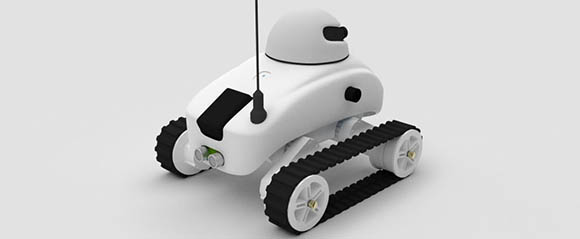
[Adam Bercu] and [Dan Landers] from Artisan’s Asylum in Somerville, MA brought a very, very cool toy to Maker Faire this year. It’s a two hundred pound WiFi repeater deploying robot able to amble across unforgiving terrain and my foot.

The robot is controlled through a web interface with the help of a front-mounted web cam with pan and tilt controls. All the signals are sent through a WiFi connection to a node.js web server; not the best way to communicate with a robot over long distances, but [Adam] and [Dan] have a few tricks up their sleeve.

On the back of the robot are two Pelican cases loaded up with a battery and a Linksys WRT54G wireless router. When the robot reaches the limits of its range, it activates a solenoid, dropping a WiFi repeater. This repeater has enough battery juice to stay powered for about a day and a half, meaning the robot can make multiple trips to deploy a wireless network through some very hostile terrain. Perfect for disaster and search and rescue operations.

There are two videos after the break: the first is [Dan] going over the capabilities of his tank bot and the second is a short demo of the bot tearing up the grass at Maker Faire.

Continue reading “200 Pound, WiFi Deploying Robot Ran Over My Foot”

Intelligent Autonomous Vehicle Makes It To Maker Faire

A few guys from Rutgers showed up at Maker Faire with Navi, their vehicle for the 2012 Intelligent Ground Vehicle Competition. Powered by two huge lead acid batteries, Navi features enough high-end hardware to hopefully make it through or around just about any terrain.

Loaded up with a laser range finder, a stereo camera setup, compass, GPS receiver, and a pair of motors capable of pulling 40A, Navi has the all the hardware sensors required to make it around a track with no human intervention. Everything is controlled by a small netbook underneath the control panel, itself loaded up with enough switches and an 8×32 LED matrix to be utterly incomprehensible.

In the videos after the break, the guys from Rutgers show off the systems that went into Navi. There’s also a video showing off Navi’s suspension, an impressive custom-built wishbone setup that will hopefully keep Navi on an even keel throughout the competition.

Also of note: A PDF design report for Navi and Navi’s own blog.

Continue reading “Intelligent Autonomous Vehicle Makes It To Maker Faire”

Professional Looking Dog Robot Was Actually [Martin’s] Master’s Thesis

If you think this thing looks good you should see it move. [Martin Smith] hit a home run on the project, which was his Master’s Thesis. Fifteen servo motors provide a way for the bot to move around. Having been modeled after a small canine the gait is very realistic. The tail is even functional, acting as a counterweight when moving the legs.

The project was meticulously built in a 3D environment before undertaking any physical assembly. The mechanical parts are all either milled from aluminum or 3D printed. Two mBed boards mounted on its back allow it to interact with its environment. One of them handles image processing, the other drives the array of motors. And of course it doesn’t hurt that he built some Larson Scanners in as eyes.

Don’t miss the video after the break which shows off the entire project from planning to demonstration. We can’t help but be reminded of the rat-thing from Snow Crash.

Continue reading “Professional Looking Dog Robot Was Actually [Martin’s] Master’s Thesis”

Whatever A Phobia Of Fingers Is Called, This Is It.

[youtube=http://www.youtube.com/watch?v=7LSXvhLKjCU&w=470]

Touched is a project by [Rebecca Strauss] that integrates servos, strings, and felt into a horrifying kinetic sculpture made up of a dozen mechanical fingers straight from a Boschian nightmare.

The fingers are made up of segments of wood articulated with the help of a small string. Each pair of fingers is controlled by a single servo, and the tips of each pair of fingers is controlled by a second servo.

After covering them in felt, [Rebecca] wrapped conductive thread around each of the fingers. When some of the fingers are touched, they all recoil as if controlled by a demon living just under a mountain of felt.

[Rebecca] brought in another kinetic sculpture using her servo controlled fingers; in the video up at the top and after the break, you can see the inner workings of this floor-mounted version. When the IR proximity sensor goes off, the fingers recoil but can be coaxed out again by gently stroking one of the phalanges.

Continue reading “Whatever A Phobia Of Fingers Is Called, This Is It.”

L.I.O.S.: The Ten-ish Dollar Robot.

We love cheap stuff here. Who doesn’t? [Oscar Rodriguez Parra] does too, and wrote in to show us his super cheapey robot L.I.O.S. The build was for the AFRON design challenge, which involves building a 10 dollar robot to teach students robotics. The winners of the challenge were neat and all, but they all look too fancy flaunting their molded plastics and electronics breadboards.

[Oscar’s] design is super simple, LDRs as eyes, a PIC12F683 to do the brainin, LEDs for indicators and a couple modded servos to drive the wheels. An extraordinarily complex cardboard flap roller helps the cart turn, but probably isn’t going to see much aside from smooth flooring. The electronics are mounted using one of our favorite techniques, the paper perf board (very similar to the substrate free technique).

Check out the video after the jump to see LIOS in action. This is an excellent introduction to robotics for any classroom. Thanks [Oscar]!

Continue reading “L.I.O.S.: The Ten-ish Dollar Robot.”

Wii Nunchuck Controlled Robot Exhibits Rock Solid Balancing

[Willy Wampa] is showing off his self-balancing robot. What strikes us about the build is how well tuned his feedback loop seems to be. In the video after the break you will see that there is absolutely no visible oscillation used to keep its balance.

The parts used are quite easy to obtain. The acrylic mounting plates are his wife’s design and were custom cut through the Pololu service. They were also the source of the gear motors. He’s using a SparkFun IMU with an Arduino and a motor shield. He first posted about the build about a month ago, but the new revision switches to a Pololu motor driver shield which he says works much better, and adds control via a wireless Wii Nunchuck.

The PID loop which gives it that remarkably solid upright stance is from a library written by [Brett Beauregard]. Once again the concept of open source lets us build great things by standing on the shoulders of others.

Continue reading “Wii Nunchuck Controlled Robot Exhibits Rock Solid Balancing”