Although uranium-235 is the typical fuel for commercial fission reactors on account of it being fissile, it’s relatively rare relative to the fertile U-238 and thorium (Th-232). Using either of these fertile isotopes to breed new fuel from is thus an attractive proposition. Despite this, only India and China have a strong focus on using Th-232 for reactors, the former using breeders (Th-232 to U-233) to create fertile uranium fuel. China has demonstrated its approach — including refueling a live reactor — using a fourth-generation molten salt reactor.
In 1977, a little way outside of Seattle, Washington Nuclear Projects 3 and 5 (WNP-3 and WNP-5) were started as part of Washington Public Power Supply System (WPPSS, pronounced “whoops”). They ran over budget, and in the 80s they were mothballed even though WNP-3 was nearly complete.
As you might remember from chemistry class, crystals are made up of blocks of atoms (usually called ‘unit cells’) that fit together in perfect repetition — baring dislocations, cracks, impurities, or anything else that might throw off a theoretically perfect crystal structure. There are only so many ways to tessellate atoms in 3D space; 230 of them, to be precise. A quasicrystal isn’t any of them. Rather than repeat endlessly in 3D space, a quasicrystal never repeats perfectly, like a 3D dimensional Penrose tile. The discovery of quasicrystals dates back to the 1980s, and was awarded a noble prize in 2011.
Penrose tiling– the pattern never repeats perfectly. Quasicrystals do this in 3D. (Image by Inductiveload, Public Domain)
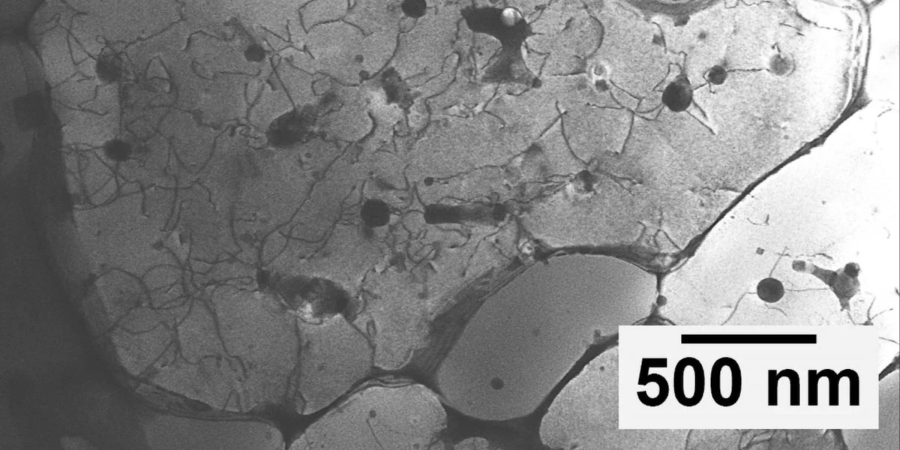
Quasicrystals aren’t exactly common in nature, so how does 3D printing come into this? Well, it turns out that, quite accidentally, a particular Aluminum-Zirconium alloy was forming small zones of quasicrystals (the black spots in the image above) when used in powder bed fusion printing. Other high strength-alloys tended to be very prone to cracking, to the point of unusability, and this Al-Zr alloy, discovered in 2017, was the first of its class.
You might imagine that the non-regular structure of a quasicrystal wouldn’t propagate cracks as easily as a regular crystal structure, and you would be right! The NIST researchers obviously wanted to investigate why the printable alloy had the properties it does. When their crystallographic analysis showed not only five-fold, but also three-fold and two-fold rotational symmetry when examined from different angles, the researchers realized they had a quasicrystal on their hands. The unit cell is in the form of a 20-sided icosahedron, providing the penrose-style tiling that keeps the alloy from cracking.
You might say the original team that developed the alloy rolled a nat-20 on their crafting skill. Now that we understand why it works, this research opens up the doors for other metallic quasi-crystals to be developed on purpose, in aluminum and perhaps other alloys.
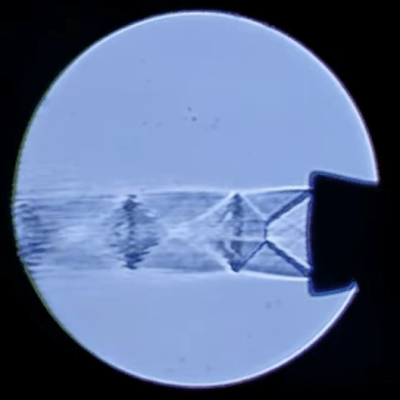
We’re suckers here for projects that let you see the unseeable, and [Ayden Wardell Aerospace] provides that on a budget with their $30 Schlieren Imaging Setup. The unseeable in question is differences in air density– or, more precisely, differences in the refractive index of the fluid the imaging set up makes use of, in this case air. Think of how you can see waves of “heat” on a warm day– that’s lower-density hot air refracting light as it rises. Schlieren photography takes advantage of this, allowing to analyze fluid flows– for example, the mach cones in a DIY rocket nozzle, which is what got [Ayden Wardell Aerospace] interested in the technique.
Examining exhaust makes this a useful tool for [Aerospace].This is a ‘classic’ mirror-and-lamp Schlieren set up. You put the system you wish to film near the focal plane of a spherical mirror, and camera and light source out at twice the focal distance. Rays deflected by changes in refractive index miss the camera– usually one places a razor blade precisely to block them, but [Ayden] found that when using a smart phone that was unnecessary, which shocked this author.
While it is possible that [Ayden Wardell Aerospace] has technically constructed a shadowgraph, they claim that carefully positioning the smartphone allows the sharp edge of the case to replace the razor blade. A shadowgraph, which shows the second derivative of density, is a perfectly valid technique for flow visualization, and is superior to Schlieren photography in some circumstances– when looking at shock waves, for example.
Regardless, the great thing about this project is that [Ayden Wardell Aerospace] provides us with STLs for the mirror and smartphone mounting, as well as providing a BOM and a clear instructional video. Rather than arguing in the comments if this is “truly” Schlieren imaging, grab a mirror, extrude some filament, and test it for yourself!
We’re probably all familiar with the Hall Effect, at least to the extent that it can be used to make solid-state sensors for magnetic fields. It’s a cool bit of applied physics, but there are other ways to sense magnetic fields, including leveraging the weird world of quantum physics with this diamond, laser, and microwave open-source sensor.
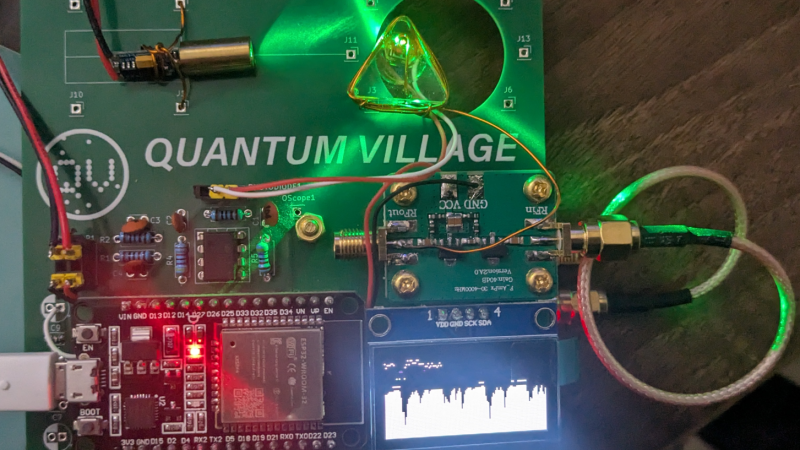
Having never heard of quantum sensors before, we took the plunge and read up on the topic using some of the material provided by [Mark C] and his colleagues at Quantum Village. The gist of it seems to be that certain lab-grown diamonds can be manufactured with impurities such as nitrogen, which disrupt the normally very orderly lattice of carbon atoms and create a “nitrogen vacancy,” small pockets within the diamond with extra electrons. Shining a green laser on N-V diamonds can stimulate those electrons to jump up to higher energy states, releasing red light when they return to the ground state. Turning this into a sensor involves sweeping the N-V diamond with microwave energy in the presence of a magnetic field, which modifies which spin states of the electrons and hence how much red light is emitted.
Building a practical version of this quantum sensor isn’t as difficult as it sounds. The trickiest part seems to be building the diamond assembly, which has the N-V diamond — about the size of a grain of sand and actually not that expensive — potted in clear epoxy along with a loop of copper wire for the microwave antenna, a photodiode, and a small fleck of red filter material. The electronics primarily consist of an ADF4531 phase-locked loop RF signal generator and a 40-dB RF amplifier to generate the microwave signals, a green laser diode module, and an ESP32 dev board.
All the design files and firmware have been open-sourced, and everything about the build seems quite approachable. The write-up emphasizes Quantum Village’s desire to make this quantum technology’s “Apple II moment,” which we heartily endorse. We’ve seen N-V sensors detailed before, but this project might make it easier to play with quantum physics at home.
A tornado can be an awe-inspiring sight, but it can also flip your car, trash your house, and otherwise injure you with flying debris. If you’d like to look at swirling air currents in a safer context, you might appreciate this tornado tower build from [Gary Boyd].
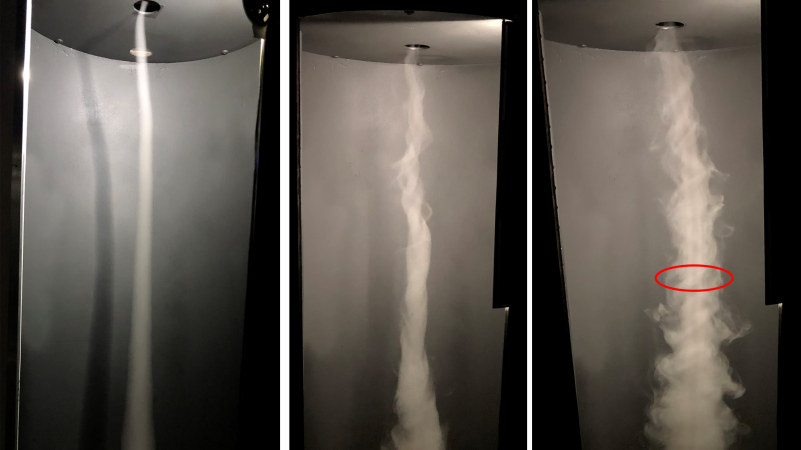
[Gary]’s build was inspired by museum demonstrations and the tornado machine designs of [Harald Edens]. His build generates a vortex that spans 1 meter tall in a semi-open cylindrical chamber. A fan in the top of the device sucks in air from the chamber, and exhausts it through a vertical column of holes in the wall of the cylinder. This creates a vortex in the air, though it’s not something you can see on its own. To visualize the flow, the cylindrical chamber is also fitted with an ultrasonic mist generator in the base. The vortex in the chamber is able to pick up this mist, and it can be seen swirling upwards as it is sucked towards the fan at the top.
It’s a nice educational build, and one that’s as nice to look at as it is to study. It produces a thick white vortex that we’re sure someone could turn into an admirable lamp or clock or something, this being Hackaday, after all. In any case, vortexes are well worth your study. If you’re cooking up neat projects with this physical principle, you should absolutely let us know!
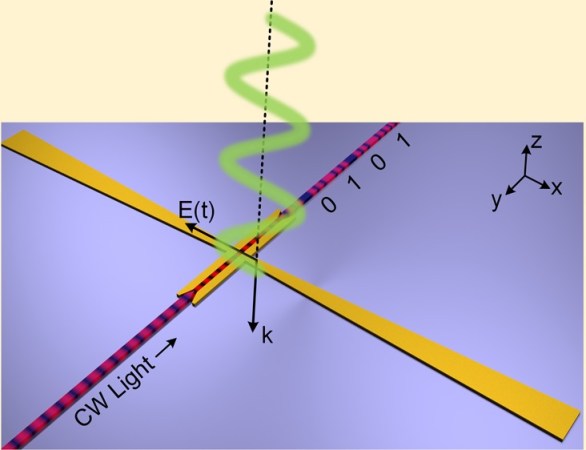
A major bottleneck with high-frequency wireless communications is the conversion from radio frequencies to optical signals and vice versa. This is performed by an electro-optic modulator (EOM), which generally are limited to GHz-level signals. To reach THz speeds, a new approach was needed, which researchers at ETH Zurich in Switzerland claim to have found in the form of a plasmonic phase modulator.
Although sounding like something from a Star Trek episode, plasmonics is a very real field, which involves the interaction between optical frequencies along metal-dielectric interfaces. The original 2015 paper by [Yannick Salamin] et al. as published in Nano Letters provides the foundations of the achievement, with the recent paper in Optica by [Yannik Horst] et al. covering the THz plasmonic EOM demonstration.
The demonstrated prototype can achieve 1.14 THz, though signal degradation begins to occur around 1 THz. This is achieved by using plasmons (quanta of electron oscillators) generated on the gold surface, who affect the optical beam as it passes small slots in the gold surface that contain a nonlinear organic electro optic material that ‘writes’ the original wireless signal onto the optical beam.