Pulsed Deposition Points A Different Path To DIY Semiconductors

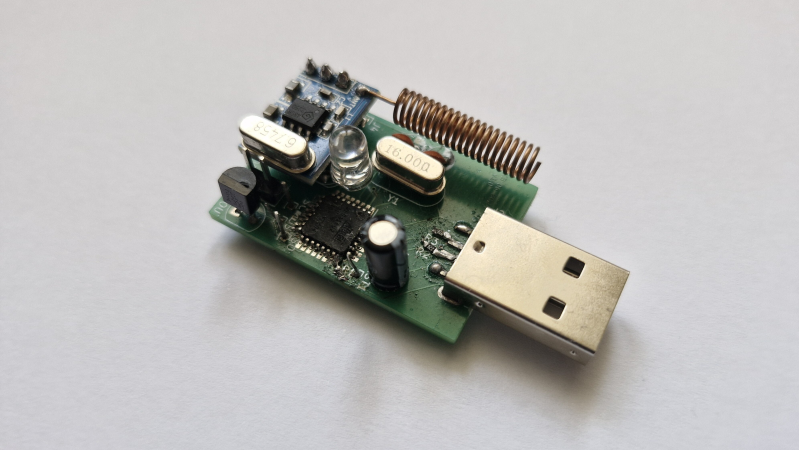
While not impossible, replicating the machines and processes of a modern semiconductor fab is a pretty steep climb for the home gamer. Sure, we’ve seen it done, but nanoscale photolithography is a demanding process that discourages the DIYer at every turn. So if you want to make semiconductors at home, it might be best to change the rules a little and give something like this pulsed laser deposition prototyping apparatus a try.

Rather than building up a semiconductor by depositing layers of material onto a silicon substrate and selectively etching features into them with photolithography, [Sebastián Elgueta]’s chips will be made by adding materials in their final shape, with no etching required. The heart of the process is a multi-material pulsed laser deposition chamber, which uses an Nd:YAG laser to ablate one of six materials held on a rotating turret, creating a plasma that can be deposited onto a silicon substrate. Layers can either be a single material or, with the turret rapidly switched between different targets, a mix of multiple materials. The chamber is also equipped with valves for admitting different gases, such as oxygen when insulating layers of metal oxides need to be deposited. To create features, a pattern etched into a continuous web of aluminum foil by a second laser is used as a mask. When a new mask is needed, a fresh area of the foil is rolled into position over the substrate; this keeps the patterns in perfect alignment.

We’ve noticed regular updates on this project, so it’s under active development. [Sebastián]’s most recent improvements to the setup have involved adding electronics inside the chamber, including a resistive heater to warm the substrate before deposition and a quartz crystal microbalance to measure the amount of material being deposited. We’re eager to see what else he comes up with, especially when those first chips roll off the line. Until then, we’ll just have to look back at some of [Sam Zeloof]’s DIY semiconductors.

MIT Demonstrates Fully 3D Printed, Active Electronic Components

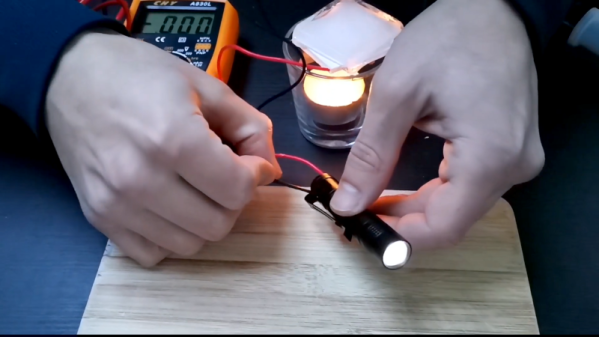
One can 3D print with conductive filament, and therefore plausibly create passive components like resistors. But what about active components, which typically require semiconductors? Researchers at MIT demonstrate working concepts for a resettable fuse and logic gates, completely 3D printed and semiconductor-free.

Now just to be absolutely clear — these are still just proofs of concept. To say they are big and perform poorly compared to their semiconductor equivalents would be an understatement. But they do work, and they are 100% 3D printed active electronic components, using commercially-available filament.

How does one make a working resettable fuse and transistor out of such stuff? By harnessing thermal expansion, essentially.

Continue reading “MIT Demonstrates Fully 3D Printed, Active Electronic Components”

Measuring Local Variances In Earth’s Magnetic Field

Although the Earth’s magnetic field is reliable enough for navigation and is also essential for blocking harmful solar emissions and for improving radio communications, it’s not a uniform strength everywhere on the planet. Much like how inconsistencies in the density of the materials of the planet can impact the local gravitational force ever so slightly, so to can slight changes impact the strength of the magnetic field from place to place. And it doesn’t take too much to measure this impact on your own, as [efeyenice983] demonstrates here.

To measure this local field strength, the first item needed is a working compass. With the compass aligned to north, a magnet is placed with its poles aligned at a right angle to the compass. The deflection angle of the needle is noted for varying distances of the magnet, and with some quick math the local field strength of the Earth’s magnetic field can be calculated based on the strength of the magnet and the amount of change of the compass needle when under its influence.

Using this method, [efeyenice983] found that the Earth’s magnetic field strength at their location was about 0.49 Gauss, which is well within 0.25 to 0.65 Gauss that is typically found on the planet’s surface. Not only does the magnetic field strength vary with location, it’s been generally decreasing in strength on average over the past century or so as well, and the poles themselves aren’t stationary either. Check out this article which shows just how much the poles have shifted over the last few decades.

The “Unbreakable” Beer Glasses Of East Germany

We like drinking out of glass. In many ways, it’s an ideal material for the job. It’s hard-wearing, and inert in most respects. It doesn’t interact with the beverages you put in it, and it’s easy to clean. The only problem is that it’s rather easy to break. Despite its major weakness, glass still reigns supreme over plastic and metal alternatives.

But what if you could make glassware that didn’t break? Surely, that would be a supreme product that would quickly take over the entire market. As it turns out, an East German glassworks developed just that. Only, the product didn’t survive, and we lumber on with easily-shattered glasses to this day. This is the story of Superfest.

Continue reading “The “Unbreakable” Beer Glasses Of East Germany”

Using Antimony To Make Qubits More Stable

One of the problems with quantum bits, or “qubits”, is that they tend to be rather fragile, with a high sensitivity to external influences. Much of this is due to the atoms used for qubits having two distinct spin states of up or down, along with the superposition. Any disturbing of the qubit’s state can cause it to flip between either spin, erasing the original state. Now antimony is suggested as a better qubit atom by researchers at the University of New South Wales in Australia due to it having effectively eight spin states, as also detailed in the university press release along with a very tortured ‘cats have nine lives’ analogy.

For the experiment, also published in Nature Physics, the researchers doped a silicon semiconductor with a single antimony atom, proving that such an antimony qubit device can be manufactured, with the process scalable to arrays of such qubits. For the constructed device, the spin state is controlled via a transistor constructed on top of the trapped atom. As a next step a device with closely spaced antimony atoms will be produced, which should enable these to cooperate as qubits and perform calculations.

By having the qubit go through many more states to fully flip, these qubits can potentially be much more stable than contemporary qubits. That said, there’s still a lot more research and development to be done before a quantum processor based this technology can go toe-to-toe with a Commodore 64 to show off the Quantum Processor Advantage. Very likely we’ll be seeing more of IBM’s hybrid classical-quantum systems before that.

Curious Claim Of Conversion Of Aluminium Into Transparent Aluminium Oxide

Sometimes you come across a purported scientific paper that makes you do a triple-check, just to be sure that you didn’t overlook something, as maybe the claims do make sense after all. Such is the case with a recent publication in the Langmuir journal by [Budlayan] and colleagues titled Droplet-Scale Conversion of Aluminum into Transparent Aluminum Oxide by Low-Voltage Anodization in an Electrowetting System.

Breaking down the claims made and putting them alongside the PR piece on the [Ateneo De Manila] university site, we start off with a material called ‘transparent aluminium oxide’ (TAlOx), which only brings to mind aluminium oxynitride, a material which we have covered previously. Aluminium oxynitride is a ceramic consisting of aluminium, oxygen and nitrogen that’s created in a rather elaborate process with high pressures.

In the paper, however, we are talking about a localized conversion of regular aluminium metal into ‘transparent aluminium oxide’ under the influence of the anodization process. The electrowetting element simply means overcoming the surface tension of the liquid acid and does not otherwise matter. Effectively this process would create local spots of more aluminium oxide, which is… probably good for something?

Combined with the rather suspicious artefacts in the summary image raising so many red flags that rather than the ‘cool breakthrough’ folder we’ll be filing this one under ‘spat out by ChatGPT’ instead, not unlike a certain rat-centric paper that made the rounds about a year ago.

One of the photo-detector spheres of ARCA (Credit: KM3NeT)

Most Energetic Cosmic Neutrino Ever Observed By KM3NeT Deep Sea Telescope

On February 13th of 2023, ARCA of the kilometre cubic neutrino telescope (KM3NeT) detected a neutrino with an estimated energy of about 220 PeV. This event, called KM3-230213A, is the most energetic neutrino ever observed. Although extremely abundant in the universe, neutrinos only weakly interact with matter and thus capturing such an event requires very large detectors. Details on this event were published in Nature.

Much like other types of telescopes, KM3NeT uses neutrinos to infer information about remote objects and events in the Universe, ranging from our Sun to other solar systems and galaxies. Due to the weak interaction of neutrinos they cannot be observed like photons, but only indirectly via e.g. photomultipliers that detect the blue-ish light of Cherenkov radiation when the neutrino interacts with a dense medium, such as the deep sea water in the case of ARCA (Astroparticle Research with Cosmics in the Abyss). This particular detector is located at a depth of 3,450 meters off the coast of Sicily with 700 meter tall detection units (DUs) placed 100 meters apart which consist out of many individual spheres filled with detectors and supporting equipment.

With just one of these high-power neutrinos detected it’s hard to say exactly where or what it originated from, but with each additional capture we’ll get a clearer picture. For a fairly new neutrino telescope project it’s also a promising start especially since the project as a whole is still under construction, with additional detectors being installed off the coasts of France and Greece.