For those who prefer the smell of solder smoke to lines of code then you may be a hardware engineer. What you should consider is how to land a job at a startup, how to work fast, be a team player, keep an open mind, and be organized. Joining a startup will be the greatest challenge of your career. You can do it! Be a hardware engineer at a startup and change the world.
I thought the surplus electronics market in Dallas was a byproduct of local manufacturing, after all we have some heavy hitters in our back yard: Texas Instruments, Maxim (Dallas Semiconductor), ST Micro (at one time), Diodes Incorporated. If we widen our radius to include Austin (3 hours down the road) we can make a much more impressive list by including: National Instruments, Freescale Semiconductor, better yet I’ll just insert the graphic I’m pulling data from right here:
Granted, not all of these are companies that manufacture silicon, or even have manufacturing facilities here in Texas. That doesn’t necessarily matter for surplus to exist. Back to my point of where surplus originated. While I wasn’t completely wrong (these companies certainly have helped contribute to the surplus electronics market) the beginnings of surplus storefronts date back to World War II. Did anyone see that coming? Neither did I. However it does make sense, the US government would have had a large stock of “stuff” to get rid of at the end of the war.
Enter the sale of government surplus all over the nation, usually near air force bases. So this is how the more generalized concept of a surplus shop came to be in existence; mix in the domestic manufacturing of electronics in the 1970’s and we have electronics surplus shops aplenty.
My First Hand Experience
I didn’t really appreciate how valuable my local electronics shop was until watching Beers in Bunnie’s Workshop – Workshop Video #36. If you haven’t seen the video you only need to know that [Ian] of Dangerous Prototypes and [bunnie] of Andrew [bunnie] Huang are standing in [bunnie]s work-space in Singapore drinking beer and talking about the lab that is [bunnie]s life. You with me now? Okay, there is a point in the video where the two discuss the ability to run down the street and buy a connector as something only available in Singapore or Shenzhen. Let me briefly pause here to clarify that I’m not comparing my local electronics shop to the Shenzhen market or Sim Lim Tower in Singapore, only stating that I too can hold parts in-hand before purchasing them. I’m also not [brandon] of Dangerous Prototypes or Andrew [brandon] Huang, clearly.
I do however have an electronics selection at my disposal that is unmatched until you get to the west coast shops. I went on a bit of an adventure with the owner [Jim Tanner] of my local shop [Tanner Electronics] to take some pictures of the retail floor and a few behind the scenes (warehouse) shots that you can check out after the break.
The back story is a little more reputable. I recently attended the Center for Marine Robotics meeting at the Woods Hole Oceanographic Institution (WHOI) and learned about a very interesting robot. For the Discovery Channel’s Shark Week the network partnered with [Amy Kukulya] at WHOI to develop an autonomous underwater vehicle (AUV) that locates, follows, and films sharks in their natural habitats, swimming, patrolling, doing their thing.
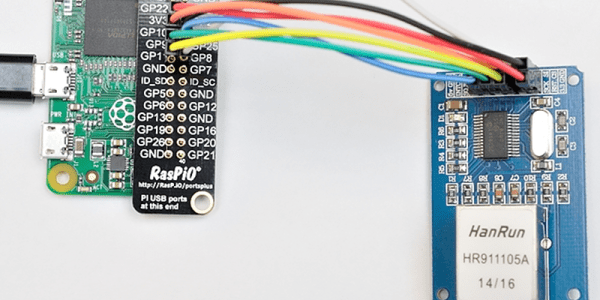
[Alex@Raspi.tv] had the misfortune of blowing the USB hub and Ethernet port on a Raspberry Pi B+. He thought about using a cheap SPI to Ethernet board to rescue it, and while he bought the board, he never got around to interfacing it to the broken Pi. However, when he saw the Raspberry Pi Zero arrive and noticed that everyone wanted to connect it to the network, he remembered the SPI board, rescued it from his junk box, and a few hours later had Ethernet via Raspberry Pi GPIO working.
The popularity of KiCad keeps increasing, and not only are more people converting to it and using it for their projects, but there’s also a growing number of folks actively contributing to the project in the form of libraries, scripts and utilities to improve the work flow.
KiPart
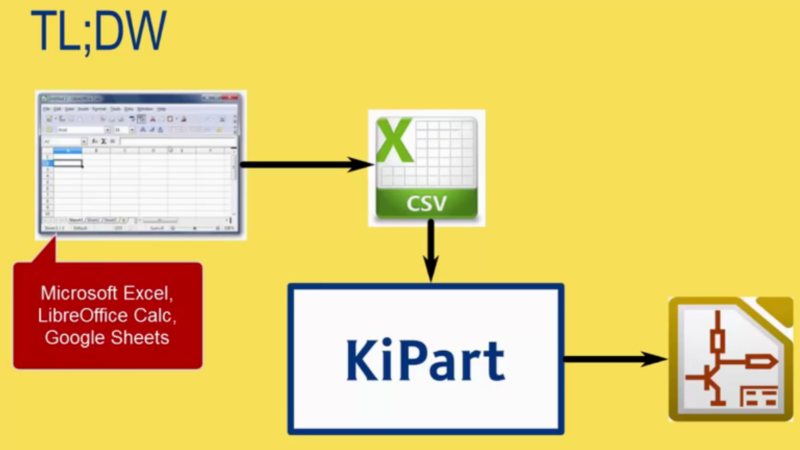
[Dave Vandenbout] a.k.a [xesscorp] has written a couple of utilities for KiCad. When working with large multi pin parts such as micro-controllers, creating a schematic symbol from scratch using the traditional KiCad schematic library editor can be quite tedious. KiPart is a python script that uses a CSV table as its input to generate the KiCad schematic symbol and is able to create multi-part symbols too. Usage is quite simple. The csv file needs a part name on its first row. The next row contains the headers. ‘Pin’ number and Pin ‘Name’ are the minimum required. Additionally, you can add in ‘Unit’, ‘Side’, ‘Type’, and ‘Style’. Unit is used when defining multi-unit parts. Side decides the location of the pin, Type its function, and Style is its graphic representation. Running the KiPart python script then results in a nice KiCad schematic symbol. Besides, KiPart can specifically generate schematic symbols for the Xilinx 7-Series FPGAs and the Cypress PSoC5LP. There are a whole host of options to customize the final output, for example ordering pin placement based on pin number, or pin name or pin function. Source files can be obtained from the [xesscorp] Github repository.
KiCost
Another useful utility from [xesscorp] is KiCost. It is intended to be run as a script for generating part-cost spreadsheets for circuit boards developed with KiCad. The one piece of information you need to add to your schematic parts is a manufacturers part number. The KiCost Python script then processes the BOM XML file, reading the manufacturer part number, scraping the web sites of several popular distributors for price and inventory data, and creating a costing spreadsheet. You can grab the source files from the KiCost Github repository.
Check the two videos below where [Dave] walks through the two utilities.
Thanks to [RoGeorge] for sending in this tip by commenting on the Open Source FPGA Pi Hat built by [Dave] that we featured recently.
The 80 acres of hills and valleys are called the Buitenschot ‘land art park’ and supposedly reduce noise in the nearby neighborhood by around 50%. They work by sending the reflections in random directions that would otherwise skip off of the ground, just like anti-echo baffles in a sound studio. A nice touch for the local residents, they also contain jogging trails.
People have made land art before — we particularly like Spiral Jetty in the Great Salt Lake — but as far as we know this is the first land art “piece” that’s also functional.
Beauty is in the eye of the beholder, of course. Unfortunately, as the Smithsonian notes, nobody is beholding it. Because Buitenschot aims to diffuse the takeoff noise coming out of the rear of the planes, they are always flying away from it; passengers don’t get to see it from the air.
If that looks like a four year old with a remote control driving a full-size dump truck — that’s because it is. As part of their Live Test Series, Volvo made a ridiculous obstacle course, and then let a four year old take the wheel of one of their heavy duty dump trucks. Viral advertising maybe — but too awesome not to share.
And don’t worry, there is a hack involved! The remote control setup in the truck isn’t that polished, and can’t possibly be a commercial “RC kit”. Which means some lucky hacker got to build a remote control system for a freaking dump truck. Consider us jealous.
Surprisingly (or maybe not), the truck seems to withstand everything the four year old throws at it. Including rolling it sideways down a hill, and of course smashing through an entire building. It’s well worth the watch and had us grinning from ear to ear.





 Another useful utility from [xesscorp] is