Hackaday Podcast Episode 314: It’s Pi, But Also PCBs In Living Color And Ultrasonic Everything

It might not be Pi Day anymore, but Elliot and Dan got together for the approximately 100*Pi-th episode of the Podcast to run through the week’s coolest hacks. Ultrasound seemed to be one of the themes, with a deep dive into finding bugs with sonar as well as using sound to cut the cheese — and cakes and pies, too.

The aesthetics of PCBs were much on our minds, too, from full-color graphics on demand to glow-in-the-dark silkscreens. Is automation really needed to embed fiber optics in concrete? Absolutely! How do you put plasma in a bottle? Apparently, with kombucha, Nichrome, and silicone. If you need to manage your M:TG cards, scribble on the walls, or build a mechanical chase light, we’ve got the details. And what exactly is a supercomputer? We can’t define it, but we know one when we see it.


Download the zero-calorie MP3.

Continue reading “Hackaday Podcast Episode 314: It’s Pi, But Also PCBs In Living Color And Ultrasonic Everything” →

This Week In Security: IngressNightmare, NextJS, And Leaking DNA

This week, researchers from Wiz Research released a series of vulnerabilities in the Kubernetes Ingress NGINX ControllerĀ  that, when chained together, allow an unauthorized attacker to completely take over the cluster. This attack chain is known as IngressNightmare, and it affected over 6500+ Kubernetes installs on the public Internet.

The background here is that web applications running on Kubernetes need some way for outside traffic to actually get routed into the cluster. One of the popular solutions for this is the Ingress NGINX Controller. When running properly, it takes incoming web requests and routes them to the correct place in the Kubernetes pod.

When a new configuration is requested by the Kubernetes API server, the Ingress Controller takes the Kubernetes Ingress objects, which is a standard way to define Kubernetes endpoints, and converts it to an NGINX config. Part of this process is the admission controller, which runs nginx -t on that NGINX config, to test it before actually deploying.

As you might have gathered, there are problems. The first is that the admission controller is just a web endpoint without authentication. It’s usually available from anywhere inside the Kubernetes cluster, and in the worst case scenario, is accessible directly from the open Internet. That’s already not great, but the Ingress Controller also had multiple vulnerabilities allowing raw NGINX config statements to be passed through into the config to be tested. Continue reading “This Week In Security: IngressNightmare, NextJS, And Leaking DNA” →

Supercon 2024: Yes, You Can Use The Controller Area Network Outside Of Cars

Ah, the CAN bus. It’s become a communication standard in the automotive world, found in a huge swathe of cars built from the mid-1990s onwards. You’ll also find it in aircraft, ships, and the vast majority of modern tractors and associated farm machines, too.

As far as [Randy Glenn] is concerned, though, the CAN bus doesn’t have to be limited to these contexts. It can be useful far beyond its traditional applications with just about any hardware platform you care to use! He came down to tell us all about it at the 2024 Hackaday Supercon.

Continue reading “Supercon 2024: Yes, You Can Use The Controller Area Network Outside Of Cars” →

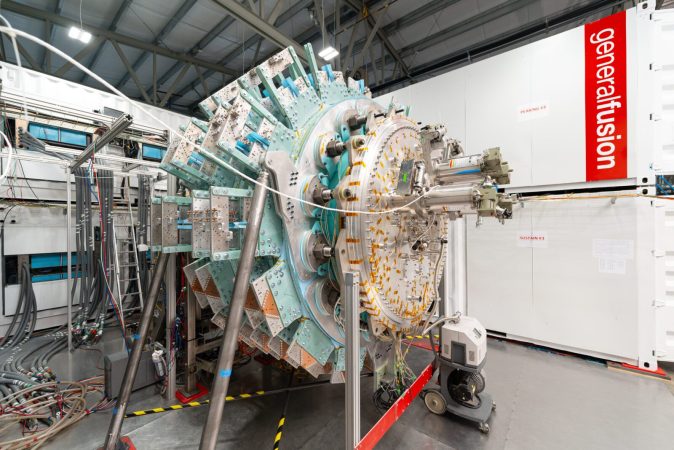
General Fusion Claims Success With Magnetized Target Fusion

It’s rarely appreciated just how much more complicated nuclear fusion is than nuclear fission. Whereas the latter involves a process that happens all around us without any human involvement, and where the main challenge is to keep the nuclear chain reaction within safe bounds, nuclear fusion means making atoms do something that goes against their very nature, outside of a star’s interior.

Fusing helium isotopes can be done on Earth fairly readily these days, but doing it in a way that’s repeatable — bombs don’t count — and in a way that makes economical sense is trickier. As covered previously, plasma stability is a problem with the popular approach of tokamak-based magnetic confinement fusion (MCF). Although this core problem has now been largely addressed, and stellarators are mostly unbothered by this particular problem, a Canadian start-up figures that they can do even better, in the form of a nuclear fusion reactors based around the principle of magnetized target fusion (MTF).

Although General Fusion’s piston-based fusion reactor has people mostly very confused, MTF is based on real physics and with GF’s current LM26 prototype having recently achieved first plasma, this seems like an excellent time to ask the question of what MTF is, and whether it can truly compete billion-dollar tokamak-based projects.

Continue reading “General Fusion Claims Success With Magnetized Target Fusion” →

Supercon 2024: A New World Of Full-Color PCBs

Printed circuit boards were once so simple. One or two layers of copper etched on a rectangular fiberglass substrate, with a few holes drilled in key locations so components could be soldered into place. They were functional objects, nothing more—built only for the sake of the circuit itself.

Fast forward to today, and so much has changed. Boards sprout so many layers, often more than 10, and all kinds of fancy geometric features for purposes both practical and pretty. But what catches they eye more than that, other than rich, saturated color? [Joseph Long] came to the 2024 Hackaday Supercon to educate us on the new world of full color PCBs.

Continue reading “Supercon 2024: A New World Of Full-Color PCBs” →

Tech In Plain Sight: Hearing Aids

You might think you don’t need a hearing aid, and you might be right. But in general, hearing loss eventually comes to all of us. In fact, you progressively lose hearing every year, which is why kids can have high-pitched ringtones their parents can’t hear.

You’d think hearing aids would be pretty simple, right? After all, we know how to pick up sounds, amplify them, and play them back. But there’s a lot more to it. Hearing aids need to be small, comfortable, have great battery life, and cram a microphone and speaker into a small area. That also can lead to problems with feedback, which can be very uncomfortable for the user. In addition, they need to handle very soft and loud sounds and accommodate devices like telephones.

Although early hearing aids just made sound louder and, possibly, blocked unwanted sound, modern devices will try to increase volume only in certain bands where the user has hearing loss. They may also employ sophisticated methods to block or reduce noise. Continue reading “Tech In Plain Sight: Hearing Aids” →